
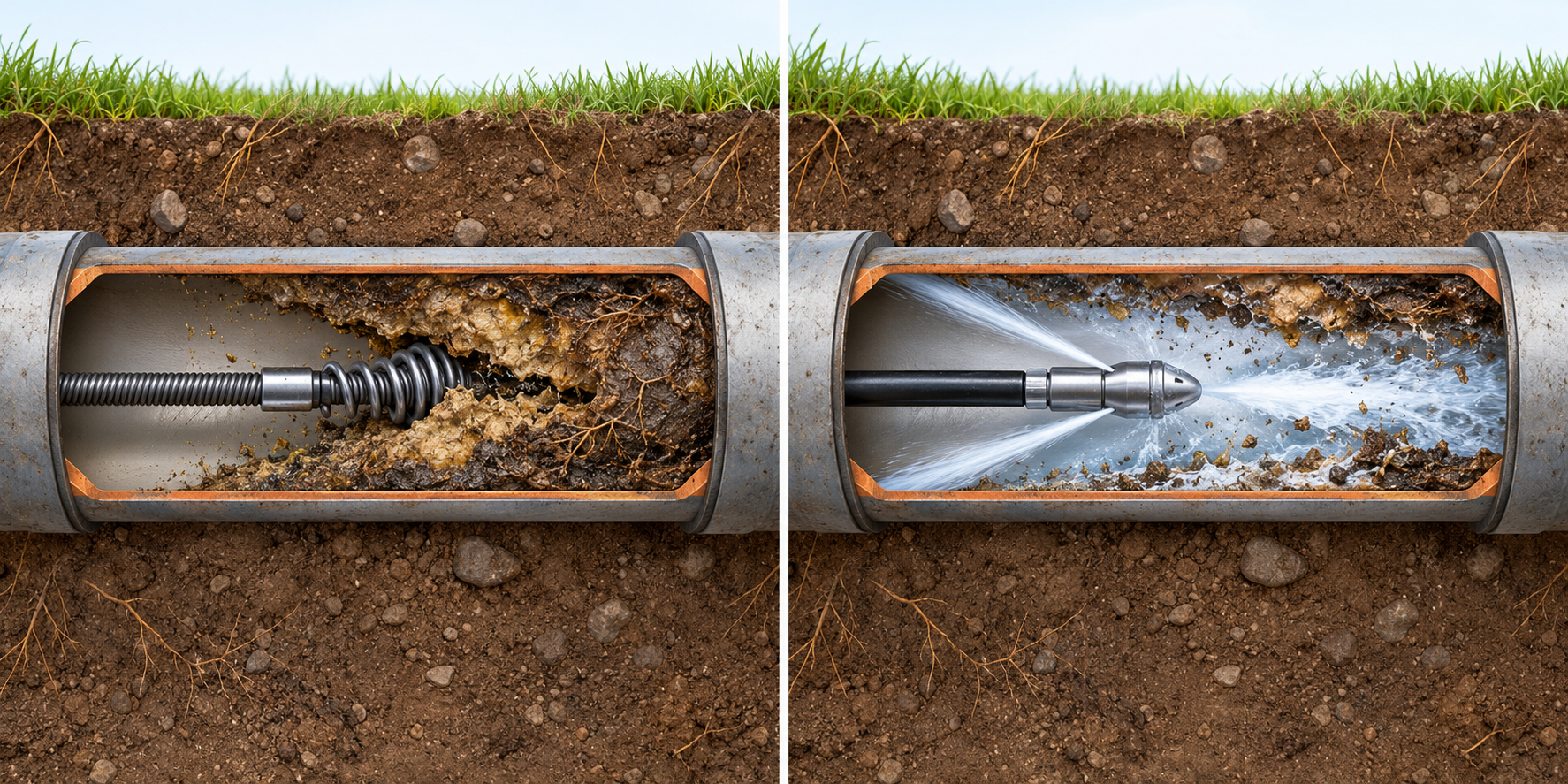
Snaking and hydro jetting solve different cleaning problems. Mechanical snaking or rodding generally aims to open a path through an obstruction. Hydro jetting uses high-pressure water to clean more of the pipe interior. In US market observations, Angi reports about $100 to $250 as an illustrative snaking range and $350 to $600 for hydro jetting. Those figures are not universal prices, and the more important comparison is whether the service matches the condition of the line.
Quick decision comparison
| Question | Snaking or rodding | Hydro jetting |
|---|---|---|
| Immediate goal | Open a path through a blockage | Remove or scour accumulated material along the line |
| Often considered for | Isolated or less extensive obstruction | Grease, scale, roots, or recurring buildup |
| Main uncertainty | Whether material remains beyond the opening | Whether the host pipe can accept high-pressure cleaning |
| Does it repair pipe damage? | No | No |
| Possible next step | Flow check or inspection if recurrence continues | Camera inspection or structural evaluation if the cause remains |
The table is a decision aid, not a rule. A contractor should be able to explain why the proposed method fits the observed blockage and the pipe’s known or suspected condition.
When snaking can be sensible
Mechanical clearing can be a reasonable first response to a single blockage in an accessible line, particularly when other fixtures are functioning and there is no history of roots, scale, or structural findings. It may restore service for less money and with less setup than jetting. If the line remains clear, the homeowner may not need a more intensive service.
The limitation is that an auger can create a passage without removing all material from the pipe. If the remaining material catches more debris, the symptom can return. A proposal should say whether the price covers one attempt, a defined service period, or additional time if the obstruction is resistant.
When hydro jetting may earn its premium
Jetting may be proposed when material is spread along the pipe rather than concentrated at one point, when roots or scale repeatedly reduce the opening, or when a prior mechanical pass restored flow only briefly. It may also be useful as preparation for a camera inspection when accumulated material blocks the view.
The premium is less persuasive when the line has an unaddressed collapse, major crack, severe offset, or alignment problem. Cleaning can restore flow while leaving the defect in place. Ask whether the contractor is recommending jetting as a maintenance service, as preparation for inspection, or as a substitute for a structural quote. Only the first two are cleaning decisions.
Pipe condition changes the comparison
High-pressure cleaning is not automatically safe for an old or damaged line. Pipe material, prior repairs, visible breaks, and access all matter. Seattle Public Utilities separates cleaning and root removal from structural repair methods such as spot repair, open cut, pipe bursting, and CIPP lining. That distinction is useful: a cleaning quote does not establish that a structural method is unnecessary, and a repair quote should not be compared with cleaning solely by total price.
If the line is fully blocked, camera visibility may be limited. After flow is restored, inspection may provide better evidence about roots, cracks, offsets, deterioration, or collapse. The inspection may be a separate charge or bundled into the cleaning service, so ask before authorizing both.
Cost scenarios
First-time accessible clog: Snaking may be the economical starting point when the objective is simply to restore flow. Budget a possible camera charge if the blockage is unusual or if the line is old and undocumented.
Recurring grease or scale: Jetting may cost more up front but can make sense if repeated narrow openings are producing multiple service calls. Compare the expected service life of the cleaning result with the cost of inspection and a repair option.
Roots in a defective line: Either cleaning method may be temporary. The durable decision is whether to inspect the entry point and compare localized repair, lining, or replacement. Do not assume chemical treatment is appropriate without specific professional and local guidance.
Structural failure: Neither snaking nor jetting is a structural repair. If a contractor cannot explain how the proposed cleaning addresses a collapse or bad alignment, ask for a separate assessment.
Normalize the two quotes
Compare access, labor time, included equipment, cleaning passes, camera inspection, recording, locating, emergency timing, taxes, permits, and restoration. A $200 snaking quote and a $500 jetting quote may be perfectly rational if the second includes a camera report and the first is a clearing-only service. Conversely, a low jetting price may omit setup or follow-up work.
Ask what evidence you will receive: a statement that water flowed, photographs, a video, a written finding, or a recommendation with a defined limit. If the line is shared or near a public main, ask who will contact the utility and whether responsibility must be determined before private work proceeds.
The practical choice
Choose the less intensive service when the blockage is isolated, access is straightforward, the line is believed to be serviceable, and the homeowner understands that it is a clearing visit. Consider hydro jetting when buildup or recurrence makes a narrow opening poor value and the contractor has considered pipe condition. Move to inspection when recurrence, roots, age, or a camera-visible defect changes the decision from “how do we clear it?” to “why does it keep failing?”
No method is universally better. The right choice is the least expensive service that answers the current decision without disguising a structural problem as a cleaning problem.
Match the method to the consequence of failure
The same blockage can justify different spending depending on its consequence. A line serving an unfinished utility area with easy access may support a simple clearing-first decision. A line serving a finished basement, a multi-unit property, or a route beneath expensive hardscape may justify better documentation and inspection sooner because recurrence is more disruptive.
Ask the contractor to state the expected result and the remaining uncertainty in plain language. “Open enough for use,” “cleaned for inspection,” and “structurally assessed” are different outcomes. Paying for the most intensive cleaning does not buy the third outcome unless the inspection and interpretation are actually included.
Normalize the scope behind the price
The word “snaking” can describe a brief pass from an accessible cleanout or a longer root-cutting service using different equipment. “Jetting” can mean one cleaning pass, several passes through a defined section, or a package that also includes inspection. Before comparing totals, write each quote as a sequence: access point, length or segment, proposed clearing method, included attempts, flow check, camera work, locating, and stopping condition. Ask what additional work requires your approval.
Time of service should also match. An after-hours clearing call may be appropriate when wastewater cannot be used, but its response premium does not show whether snaking or jetting is the better scheduled maintenance choice. Compare ordinary service prices only after urgent flow has been restored, and keep camera or structural work separate if it answers a later question.
Use observations to choose, then document the result
When the likely material is grease, soft debris, or one accessible blockage, a lower-intensity opening may answer the immediate need. If a contractor reports extensive buildup along the pipe, repeated roots, or scale that quickly catches new debris, jetting may be a more complete cleaning attempt. If the report identifies a collapsed, offset, cracked, or badly aligned section, neither clearing method corrects that condition. Ask the contractor to show which observation supports the proposed service.
After either method, keep the date, access point, what was removed, how much of the line was reached, whether flow was checked, and how soon symptoms return. A line that remains clear after snaking may not benefit from a more intensive service. A line that blocks again at the same location may need inspection even if jetting temporarily restores flow. This record prevents a future quote from treating each visit as a new, unrelated clog.
The economic comparison is therefore conditional: pay for the least intensive method that can answer the current question, and move to inspection when the cleaning result or recurrence pattern leaves a structural uncertainty. That keeps an equipment label from becoming a substitute for diagnosis.
Choose the evidence you expect to receive
Before authorizing either service, ask whether the provider will report the point reached, material removed, remaining flow restriction, camera visibility, and any concern about pipe condition. If the line cannot be viewed until after cleaning, confirm whether inspection is optional and what it costs. A written note that flow returned may be sufficient for a one-time event; a recurring problem calls for more detail about location and recurrence.
When contractors disagree, ask each to explain the expected result of its method against the same symptom and history. One may be quoting a basic opening, another a full cleaning for camera access. Give both the same prior invoices and camera files, and ask what condition would cause a method change. The homeowner can then compare like-for-like work instead of choosing by a service name.