
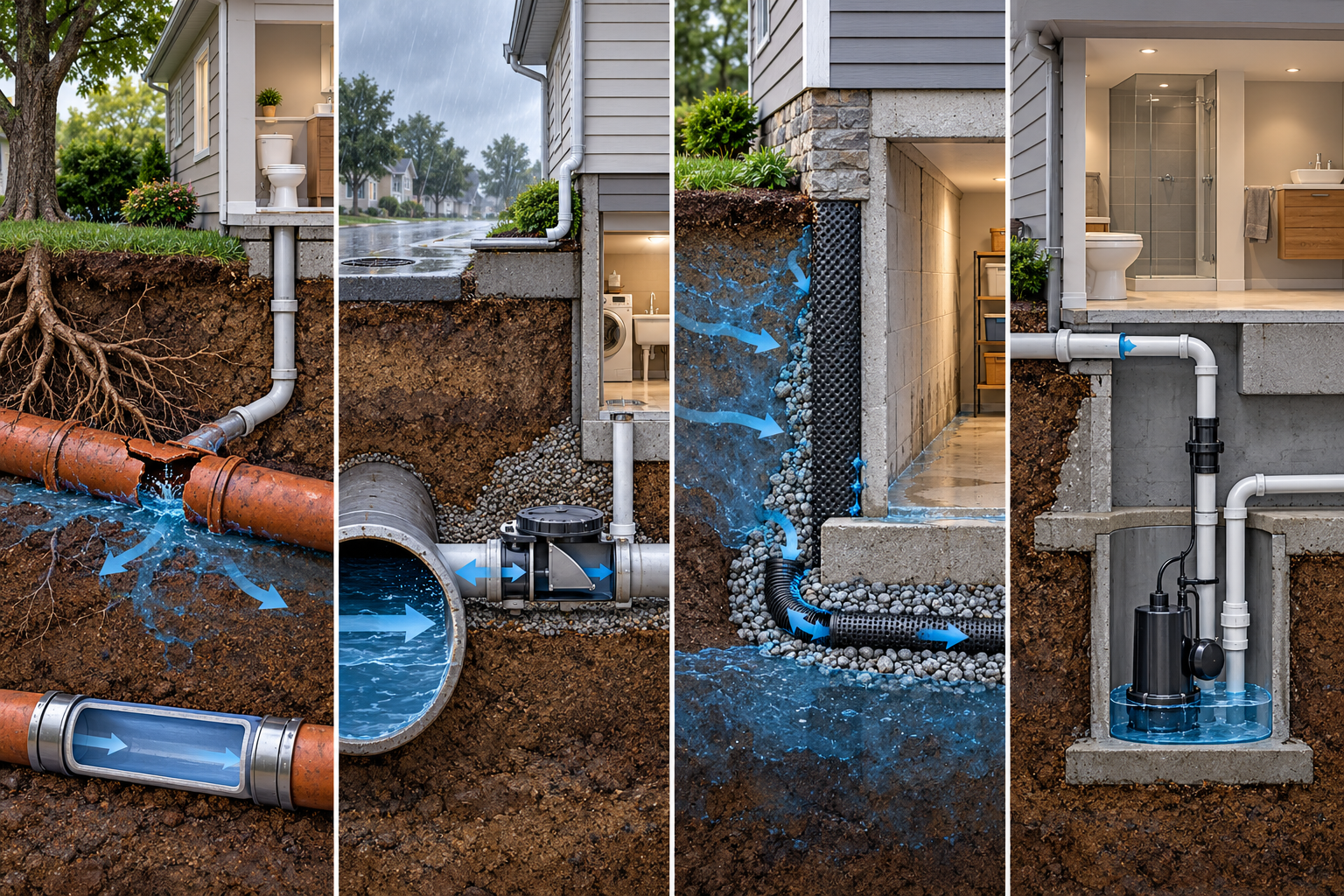
The right prevention project depends on why the backup happened. A defective private lateral, a blockage, municipal surcharge, stormwater entering a sanitary system, below-grade fixtures, and foundation drainage can produce different failure paths. Buying a backwater valve or pump without identifying the mechanism can spend money while leaving the main risk unchanged.
Start with the event
Record where water or sewage appeared, which fixtures were affected, whether nearby properties had the same issue, whether the event followed heavy rain, and whether clearing restored flow. A camera inspection may be needed after clearing. Contact the utility when the problem may involve a public main or right-of-way.
EPA lists blockages, line breaks, sewer defects that admit stormwater or groundwater, power failures, and improper design among possible sanitary-sewer-overflow causes. It does not diagnose an individual home or assign responsibility. Treat the list as a reason to investigate different pathways.
Compare the main options
| Option | Addresses | Does not automatically address |
|---|---|---|
| Lateral repair or replacement | Private defects, roots, breaks, collapse, or recurring structural cause | Public surcharge or foundation water |
| Backwater valve | Reverse flow through a protected sanitary route | Defective pipe, all fixtures, outside water, or every backup mechanism |
| Sewage ejector system | Fixtures that cannot drain by gravity; configuration-specific pumping | A general lateral defect or power-independent protection |
| Grading/foundation drainage | Water entering from the site or foundation system | Sanitary sewer obstruction |
| Utility or municipal response | Suspected public-main event or public-side defect | A private pipe the owner is responsible for |
The categories overlap, but they are not interchangeable projects.
Backwater protection
Government of Canada guidance says valve type and installation location depend on the plumbing arrangement. It recommends professional plumbing assessment, local permit and inspection checks, grading review, an accessible inspection chamber, manufacturer instructions, alarms where appropriate, and regular maintenance. Those inputs affect both installed cost and ownership cost.
Toronto similarly presents backwater valves and pumping equipment as property-specific measures. A valve may be relevant when reverse flow is the risk, but ask which fixtures it protects and how wastewater use is affected if it closes.
Lateral correction
If a camera identifies a cracked, root-infiltrated, offset, or collapsed private lateral, correcting that condition may provide more direct prevention than adding a device alone. Compare cleaning, spot repair, lining, bursting, and open-trench replacement by defect extent, method suitability, access, restoration, and responsibility.
Private lateral ownership varies. A city example cannot decide another property’s bill. Obtain utility or local-rule confirmation before including a public or shared segment in a private prevention budget.
Pumping and site drainage
Sewage ejectors serve fixtures below gravity sewer level and add pump, basin, venting, electrical, alarms, and maintenance. Sump systems and foundation drainage address groundwater and are not sewage ejectors. The Canadian private-side guidance emphasizes that slope, lot, discharge capacity, grading, and system conditions affect drainage choices, and identifies power failure and maintenance among possible sump-system failure contributors.
If sewage contamination has occurred, conveyance repair and contaminated-material remediation are separate decisions. Keep cleanup, drying, demolition, and reconstruction outside this article’s plumbing prevention comparison.
Cost scenarios
One private blockage: Cleaning and camera inspection may be the first prevention investment. A device is premature if the failed mechanism has not been established.
Recurring backup through a defective lateral: Price the structural repair and compare it with repeated emergency service, not just with a valve installation.
Rain-related backup with no private defect found: Utility investigation, backwater protection, grading, or broader resilience work may be relevant. No one option is universal.
Below-grade bathroom: A sewage ejector may be necessary for the fixture arrangement, but the quote should include the whole system and any electrical, venting, access, and permit work.
Local programs and maintenance
Toronto’s subsidy page gives a current local example of assistance for qualifying backwater and plumbing work, including an aggregate cap described as up to $6,650 per property for stated dates and conditions. It is not a general benefit. Check current local eligibility, caps, application timing, and approved-work rules before deducting any subsidy from a budget.
Every prevention option also creates maintenance: cleaning and inspecting a valve, testing alarms, servicing pumps, keeping access available, or maintaining grading. Include that recurring effort in the ownership comparison.
Questions before spending
- What mechanism caused the previous backup?
- Which pipe segment or fixtures does this option protect?
- Is the proposed work a correction, a barrier, or a backup system?
- What assessment, access, permit, inspection, and restoration are included?
- What happens during power failure or valve closure?
- What local utility, code, subsidy, or responsibility rule applies?
- Which risks remain outside the proposed scope?
Prevention is a cause-and-consequence decision. The best project reduces the documented pathway to backup and states the events it cannot prevent.
Compare prevention by residual risk
For each option, write the failure it addresses, the conditions required for it to work, the maintenance it adds, and the event it leaves outside scope. That turns a valve, pump, lateral repair, or grading proposal into a comparable risk decision. It also exposes combinations that may be necessary—for example, correcting a private defect while separately addressing reverse flow or outside drainage.
Avoid buying a device merely because it is easier to explain than a diagnosis. If the event mechanism is still unknown, fund the information needed to distinguish private, public, sanitary, and foundation-water causes before selecting a permanent prevention project.
Sort the evidence by where the water appeared
The first record should state which fixture, floor drain, room, or outside area was affected; whether more than one property had the event; what the weather was like; and whether the water smelled or behaved like wastewater. Those observations do not diagnose the source, but they help direct the next professional inquiry. A plumber can assess fixture and lateral behavior, while a utility can investigate a suspected public main. A foundation or drainage professional may be needed when water entered through walls, floor joints, or the site.
Ask each investigator to identify what evidence would confirm or weaken the proposed cause. A camera report may show a private defect but not prove that a municipal surcharge did not occur. A clean private line may shift attention to public capacity, a valve arrangement, or outside water, but it does not settle those causes by itself. Keep reports and event timing together so another service provider does not restart from a generic symptom description.
Compare combined measures when risks overlap
One property can have more than one pathway. Repairing a defective lateral may address a private leak or recurrent obstruction while leaving reverse flow during a public surcharge possible. A backwater valve may address that reverse path while leaving a cracked private pipe untouched. Grading or foundation drainage may reduce surface or groundwater entry without repairing sanitary plumbing. A pump may serve below-grade fixtures while adding dependence on power and maintenance.
If two measures are proposed, ask which separate failure each one addresses and whether one is a prerequisite for the other. Do not add all projects to a “prevention package” without evidence of the risks they reduce. Price each necessary stage, including inspection, permits, access, restoration, alarms, testing, and maintenance, and list residual exposures after each project.
Evaluate prevention as a sequence
After an event, the least-regret sequence is often to make the area safe, document the event, restore wastewater function, and establish the cause before choosing a permanent measure. If the cause is a clear private defect, obtain a repair scope and verify responsibility. If the public system may be involved, contact the utility before including public work in a private quote. If the evidence points to reverse flow or outside water, have the relevant plumbing or drainage configuration assessed.
Sequence can avoid buying an ineffective device or opening the wrong part of a property. It also creates a useful budget distinction: diagnostic spending buys evidence, correction spending changes a known defect, and protection spending reduces exposure to a defined event. The homeowner should be able to explain what each proposed dollar changes.
Keep local assistance and recurring obligations visible
A subsidy or municipal program may reduce a qualifying installation cost, but it does not necessarily cover diagnosis, repair, cleanup, or work completed before approval. Toronto’s program is one local example with dated eligibility and caps; verify the current property criteria, eligible contractor and work, timing, payment method, and required documents before using an amount in a budget.
After installation, prevention still carries ownership work: inspecting a valve, testing an alarm, servicing a pump, maintaining grading, or retaining access to a repaired cleanout. Ask what the manufacturer or local professional requires for the specific product and who will perform it. Compare the continuing cost and inconvenience with the risk being reduced rather than treating the purchase as a one-time permanent guarantee.
After any measure, keep a record of its location, scope, maintenance, and the risk that remains. If another event occurs, that history can show whether the same pathway returned or a different system needs attention.
That record can prevent a second contractor from recommending the same measure without reviewing the first.