
A backwater valve is a device intended to limit reverse flow from a sanitary sewer into a building. The installation cost depends less on the valve body alone than on the plumbing arrangement, access, excavation or slab opening, inspection chamber, alarm, permits, and restoration. There is no universal installation price because a retrofit in an unfinished basement is a different project from work beneath a finished floor.
What the device does—and does not do
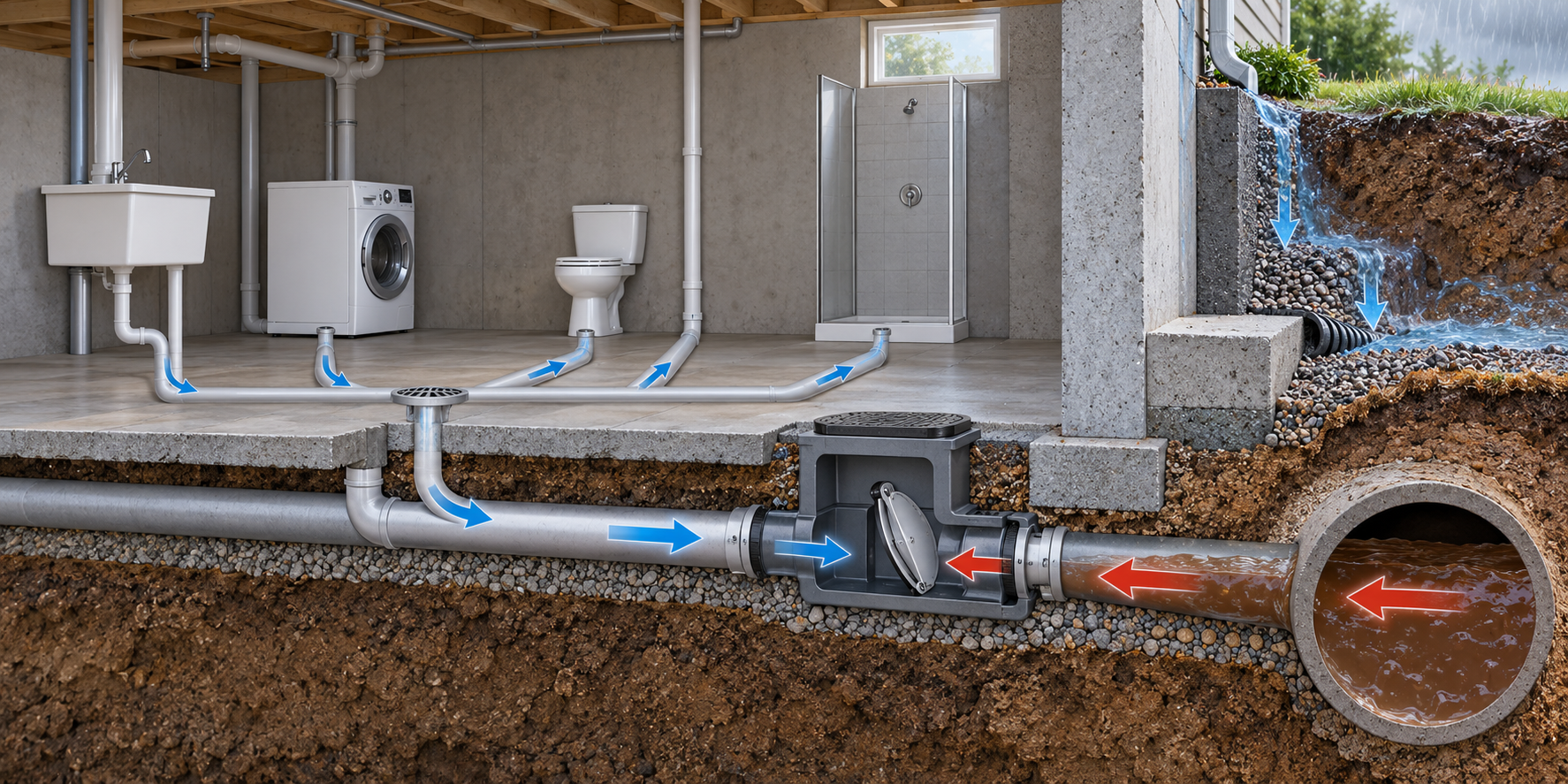
Government of Canada guidance describes normally open valves that allow wastewater to exit normally and close when backflow is detected, and normally closed valves that open in one direction when wastewater is discharged. The appropriate type and location depend on the plumbing arrangement and product instructions.
A valve is not a guarantee against every basement-water event. It does not repair a defective private lateral, stop water entering through foundation walls, or solve every stormwater and municipal-capacity problem. If it closes, wastewater use connected to the protected route may be affected. Ask the professional to explain the protected fixtures, limitations, and alternate drainage arrangements.
Cost layers
| Layer | What changes it |
|---|---|
| Assessment | Existing layout, protected fixtures, backflow history, and valve effectiveness |
| Access | Exposed pipe versus slab, floor, wall, or finished-space opening |
| Plumbing | Valve, fittings, connections, cleanout, chamber, and configuration |
| Electrical and alerts | Alarm, power, battery or other property-specific coordination |
| Administration | Local permit, inspection, product, and installation requirements |
| Site conditions | Grading, drainage, excavation, soil, and restoration |
The Canadian guidance recommends a plumbing inspection, local permit and inspection checks, grading assessment, an accessible inspection chamber, professional installation, and compliance with manufacturer and local requirements. Those are planning inputs, not a national construction specification.
Scenario bands
Accessible basement retrofit: The relevant pipe is exposed and the configuration is clear. Plumbing labor and the device may dominate, with limited restoration.
Finished floor or slab access: Cutting, removing, protecting, and restoring finishes can exceed the device cost. Ask whether a structural or finish trade is included.
Multiple protected fixtures or complex drainage: Assessment, additional valves, alarms, or alternate discharge arrangements may be needed. Do not assume one valve protects every fixture.
Backup plus poor grading or foundation drainage: The valve may be only one part of a broader prevention plan. Keep site drainage, sump, and foundation work separate so a device is not sold as a complete solution.
Maintenance is part of ownership cost
The Government of Canada recommends regular inspection and maintenance and notes that requirements depend on valve type. Its page contains both annual and twice-yearly cleaning wording, so do not present one cadence as a universal rule. Follow the applicable product instructions and local professional guidance.
Include access to the inspection chamber in the installation decision. A difficult-to-reach valve may be cheaper to install but harder to maintain or verify. Ask who will inspect it, what a service visit includes, and what happens if the gate or flap does not operate.
Local programs and permits
Toronto’s current program is an example of jurisdiction-specific assistance: for qualifying work completed on or after November 12, 2025, its page describes up to $6,650 per property under an expanded program, with device-specific limits. That is not a general subsidy expectation. Dates, eligibility, application timing, caps, and eligible work must be checked directly before relying on the number.
Permit and inspection requirements are equally local. A Canadian national guidance page can explain why to check them, but the municipality, authority, and applicable code control the actual installation.
Compare alternatives by cause
If the backup is caused by a private blockage or defective lateral, correcting that cause may be more valuable than installing a valve alone. If the risk is reverse flow during a sewer surcharge, a correctly configured valve may be relevant. If fixtures are below gravity sewer level, a sewage ejector configuration may be a different decision. If water is entering from outside, foundation drainage and grading may dominate.
Start with a plumbing assessment and ask the contractor to describe the mechanism the device is intended to address. Compare device installation, lateral repair, pumping, and broader drainage work by the risk they reduce—not by the device’s purchase price.
Quote questions
- Which fixtures and pipe segment will be protected?
- Why is this valve type and location suitable?
- What access, excavation, chamber, alarm, and restoration are included?
- Are permits and inspections included or separate?
- How will normal wastewater use be affected if the valve closes?
- What maintenance and testing does the manufacturer require?
- Are grading, downspouts, foundation drainage, or lateral defects outside scope?
- Is a local subsidy current, eligible, and paid after approved work?
The best backwater-valve budget includes the assessment, installation, access, local administration, and ownership maintenance. It also states what problem the valve can address and what risk remains outside it.
A decision sequence for a retrofit
First document the backup path and identify the fixtures or floor drains affected. Next, have the plumbing arrangement assessed, including whether the proposed valve can protect the relevant route and whether closing it would leave fixtures without a usable discharge path. Then obtain the current local permit and inspection requirements and price access and restoration separately from the device.
This sequence prevents two common mismatches. A valve can be installed neatly but protect the wrong branch, or it can protect the sanitary route while outside water continues to enter through the foundation. It also gives the homeowner a basis for comparing a valve with lateral repair, a pump, grading, or other work. If the contractor cannot explain the mechanism being reduced, the quote is not yet a prevention plan.
Check the protected plumbing path
Before accepting a price, request a simple explanation or drawing of which fixtures and branches the valve protects, where the valve sits, and what happens to those fixtures when the valve closes. A home with several lower-level fixtures may need a different arrangement from one protected by a single branch. The professional should identify any connected fixture that could continue discharging into a closed or blocked path and explain how the proposed design handles it. This is a configuration review, not a do-it-yourself installation guide.
Ask whether an existing cleanout or access chamber can be used, whether the slab or finished floor must be opened, and whether an alarm or maintenance access is included. An inexpensive device price does not describe the installed project. If the valve cannot be reached for inspection after the room is finished, the owner may face added access cost later or may not be able to verify its condition.
Price the whole ownership arrangement
Compare the installed valve with the risk pathway it addresses. If repeated backups arise from a private blockage or a defective lateral, repairing that cause may be more direct. If reverse flow is documented and the plumbing arrangement can be protected, a valve may be one part of the plan. If a fixture sits below gravity drainage, the system may require pumping instead. Each path creates different access, permit, restoration, and maintenance costs.
Ask for the installed total, surface restoration, inspection and permit charges, and any ongoing inspection or cleaning expected by the manufacturer or local professional. Government guidance contains different suggested maintenance intervals, so this article does not turn them into a universal schedule. Request the instruction for the actual valve model and record who will perform maintenance and how access is kept clear.
Understand the event the valve cannot prevent
A closed valve can limit reverse sewer flow along the protected route, but it may temporarily prevent wastewater from those fixtures from draining. A valve does not rebuild a broken line, protect every branch automatically, stop water entering through walls or foundations, or ensure that a municipal system has capacity. Ask what happens during a long surcharge and what household behavior or alternative arrangement is expected while the device is closed.
After installation, retain the model, location, inspection record, permit sign-off, and maintenance instructions. That record helps a future plumber find the device and helps the owner distinguish sewer backflow from outside water or a private lateral failure. The value of the project depends on matching the device to the known risk and keeping it serviceable over time.
Compare bids by access and protected fixtures
Ask each installer to identify whether the work is a new valve, a replacement, or relocation; which branches are included; how the inspection access will be built; and what surfaces will be opened and restored. Confirm that both quotes address the same plumbing path and valve type. A lower total that covers one branch cannot be compared with a project protecting a larger section or including an alarm and access chamber.
If a subsidy may apply, verify its current requirements before work starts. Programs may require specific devices, a professional contractor, an inspection, or approval before installation. Keep that eligibility check separate from the contractor’s price, and do not count a maximum reimbursement until the property and application are confirmed. The remaining decision is whether the installed device addresses the observed reverse-flow risk and whether the owner can maintain it as required.