
Not every home needs routine sewer cleaning on a fixed calendar. Preventive service has more value when a line has known roots, recurring blockage, an older or undocumented condition, difficult access, or a planned project that could disturb the route. The evidence supports condition-based maintenance, not a universal frequency or guaranteed payback.
What maintenance can include
Maintenance may mean a scheduled cleaning, a camera inspection, root-related monitoring, cleanout improvement, or simply retaining records and correcting practices that contribute to blockages. Angi reports illustrative US ranges of about $100 to $250 for snaking and $200 to $1,300 or more for camera inspection, with another guide reporting a wider camera-per-visit range. These are market observations, not Canadian prices or required household budgets.
King County recommends knowing the route, age, and condition of a side sewer; avoiding garbage and grease in drains; considering roots when planting; locating the line before remodeling or landscaping; and obtaining an inspection before buying a home in its jurisdiction.
Risk factors that change the decision
- previous blockages and the time between them;
- roots, scale, or deposits documented on video;
- pipe material, age, and previous repairs;
- missing or difficult cleanout access;
- planned excavation, landscaping, addition, or hardscape;
- shared, traversing, or unusual connection;
- history of backup after rain or municipal events.
These factors do not diagnose a failure. They change the value of buying information or reducing an access problem before an emergency.
Inspection versus cleaning
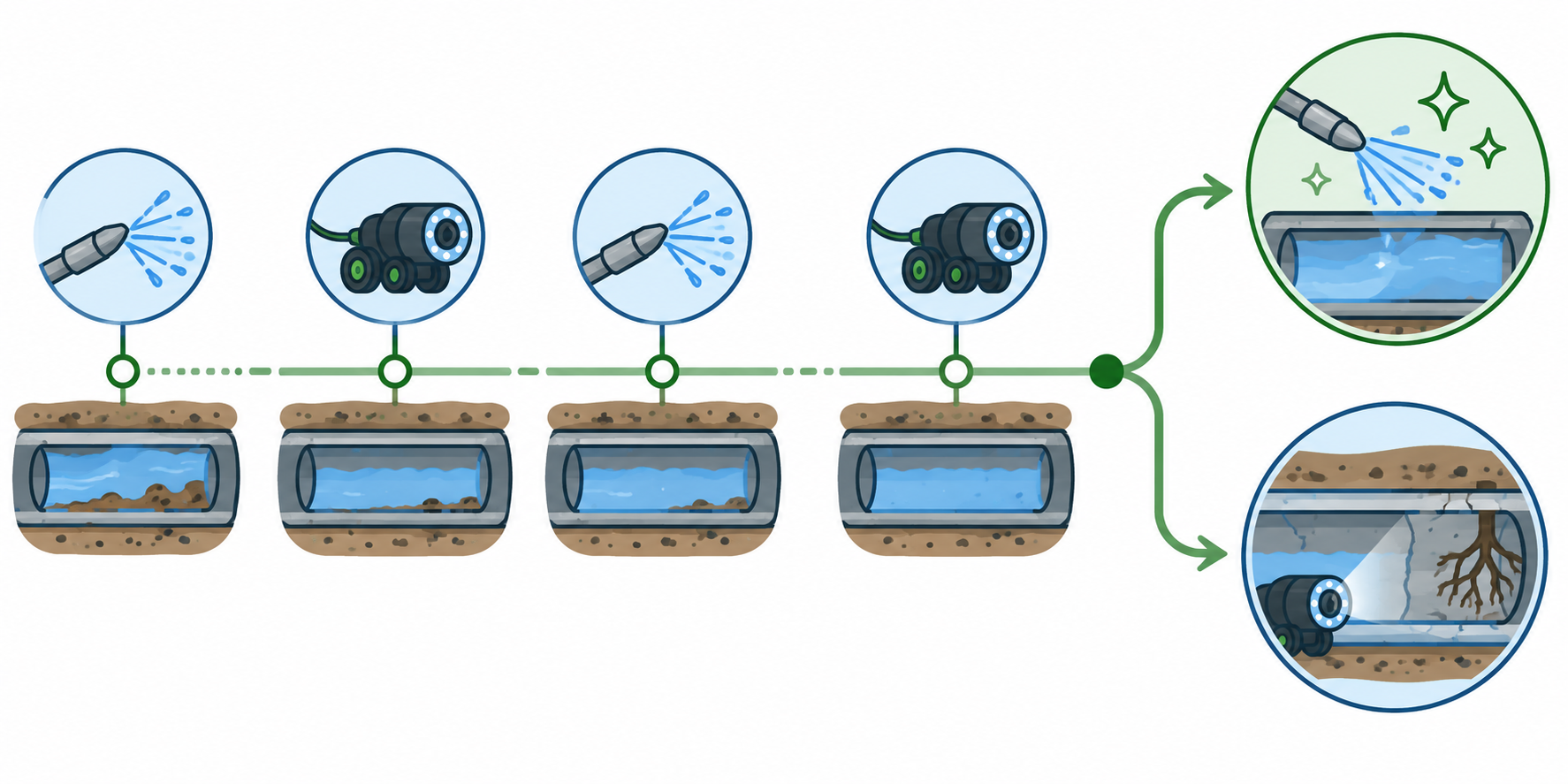
Cleaning buys flow; inspection buys condition information. A cleaning visit may be reasonable when the line is functioning and the objective is to remove a known buildup. A camera is more valuable when the cause is unknown, the line is old, a repair quote is large, or recurrence suggests that clearing is only temporary.
If a line is blocked, clearing may be needed before the camera can see. Seattle Public Utilities says inspection is generally more useful after blockage removal. Ask whether the service is cleaning-only, camera-only, or a sequence with a video, report, locate, or follow-up.
Budgeting scenarios
No history, accessible line: Routine paid cleaning may have low value. Keep the route and cleanout information and respond to symptoms.
Known roots or recurring clogs: Compare scheduled inspection or cleaning with the cost of another emergency visit. If roots repeatedly appear at one defect, price structural correction as well.
Older line before landscaping: A camera and locate may prevent an excavation surprise and document the route before new work covers it. This is planning value, not proof that replacement is needed.
Maintenance that never ends: If each visit restores flow for only a short time, maintenance may be masking a capital repair. Request a camera-based structural comparison instead of assuming the next cleaning is preventive.
Records are part of maintenance
Keep invoices, service dates, camera video, findings, route maps, repairs, and utility contacts. A record changes future quote quality and may matter during a sale or responsibility dispute. Note which segment was serviced and which remained unseen.
Maintenance records do not establish legal ownership. Private-lateral boundaries vary by jurisdiction, and a utility or municipality may need to investigate a suspected public segment.
Cost of delay versus cost of prevention
Preventive work is valuable when it reduces a meaningful risk: emergency access, damage to finishes, difficult restoration, or a known recurrence. It is less valuable when it is an arbitrary service with no condition-based reason. Do not promise that cleaning prevents structural failure.
Use a simple comparison: cost of planned inspection or cleaning, cost and disruption of access, evidence of recurrence, consequences of a backup, and the owner’s time horizon. A homeowner may reasonably accept occasional service where the line is accessible and consequences are limited; another may favor earlier investigation because a failure would affect a finished basement or expensive hardscape.
Quote questions
- What condition or history justifies preventive service?
- Is the scope cleaning, inspection, locating, or a combination?
- What segment and length are included?
- Is the video and report retained by the homeowner?
- Are root treatment, access, emergency timing, or restoration separate?
- What finding would change the plan to structural repair?
- Is a proposed frequency based on the actual line or merely a generic package?
Preventive sewer maintenance is best treated as a risk decision. Pay for the service that answers a known uncertainty or reduces a documented recurrence, not for a calendar rule unsupported by the property’s condition.
Maintenance over an ownership horizon
Estimate the likely maintenance path using the actual line history: expected service frequency, access cost, emergency premium, cleanup exposure, and the inconvenience of an outage. Compare that with one inspection and a defined repair investigation. The comparison should show assumptions rather than claim that one repair always pays back after a fixed number of visits.
For a planned sale, records can have value even when no repair is performed. A buyer can see what was inspected, what was found, and what remains uncertain. For a planned landscape or remodel, locating before work may prevent an access surprise. For a long-term owner, an accessible cleanout and condition record may reduce future mobilization, but neither replaces maintenance of the actual line.
Avoid packaged service plans that promise a fixed frequency without explaining the observed risk or deliverables. Ask whether the provider is selling a cleaning, a condition assessment, or a warranty-like response plan; those are different economic products.
Set a service interval from the line’s history
If inspection shows roots, deposits, or recurring blockage, ask the qualified contractor what observation supports a proposed cleaning interval and when that interval should be reconsidered. A one-time recommendation made without camera evidence or service history may be a generic package rather than a line-specific plan. If the pipe remains clear and there is no documented problem, routine paid cleaning may add little value; retain access and route records and respond to changes.
Track each visit with its date, symptom, method, material removed, segment reached, and time until recurrence. The interval between services is useful only when the result is also known. A line that stays open for years after a simple clearing presents different economics from one needing urgent jetting after a short period. If the same defect appears in the same place, price repair and repeated maintenance as different paths.
Compare scheduled work with emergency exposure
A scheduled service may cost less than emergency dispatch, but that does not guarantee it prevents a backup. Compare the actual maintenance fee and deliverable with the likely consequences of recurrence: service disruption, access opening, cleanup, and restoration. A camera inspection can be more valuable than another cleaning when it could change the plan from repeated flow restoration to structural correction. If the line is blocked, however, the camera may require a prior clearing step.
For an older or shared line, maintenance should include documentation and responsibility questions as well as physical service. A route map, video, and locate may help future contractors, neighboring owners, or a utility review the same condition. These records do not determine who pays, but they can reduce repeated discovery and make later bids more comparable.
Watch for maintenance that is masking a repair
Repeated cleaning becomes a warning about the decision process when each visit restores flow but no one records why the line blocked. Ask the contractor to explain whether the material is removable buildup, roots entering at a joint, or a symptom of a structural defect. If the camera cannot pass or the defect cannot be located, request an investigation plan with a cost and stopping point.
The choice is not simply “maintain forever” or “replace now.” A homeowner may continue service where recurrence is infrequent and access is easy, repair one documented weak point, or obtain a broader assessment when failures are distributed. Compare the cost of the next few services only as a scenario, not as an assumed break-even calculation. The condition evidence and consequence of failure should drive the decision.
Decide what a maintenance visit must deliver
Before scheduling, state whether the goal is to restore flow, remove a known buildup, inspect condition, locate a route, or prepare for a repair quote. Ask whether the provider will deliver a video, report, marked location, material-removal note, or only a service invoice. If two services offer different outcomes, the more expensive one may still be better value when it resolves a specific uncertainty; if the line is functioning and no decision depends on added evidence, a bundled camera may add little.
Keep each visit tied to a next decision. If a camera shows a defined defect, request a repair assessment. If it shows a serviceable line with buildup, decide whether a future cleaning is justified by actual recurrence. If the camera cannot reach the issue, price cleaning or another access step. This avoids paying for an annual package that does not change when the pipe is inspected, how the outcome is recorded, or what condition would stop routine maintenance.
Account for consequences as well as service fees
Two homes with the same pipe condition may choose different maintenance because the consequences differ. A line with an accessible cleanout and no finished lower level may tolerate a different response than one where a backup could damage occupied space or require expensive access. This does not make routine cleaning a guarantee; it changes how much the owner may value early information and a documented route.
If maintenance is billed through a service plan, compare its annual charge, visit limits, covered segment, emergency response, exclusions, and cancellation terms with individual services. A plan that covers clearing is not necessarily insurance for pipe replacement or sewage cleanup. Keep those promises separate and evaluate the work the household actually expects to need.