
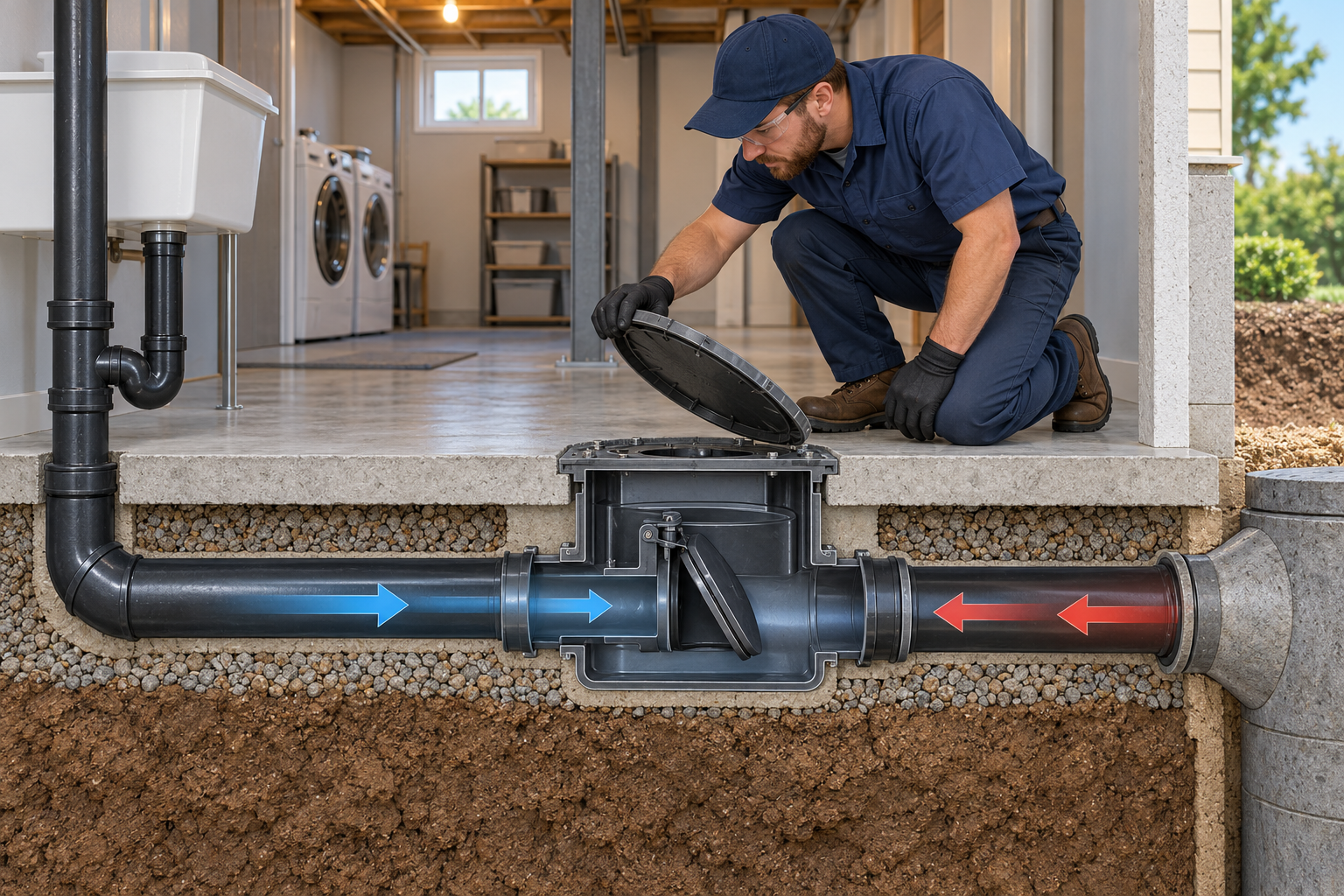
A backwater valve is intended to reduce the chance that a backed-up sanitary sewer sends water into a home through a connected drain. It addresses one pathway. It does not stop groundwater, surface runoff, a burst pipe, or floodwater entering through walls and openings, and it does not remove the need to maintain the valve and the rest of the drainage system.

A rough planning range
For budgeting, treat this as a plumbing-access project rather than a small valve purchase. A readily accessible cleanout or exposed line may keep the work in the lower-cost range. A valve under a concrete slab, in a finished basement, or in a difficult lateral configuration can become a multi-thousand-dollar project after excavation, concrete cutting, plumbing changes, testing, and restoration. Large municipal or shared-lateral conditions can fall outside an ordinary house quote.
U.S. and Canadian prices vary by city, access, labor, valve type, and local inspection requirements. Do not use an online product price as an installed cost, and do not convert one country’s quote into the other country’s currency.
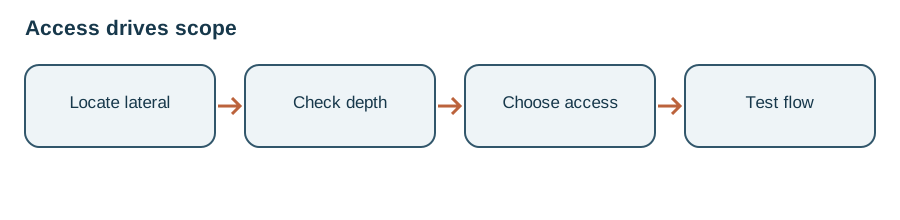
What the plumber must establish
The contractor needs to understand the building drain, cleanout access, sewer direction, fixtures below the likely backup level, and whether the proposed valve can be reached for inspection. Some systems use a check or flap valve that operates automatically but can be held open by debris. A gate valve can provide a stronger seal in some configurations but requires human operation. A dual arrangement combines functions and may cost more. These are source-supported distinctions, not a universal recommendation for one valve type.
The valve must be installed where it does not create an inaccessible obstruction or prevent required drainage. A professional should confirm whether the layout, slope, cleanouts, venting, backflow path, and downstream connections are compatible. Local plumbing authorities may require a particular device, access chamber, alarm, permit, or inspection; requirements are not universal across the United States or Canada.
Cost drivers
- Access: exposed piping is usually less disruptive than slab cutting, excavation, or finished-floor removal.
- Valve and chamber: type, diameter, access cover, alarm, and replacement parts affect the material and labor scope.
- Restoration: concrete, tile, drywall, cabinets, flooring, landscaping, or driveway repair can be a significant part of the price.
- System condition: damaged or undersized piping, poor slope, a missing cleanout, or a failing lateral can change the project entirely.
- Permit and inspection: include local charges and any required testing rather than assuming they are included.
- Maintenance access: a cheaper hidden valve may be a poor value if nobody can inspect or clean it.
Ask for an itemized quote showing the valve type, exact location, access method, bypass or cleanout arrangement, alarm, restoration, inspection, and exclusions. Clarify whether the contractor has evaluated the full sewer-backup pathway or only the proposed valve location.
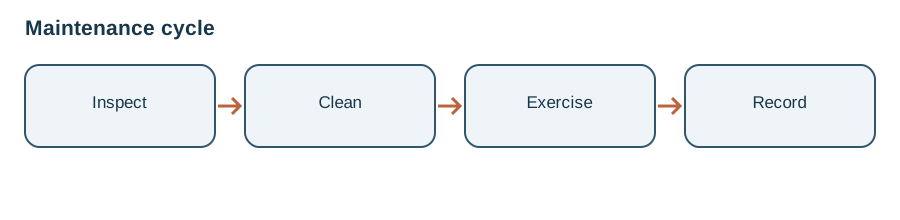
Maintenance is part of the decision
Canadian flood guidance recommends annual inspection of a backwater valve. FEMA material also emphasizes inspection and debris control for applicable valve types. Follow the device instructions and local requirements. A valve can fail to protect the home if debris holds a flap open, a gate is left in the wrong position, access is blocked, or the upstream plumbing cannot drain as expected.
Coordinate the valve with sump redundancy, alarms, shutoff devices, grading, downspouts, and foundation drainage. A backwater valve can lower sewer-backup risk while leaving other flood pathways untouched. It may be a sensible first phase, but the quote and the homeowner’s decision should state exactly which risk it addresses.
Questions before approving the installation
Ask the plumber to identify the drain or lateral being protected, the likely backup direction, fixtures below the protection level, and the location of the cleanout. Confirm whether the proposal includes a camera inspection or another method of establishing the pipe condition. A valve installed in the wrong branch may protect one path while leaving another open.
Clarify how the home will drain when the valve is closed, how the valve will be reached for cleaning, what happens if debris holds the flap open, and whether an alarm is included. Ask who will inspect it each year and whether the service is part of a maintenance plan. If a manual gate is proposed, make sure the household understands the operating responsibility and the conditions under which it should or should not be closed.
Restoration can dominate
For an interior installation, the product may be the smallest line item. Concrete cutting, dust control, excavation, plumbing relocation, waterproofing, flooring, cabinetry, and finish matching can determine the final price. Request photographs or a marked plan of the proposed location and a written allowance for restoration rather than assuming the original finish can be repaired invisibly.
If the lateral is damaged, undersized, shared, or difficult to access, ordinary sewer repair or a larger drainage project may be the more appropriate next step. A valve is not a substitute for diagnosing the pipe or addressing a recurring blockage.
Distinguish backup protection from sewer repair
A backwater valve may reduce reverse flow while the municipal or shared sewer is surcharged, but it cannot repair a cracked lateral, collapsed pipe, root intrusion, poor slope, or recurring obstruction. If the home has repeated backups, odors, slow drainage, or unknown piping, ask whether a camera inspection or another sewer assessment is needed before selecting a valve. A valve installed in the wrong branch may protect one path while leaving another open.
The contractor should explain how fixtures below the valve behave, whether a cleanout remains usable, and how the system will be tested. Ask about alarm placement, battery or power needs, and who receives the warning. If the household cannot respond to an alarm, remote monitoring or a different mitigation phase may be appropriate.
Include future access in the price
Do not bury the valve behind a permanent finish or place it where annual inspection requires major demolition. Mark the access cover and keep it clear of storage. If future flooring, basement finishing, or foundation work is planned, coordinate the valve location now. The maintenance cost over the life of the home can outweigh a small installation-price difference.
After installation, confirm how the plumber will test drainage through the protected fixtures and how the access cover will be identified. Ask what the household should do if the valve closes during an event and whether the alarm works during a power interruption. These operating details belong in the handover because the valve’s usefulness depends on people knowing when ordinary drainage is unavailable and how to arrange inspection afterward.
Compare the likely installation paths
An accessible line with a suitable location may need a smaller opening and less restoration than a valve installed below a finished slab. If the cleanout is missing or the pipe route is uncertain, investigation may come before a fixed installation price. If a shared lateral, damaged sewer, or unusual fixture layout is involved, the plumber may need to confirm ownership and drainage relationships before recommending a device. These are different cost situations; a retail valve price cannot stand in for any of them.
Ask the bidder to describe the expected path from the first inspection through testing and restoration. Identify whether the work includes locating the pipe, protecting the room from dust and water, cutting and removing concrete, installing the chamber, reconnecting branches, checking drainage, and restoring the floor. Ask for separate allowances for concealed conditions so that an unexpected pipe or slab issue does not turn the proposal into an open-ended price. Clarify which changes would require approval before the crew proceeds.
A useful proposal also shows what the household will need to do while the work is underway. Fixtures may be unavailable during part of the installation, concrete dust may require temporary room closure, and floor restoration may need separate drying or curing time. Ask how long the home will be without normal drainage, whether a temporary arrangement is planned, and who coordinates any required inspection. Include these practical effects when comparing an interior installation with an accessible exterior chamber or a broader sewer repair.
When the diagnosis suggests a deteriorated lateral rather than reverse-flow alone, compare the cost and disruption of repairing that underlying condition with adding a valve. The decision is not always “valve or no valve”: a valve may remain useful after repair, or it may not address the dominant failure. Ask the plumber to explain the relationship rather than combining both scopes into a single total without line items.
Resolve access and responsibility before work begins
A valve can be a small component within a much larger access and restoration job. Ask the plumber to show where the building sewer will be reached, what surfaces may be opened, how the valve will remain accessible, and who repairs those surfaces. If the route or connection is uncertain, request an investigation step and its cost before treating the installation price as fixed. A camera inspection or other diagnostic work may clarify the route, but the contractor should explain what question it is intended to answer.
Also establish how the device interacts with other drainage and plumbing connections. The quote should identify what is protected, what remains outside the valve’s coverage, and how household fixtures behave when the valve closes. Local rules and property layouts differ, so verify approval and inspection requirements with the responsible authority and the contractor. Do not assume that installing a valve corrects a damaged or undersized sewer lateral.
Compare a repair that restores access and a reliable test with a low initial quote that leaves the valve difficult to inspect. Ask for the expected inspection method, service interval guidance, and the party responsible for explaining operation to future owners.