
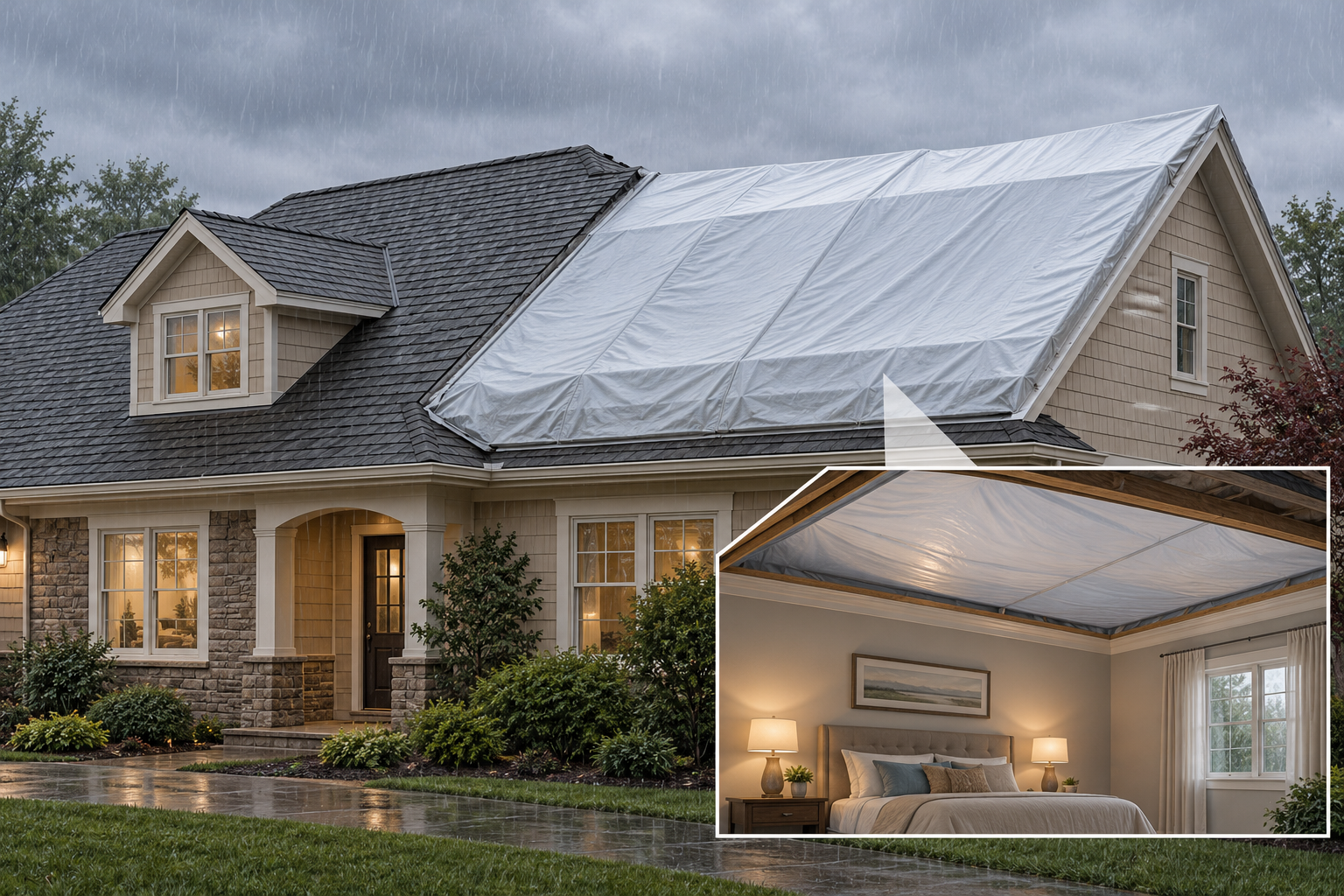
When construction leaves a roof, wall, window, door, or addition opening exposed, temporary weather protection buys time until permanent work is complete. It can range from a simple planned covering to a more involved enclosure with access equipment, anchoring, inspection, maintenance, and repeated adjustments. It is not the same as a permanent weather-resistive assembly.
Situations that may need protection
- a roof opened for replacement or an addition tie-in;
- a wall opened for structural or exterior work;
- windows or doors removed before replacements arrive;
- delayed material delivery or inspection;
- a partial demolition that exposes interior finishes;
- emergency protection after storm or accidental damage.
The right system depends on the opening, expected duration, wind, rain, snow, temperature, security, drainage, and the consequence of water entering the building.
Cost components
Ask whether the proposal includes:
| Component | Questions to clarify |
|---|---|
| Covering or enclosure | What area is protected, and what weather is it designed to resist? |
| Anchoring and drainage | How is it secured, and where does water go? |
| Access | Are scaffold, lifts, stairs, or other equipment included? |
| Labor | Who installs, inspects, repairs, and removes the protection? |
| Duration | What is included if permanent work is delayed? |
| Monitoring | Who checks after wind, rain, snow, or temperature events? |
| Interior protection | Are floors, finishes, contents, and moisture-sensitive areas protected? |
| Risk allocation | Who pays if weather damages exposed work or the temporary system? |
Available evidence supports these cost mechanisms but not a reliable national price. Emergency work may cost more because it requires rapid mobilization, difficult access, or short-notice material and labor.
Temporary does not mean weatherproof in every condition
A tarp, sheet, temporary door, or enclosure has limits. Do not assume it can withstand a particular wind or snow load unless the responsible professional and product guidance support that claim. Do not represent temporary protection as equivalent to the permanent roof, wall, flashing, drainage, or air and moisture-control assembly.
If scaffold or an elevating platform supports the work, the access system introduces its own ground, setup, weather, overhead, and falling-object considerations. CCOHS and OSHA describe professional work-at-height boundaries; they do not provide a homeowner erection or operation procedure.
Planned versus emergency protection
Planned temporary protection can be coordinated with demolition, delivery, and permanent installation. Emergency protection often prioritizes immediate water control, followed by a second visit for a durable temporary arrangement and then permanent repair. Ask whether the quote covers one visit, repeated inspections, maintenance, and removal.
Questions to ask before work opens the building
- What opening is exposed, for how long, and what weather is expected?
- What covering or enclosure is proposed, and what are its limits?
- How are anchoring, drainage, ventilation, and interior finishes handled?
- Who inspects the system after weather events?
- What access equipment, mobilization, and removal are included?
- Who bears the cost of damage, delay, standby, or repeated visits?
- When does temporary protection end and permanent work begin?
For access equipment that may support an enclosure, see scaffolding rental cost. For the broader project setup and repeat visits, read construction mobilization costs.
Price the size, duration, and required performance
Temporary weather protection can range from covering a small opening during a short task to protecting a larger roof or exterior during an extended phase. The cost depends on the area, height, access, attachment and support conditions, wind and precipitation exposure, material choice, installation time, inspections or maintenance, and how long the building remains open. A cover that shields a limited opening for a brief period is not equivalent to an enclosure intended to protect a whole work area over changing weather.
Ask what conditions the proposed protection is intended to address and what conditions remain outside the plan. Temporary does not mean watertight under every storm or safe at every exposure. The qualified contractor should select and secure the arrangement for the actual structure and weather risk. The estimate should describe the work and duration without promising performance the method cannot support.
Planned work and emergency response have different economics
Protection installed as part of a scheduled roof opening or window replacement can be coordinated with the crew, access equipment, materials, and forecast. An emergency covering after a sudden opening may require immediate mobilization, work outside normal hours, limited material choice, and a second visit for a more durable temporary measure. Those costs can be difficult to compare because urgency and exposure differ.
The first response may only limit immediate exposure until permanent work can proceed. Ask what the service accomplishes, how long it is intended to remain, who checks it, and whether it needs replacement or removal. If more than one contractor is involved, assign responsibility for the temporary condition at each handoff. Do not assume that an emergency cover includes permanent repair, interior drying, or damage restoration.
Coordinate enclosure with the next trade
Temporary weather protection has to fit the sequence of demolition, framing, roofing, window installation, insulation, and finish work. A cover may need to be moved so a trade can continue, and an opening left exposed longer than planned may create extra service or damage risk. Coordinate when the structure will be opened, when permanent materials arrive, how weather exposure is monitored, and who can authorize a change to the temporary plan.
Scaffolding, lifts, or other access equipment may be required to install, inspect, or remove protection. Their delivery, rental, and setup costs can be separate. Staging may also be needed to keep the replacement materials dry and accessible. Ask the contractor to identify these linked services and which estimate includes them. For an occupied project, temporary indoor protection and dust containment may also remain necessary while the exterior is open.
Compare the risk and the contract boundary
The least expensive cover may be adequate for a short, limited opening, while an exposed roof, large wall opening, or uncertain schedule can require more robust professional planning. The homeowner should compare the expected protected area, duration, inspection or maintenance, repair response, and removal—not select a material or attachment detail. Ask how weather delay changes rental or labor charges and what happens if a scheduled trade cannot close the opening on time.
Clarify whether the proposal includes only the temporary installation or also any interior protection, water collection, removal, disposal, and permanent repair. Identify who bears responsibility if the work period extends or a temporary element is disturbed by another trade. A contract can assign specific duties, but an estimate alone does not settle insurance coverage, legal responsibility, or the cause of later damage; those questions belong to the parties and professionals responsible for the project.
Low-complexity and high-exposure examples
A small, accessible opening with the next trade scheduled immediately may need a short service period and straightforward removal. A larger opening before a weekend or uncertain material delivery can require longer protection, additional checks, and coordination across crews. A roof opening over finished rooms may also need interior surface protection and a plan for occupied space. These examples show why the protection allowance should follow the actual schedule and exposure rather than use a generic per-project percentage.
Record the target opening date, planned close-in date, responsible contractor, and extension process. If the permanent repair is delayed, request a revised temporary plan and price before the existing arrangement expires or changes. Do not rely on a homeowner-installed improvised cover for a structurally or weather-sensitive opening; have the responsible professional determine the appropriate response.
Quote questions
Ask what area and weather conditions are covered, who selects and installs the protection, how long the price includes it, how it will be inspected or maintained, what counts as a repair or extension, and who removes it. Confirm related access-equipment, interior-protection, staging, and cleanup charges. Identify excluded permanent repairs and weather-related damage scope so the temporary work is not mistaken for a completed building-envelope repair.
For access support, compare scaffolding rental cost and aerial lifts. For the broader cost of repeat visits and site setup, see construction mobilization costs.
Keep a dated record of the expected opening and close-in milestones, the responsible contractor, and the agreed extension process. If the permanent work slips, ask the contractor to review the temporary protection and confirm whether its scope or price changes. This creates a timely decision point before a short-term arrangement is relied on beyond its original schedule.
Set a review point before the temporary term expires
Temporary protection is usually tied to an expected close-in date. If material is delayed or the next trade cannot start, the parties should review the condition and decide whether to extend, repair, replace, or remove the temporary arrangement. Ask whether that decision requires another site visit and who pays for continued service. Record the revised target date and the contractor responsible for checking it. This does not predict the weather or guarantee a covering’s performance; it gives the project a defined point to reassess exposure instead of relying on an expired assumption.