
Construction staging is the planned place where materials, tools, removed contents, and debris wait before their next move. It may be a protected area of the property, a contractor trailer, a portable container, or off-site storage. The cost is not only rent: delivery, pickup, protection, security, access, and double handling can change the project total.
Why staging matters
Workers need room to move and materials need to remain identifiable, dry, stable, and available when the next task begins. Limited staging can force just-in-time deliveries, smaller loads, extra trips, or a longer hand-carry route. It can also make the project slower if crews repeatedly move the same material to reach the work.
EPA notes that separating construction and demolition materials can require multiple containers, labor, space, and coordination. The same principle applies to temporary staging: separation may create value through protection, reuse, or recycling, but it consumes space and handling time.
On-site versus off-site storage
| Arrangement | Potential advantage | Cost or risk to clarify |
|---|---|---|
| On-site protected area | Fewer delivery trips and quick access | Uses driveway or yard space; material may face weather, theft, or damage |
| Portable storage container | Keeps material and contents together near the project | Delivery route, placement surface, rental duration, and security matter |
| Contractor trailer or locked storage | May be integrated with the contractor’s workflow | Ownership, access, and included rental or handling terms vary |
| Off-site storage | Preserves home and lot space | Adds delivery, pickup, travel, scheduling, and double-handling costs |
| Just-in-time delivery | Reduces storage duration and site congestion | Delays or missed windows can stop work and create redelivery charges |
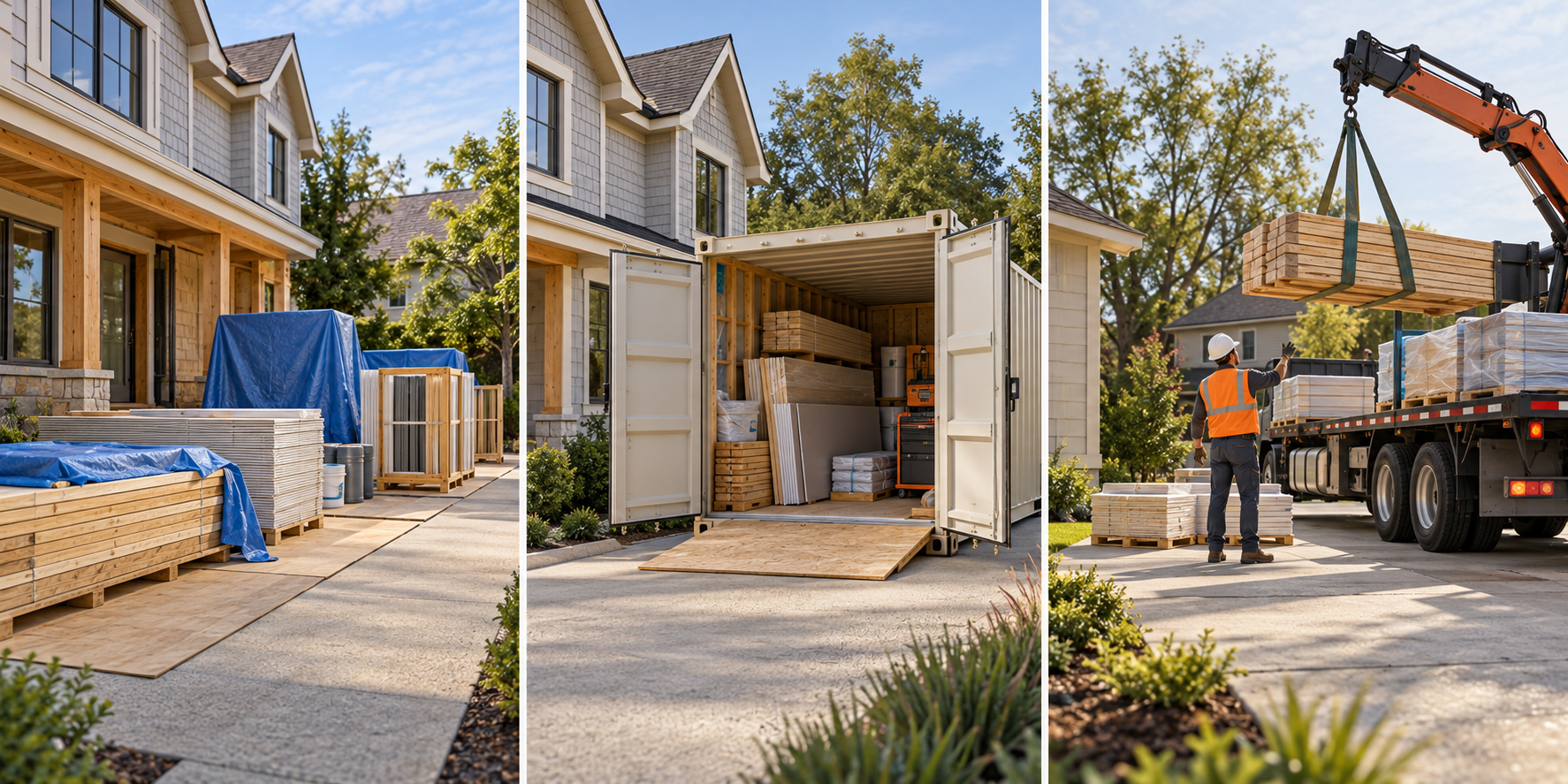
There is no universal best option. The right arrangement depends on project duration, material sensitivity, available space, site security, and delivery reliability.
Cost drivers to put in the estimate
Ask for:
- delivery, placement, pickup, and rental duration;
- surface protection and access preparation;
- loading and unloading labor;
- travel or delivery-zone charges;
- weather protection and ventilation where appropriate;
- security, locks, lighting, or monitoring;
- inventory responsibility and damage or theft risk;
- extra handling when material moves from storage to the work area;
- removal and cleanup at project closeout.
If a general-contractor quote includes “storage” or “staging,” ask whether it is a fixed allowance or a cost that changes with schedule and material quantity.
Staging in a limited driveway or yard
Map the area before materials arrive. A container or trailer can block a garage, reduce parking, interfere with equipment, or leave too little space for a lift or scaffold. The delivery vehicle may need more turning room than the storage unit itself. A property-line, sidewalk, street, or drainage issue can require separate local coordination.
Protect stored materials from weather only with a plan appropriate to the material and the manufacturer’s requirements. Temporary storage is not a substitute for a permanent enclosure or a guarantee against moisture damage.
Questions to ask
- What is being stored, for how long, and why cannot it be delivered later?
- Who pays for delivery, pickup, rental extensions, loading, unloading, and extra handling?
- Where will the unit sit, and can the delivery vehicle reach that location?
- Who protects materials from weather and theft?
- Who is responsible for damage, missing items, or a blocked access route?
- How will storage affect the schedule and the number of material moves?
- Is temporary surface or weather protection included?
For the cost of getting material from the truck to the usable work area, see material delivery and placement costs. For occupied-finish protection, read temporary protection during remodeling.
Compare the cost of keeping material with the cost of moving it
Onsite staging can reduce travel between storage and the work area, but it uses space that may be needed for parking, access, deliveries, or occupied rooms. Offsite storage can keep the property clear and protect material from site activity, but adds transportation, handling, access appointments, and possible retrieval delay. The cheapest monthly storage charge is not necessarily the lowest project cost if items must be moved several times.
List the materials, expected arrival dates, installation sequence, size, condition, and time they need to remain available. Ask whether each item can be delivered closer to its installation date, whether partial deliveries are possible, and what happens if the schedule moves. A short renovation with stable dates may need only a limited staging area. A phased project with long-lead or fragile materials may require secured storage and inventory tracking over a longer period.
Handling can become the hidden storage expense
Storage proposals can include loading, unloading, receiving, inventory, pallet handling, access appointments, and return delivery—or exclude some of them. If a material moves from supplier to warehouse to home to a temporary room before installation, each transfer adds labor and the possibility of damage or delay. Ask how many moves the price assumes and whether a partial retrieval creates another handling charge.
An onsite pile can also be moved more than once as trades need the same area. That may create labor, protection, and scheduling cost even though no separate storage invoice appears. Identify who may relocate the items and who authorizes a change. If the contractor has included staging in general conditions, ask which materials, area, and duration are covered so a separate warehouse or storage fee does not duplicate the same service.
Security, weather, and condition are part of the choice
Some materials need protection from moisture, temperature swings, sunlight, theft, or impact. The correct storage condition depends on the product and its instructions; do not assume a garage, driveway, or temporary cover is suitable for every item. Ask the supplier or installer how material should be held, who checks it, and what happens if packaging or product condition is compromised.
An offsite warehouse may offer controlled access or covered space, but the homeowner should confirm the specific conditions and insurance or responsibility terms in the agreement. An onsite location may be convenient but expose items to weather or other trades. Staging beside a work zone may also conflict with dust containment, temporary protection, or a required path for residents. State who covers, secures, labels, and inspects stored items.
Match staging to the phase sequence
For an occupied remodel, separate items needed daily from those that can remain boxed or stored. Staging an appliance, vanity, flooring, or cabinet too early can make rooms unusable and limit contractor access. For a new build or addition, early delivery may be needed to align with crew availability, but materials should not obstruct site work or be exposed to unsuitable conditions. The schedule should connect delivery, receiving, staging, installation, and removal of packaging.
If a project is delayed, ask whether storage charges continue, whether a return delivery can be rescheduled, and who is responsible for the resulting extension. If the contractor needs to store its own equipment or materials, clarify which areas are dedicated to the crew and when they will be cleared. Keep owner belongings and contractor-supplied materials distinct so responsibility for security and damage is clear.
A practical comparison for a constrained property
Suppose the driveway is the only workable delivery location and the project still needs a path for workers and residents. A direct delivery may avoid warehouse handling, but a large pallet could block access and require a later move. Offsite holding may preserve the route, while adding a warehouse charge and another delivery. A third option could be a smaller timed delivery by phase. Compare all three using the same material quantities and installation schedule, including handling, access, storage duration, and any return trip.
Ask bidders to identify storage location, covered or conditioned status if relevant, receiving hours, access notice, inventory responsibility, handling charges, security, damage responsibility, delivery lead time, extension rates, and final removal. If a site walk reveals that material must share space with a dumpster, lift, scaffold, or temporary utility, include that conflict in the sequence. The best choice is the one that minimizes total handling and schedule risk while preserving safe access and suitable storage conditions.
For the unloading and last-distance cost before storage, see material delivery and placement. For the cost of moving material along finished routes, read temporary protection during remodeling. If the site itself is difficult to reach, compare access costs.
Ask for a receiving record that identifies quantity, condition, storage location, and the party responsible for the next handoff. If materials are stored offsite, confirm pickup notice, access hours, and whether partial retrieval changes the charge. If they stay onsite, mark the reserved area and the date it must be cleared. Those details make a storage allowance measurable and reduce disputes over missing, damaged, or moved items.
Include household disruption in an occupied remodel
Storage decisions can change how much of the home remains usable. Boxes or appliances left in a hallway can restrict movement; moving belongings offsite can add packing, transport, and retrieval work beyond a contractor’s material allowance. Decide which rooms and paths must stay available and identify the contractor’s laydown area separately from household storage. If the work requires residents to move items, clarify who handles heavy or fragile belongings and whether the homeowner must empty a room before the crew arrives. A staging estimate should describe construction materials and contractor equipment; it should not quietly assume that household moving is included.