
A crane service is priced around a planned lift, not simply the number of hours the boom is moving. A short rooftop placement can require a large machine, a large setup footprint, a qualified crew, rigging, traffic coordination, and extensive preparation. Evidence for residential crane prices is too heterogeneous for a dependable national range, so the quote’s assumptions matter more than a generic average.
Crane rental versus crane service
“Crane rental” can mean equipment supplied to a qualified contractor. “Crane service” often means the crane, operator, and at least part of the lift crew are provided as a coordinated service. Ask exactly which arrangement you are buying. Rigging, signaling, lift planning, traffic control, permits, and standby may be separate.
The variables that move the price
| Variable | Why it matters |
|---|---|
| Load | Weight, dimensions, balance, lifting points, and fragility determine the required setup |
| Radius | A load farther from the crane generally changes capacity and machine requirements |
| Height and reach | The boom configuration and clearance can require a different crane |
| Setup | Outriggers, mats, leveling, ground support, and assembly take time and space |
| Access | Travel route, street position, property lines, overhead wires, and staging can limit options |
| Crew | Operator, rigger, signal person, spotter, and specialty handling may be needed |
| Time | Minimum service windows, loading, waiting, weather, and standby can exceed the actual pick |
| Coordination | Utility, traffic, public-space, neighbor, and delivery planning may add work or approvals |
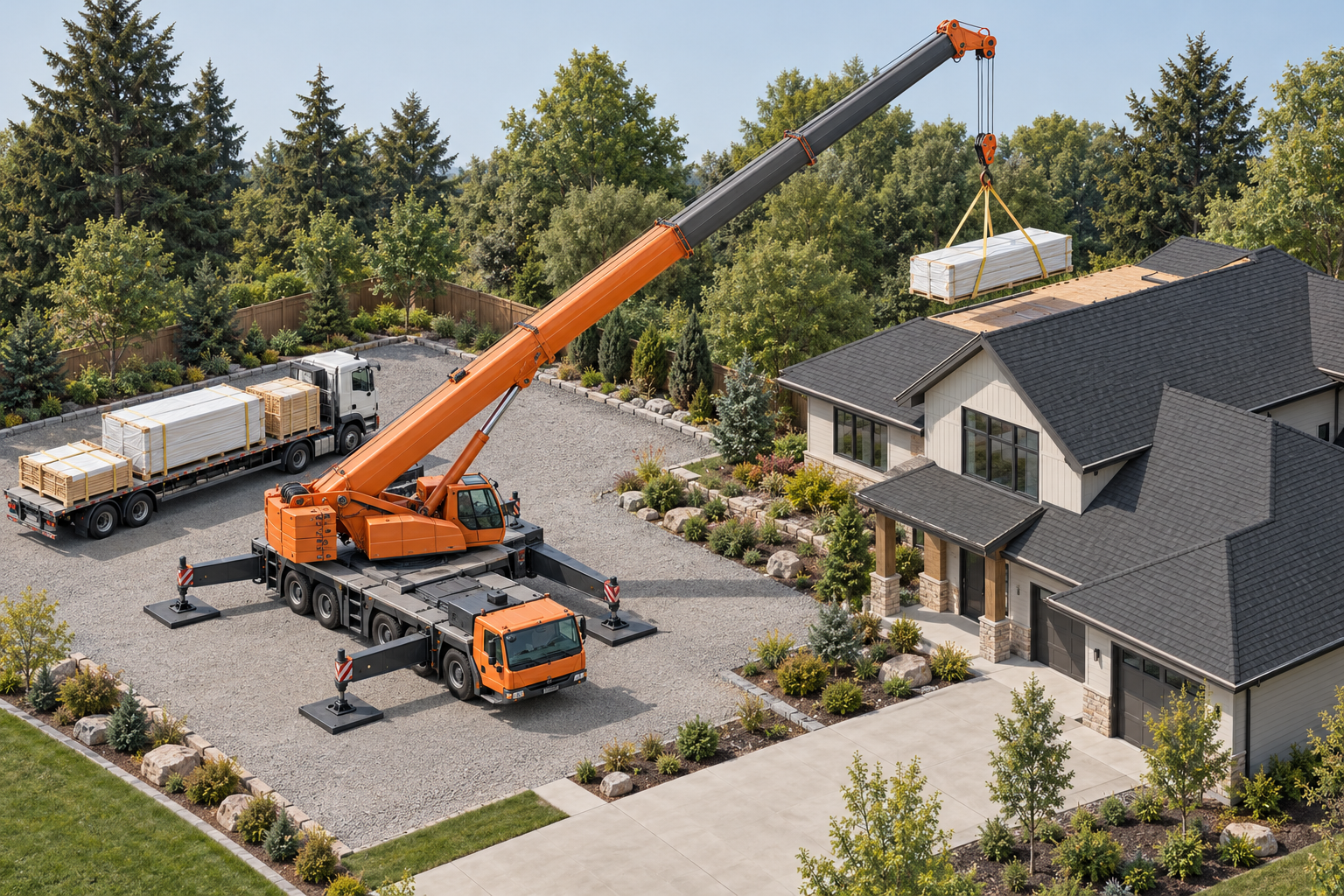
One difficult pick can cost more than several easy picks because the crane size and setup are selected for the hardest combination of weight, radius, height, and site conditions.
Ground and overhead hazards are cost and safety issues
OSHA’s U.S. construction-crane scope describes covered equipment as power-operated equipment that can hoist, lower, and horizontally move a suspended load. Its ground-condition rule addresses slope, compaction, firmness, drainage, grading, support materials, and known hazards below the setup area such as voids, tanks, and utilities. OSHA’s cited power-line rule addresses planning and clearance during crane or derrick assembly and disassembly when equipment, loads, load lines, or rigging could approach a line. Other crane operations may be subject to additional requirements that qualified project personnel must determine for the site and work sequence.
These are U.S. construction-safety boundaries, not homeowner operating instructions and not a substitute for Canadian or provincial requirements. A qualified crane company should determine the lift plan, ground support, clearances, rigging, and personnel requirements.
Street and property coordination
The crane may need to occupy a street, driveway, lane, or neighboring area. Ask who handles right-of-way permissions, traffic or pedestrian controls, neighbor notices, utility coordination, surface protection, and restoration. Administrative permits and approvals remain a separate project-planning question, even when the crane company helps coordinate them.
How to request comparable proposals
Give each bidder the same information:
- Load weight, dimensions, center of gravity if known, and lifting points.
- Pick location, set location, height, radius, and obstacles.
- Crane access route, setup surface, slope, overhead lines, and underground concerns.
- Desired date, number of picks, loading/waiting time, and weather contingency.
- Whether rigging, operator, signal person, traffic control, permits, and cleanup are included.
Then ask for the minimum billable window, mobilization, overtime, standby, cancellation, and remobilization terms. Do not accept a low hourly number that excludes the items needed to perform the lift.
For the site conditions that may make a crane necessary, read difficult site access. For movement of ordinary materials, see material delivery and placement costs.
The load and the site jointly determine the service
Crane capacity at a stated radius is not the only planning question. The contractor needs to match the load, pick location, placement point, boom configuration, setup area, and ground conditions to an appropriate crane and crew. A smaller machine may not reach across a building or place a load over an obstruction; a larger machine may need more space, transport, setup time, and site preparation. The homeowner should provide the intended load and location information, while qualified project personnel determine whether the lift is feasible and what equipment is suitable.
The project cost can also include a lift director or other qualified personnel, rigging services, traffic or pedestrian coordination, surface protection, and separate setup or breakdown work. Ask who supplies each service and whether it is included. Do not compare one provider’s fully staffed crane service with another provider’s bare equipment rental as if they were equivalent.
Site review can prevent an expensive failed booking
Before a proposal is firm, identify where the crane would arrive, set up, and travel; where the load originates and where it must go; and what lies between those locations. Ground conditions, buried features, slopes, overhead lines, nearby structures, tree branches, street access, and public space can affect feasibility. These are not homeowner load-planning instructions: a qualified crane provider must evaluate the conditions and decide whether engineering or additional professional review is needed.
An early site visit can expose constraints before the crane is dispatched. If setup area or support assumptions are wrong, the provider may need to delay, bring a different machine, or remobilize. Each can affect price and schedule. Ask which site observations were confirmed, which remain assumptions, and what change in conditions triggers a revised quote.
Minimums, standby, and schedule coordination
Crane jobs often carry a minimum service window or minimum charge. The quoted hourly figure does not necessarily include mobilization, setup, rigging, travel, standby, overtime, cancellation, or a second visit. Ask for the complete service window and the time at which billing begins and ends. Confirm whether the crew waits while another trade prepares the load or whether the lift will be rescheduled if the site is not ready.
Coordinate the crane date with delivery, access, and placement work. A load that arrives before the crane or a destination that is not ready can create handling, storage, and waiting costs. If several lifts are planned for different phases, ask whether the provider will price them as separate mobilizations or one scheduled service. Do not assume that a later lift has the same site conditions or minimum as the first.
Keep alternate methods in the comparison
Where the task is routine movement to an accessible work area, a material-delivery service, lift, or staged manual handling may be more suitable than a crane. Where a load must be placed over a building or obstruction, a crane may be the practical method even though mobilization is substantial. The comparison should include what each method can reach, the labor and time it requires, the access it consumes, and any temporary protection or follow-on handling.
Avoid choosing on equipment cost alone. A cheaper delivery that leaves the material at the curb may require another crew or machine to move it. A crane may lower handling time but need more coordination and site preparation. Ask the contractor to state the outcome each option achieves and which price excludes unloading, rigging, placement, or final positioning. For routine placement, see material delivery and placement costs; for the underlying access constraints, compare difficult site access.
Questions that make bids comparable
Give bidders the same description of load dimensions and approximate weight if known, pickup and placement points, schedule window, site access, and known ground or overhead constraints. Ask for equipment and crew scope, mobilization and setup, minimum time, standby, overtime, rigging, traffic coordination, cancellation terms, and the price basis for a second lift. Request confirmation that a site review occurred and which assumptions still need professional verification.
The written proposal should distinguish the service from permits, utility coordination, engineering, ground improvement, and other site work if those are excluded. Local approval and public-way obligations are jurisdiction-specific and belong in the project’s administrative scope. Keep them visible in the schedule and budget, but do not treat this article as instructions for operating or directing a crane.
Ask the provider to list the assumptions that must remain true on lift day and how the parties will confirm readiness. Identify a contact for the supplier, crane crew, and receiving trade; confirm the delivery sequence and an alternate date if the site is not ready. A missed coordination window can trigger standby or a second mobilization even when the planned service duration is short. Keep that schedule risk visible alongside equipment and crew price.
A canceled lift can leave several linked costs
A crane booking depends on the load, crew, site, and receiving trade being ready in the same service window. If a load has not arrived, the placement area is unavailable, or a site assumption has changed, the provider may be unable to proceed. Ask whether cancellation, standby, weather delay, or rescheduling is charged and how far in advance notice is required. Identify who will make the go/no-go decision and how the supplier or installer will be notified. A realistic alternate date and a clear cancellation term can protect the project schedule without asking anyone to proceed when the professional lift plan no longer fits the conditions.