
An aerial lift can be economical when the machine can reach the work area quickly and safely. It can be a poor fit when the access path, ground, overhead hazards, or required work duration makes delivery and setup difficult. The daily rental is only one part of the decision.
Boom lift versus scissor lift
At a high level, a scissor lift raises a platform mostly vertically. A boom lift uses a telescoping or articulating arm to reach up and, in some configurations, over an obstacle. These are general equipment distinctions, not a selection or operating rule. The contractor or rental professional must match the machine to the actual site and work.
| Consideration | Scissor lift | Boom lift |
|---|---|---|
| Primary advantage | Vertical platform access over a relatively defined footprint | Horizontal outreach or positioning around obstacles |
| Site need | Firm support, adequate width, and room to move the platform | Firm support plus clearance for the boom, counterweight, and swing or articulation |
| Typical cost pressure | Height, platform size, delivery, duration, and surface | Reach, capacity, setup, delivery, duration, and more complex site geometry |
| Poor fit | Narrow route, slopes beyond equipment limits, holes, or overhead conflicts | Insufficient ground, overhead wires, restricted swing, or no safe setup area |
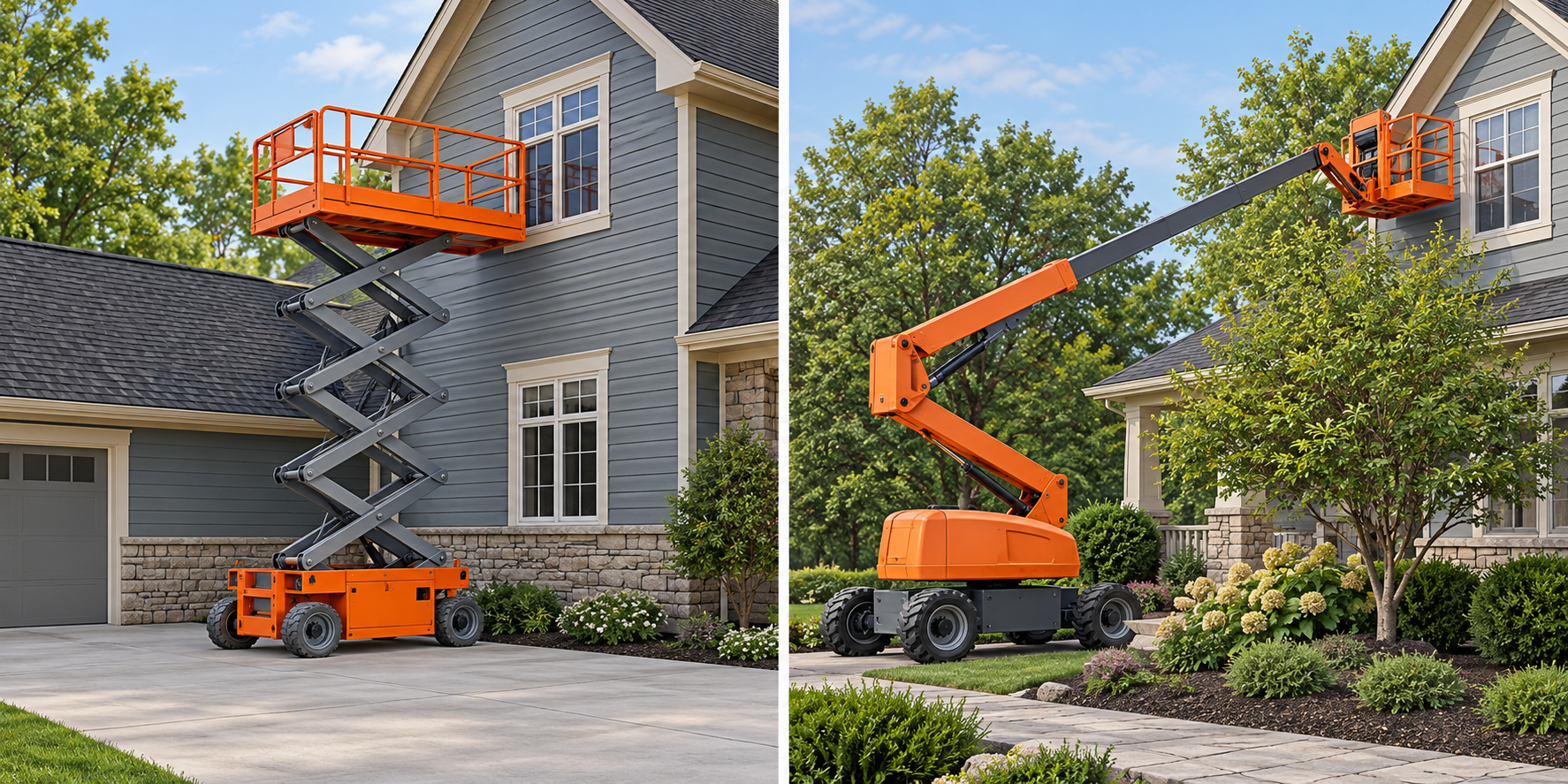
Nominal working height does not tell you whether the machine can reach the work from the available setup point.
Cost components beyond the rental day
Ask whether the quote includes:
- delivery and pickup;
- fuel, charging, and damage waiver or similar fees;
- daily, weekly, or extended rental period;
- operator or service crew;
- setup, relocation, and standby time;
- ground protection, mats, or stabilization;
- traffic, pedestrian, or neighbor controls;
- remobilization if the project is delayed.
Current rates vary by equipment class, market, availability, season, and provider. The evidence for this category supports selection factors, not a reliable national rental range. Use an equipment-specific local quote with the delivery route and work duration stated.
Site-fit questions
Measure or document the gate and route width, turning points, slope, surface, overhead clearance, wires, soft ground, holes, drop-offs, traffic, and the distance to the work. A machine that fits through the gate may still fail at the turning point or require more ground support than the driveway can provide.
CCOHS identifies firm and level setup, stabilizers or outriggers where applicable, training, pre-use inspection, loading limits, overhead wires, traffic, hazardous atmospheres, and weather as important elevating-platform considerations. OSHA likewise treats aerial-lift operation and fall protection as professional safety matters. This article does not tell homeowners how to operate, move, tie off, or modify a lift.
Lift or scaffolding?
A lift may be attractive for a short task, several separated work points, or work around an obstacle. Scaffolding may be more efficient for a long façade, repeated access at one elevation, or work that needs a stable platform for an extended period. Include setup, relocation, delivery, protection, and idle time in both comparisons.
Questions for the contractor or rental provider
- What exact height, outreach, capacity, footprint, and surface assumptions were used?
- Who is authorized and trained to operate the equipment?
- Is the operator included, or is the machine being delivered for a qualified contractor?
- Does the price include delivery, pickup, fuel or charging, and damage terms?
- How are slopes, soft ground, overhead wires, traffic, and weather handled?
- What happens if the lift cannot reach the work after delivery?
- Would scaffolding reduce total setup or idle time?
For the common site-wide cost drivers, see difficult site access. For fixed elevated access, compare scaffolding rental cost.
Price the complete rental window
The daily or weekly equipment rate is only one part of an aerial-lift quote. Delivery and pickup, minimum rental period, fuel or charging, damage waiver or insurance terms, cleaning, late return, and any required qualified operator can affect the total. If a lift arrives before the work area is ready, the rental clock may still run. Ask when billing begins, how a weekend is counted, who requests pickup, and whether the provider charges for a failed delivery or inaccessible placement.
The equipment can also sit idle while another trade prepares the area or finishes a prerequisite. A short task scheduled tightly around delivery may make a rental more economical than holding the lift for several days; repeated tasks spread across phases may make repeated delivery charges material. Compare the full schedule rather than multiplying a daily rate by the hours the machine is expected to be used.
Choose by reach and work pattern, not by height alone
A scissor lift generally raises a platform vertically and needs a suitable route and supporting surface. A boom lift can reach outward as well as upward but has different footprint, movement, and access demands. The contractor or rental provider should select equipment based on work position, load, platform needs, ground condition, obstructions, and route. A homeowner should not choose solely from advertised working height or assume a machine can pass through a gate because its platform fits the target.
For a broad run of repetitive exterior work, stationary scaffold may be simpler to keep in place. For a brief task at several locations, a mobile lift may reduce setup or serve a point scaffold cannot reach. A narrow side yard, planted garden, sloped ground, soft lawn, overhead obstruction, or sensitive paving can change either option. Request a site review when the route and work location are not obvious from the driveway.
Operator, delivery, and site responsibility change the comparison
Some proposals price equipment only; others include delivery, qualified operator service, or support with the lift plan. Clarify who is responsible for receiving the equipment, confirming access, arranging the work area, and returning the machine. A contractor-supplied operator and a homeowner-rented machine are not equivalent service offers. Do not use an equipment-only quote as an instruction or authorization to operate a lift.
Ask what the provider needs to know about gate widths, slopes, overhead clearances, surface bearing, landscaping, and travel distances before dispatch. If the lift cannot reach the task after arrival, the project may pay for a second delivery, a different unit, standby time, or an alternate access system. Providing photographs, measurements, and a site visit can reduce that uncertainty.
Compare one location with several phases
A single elevation or brief soffit repair may allow the team to complete the work in one rental period. A larger exterior project may need setup at several sides of the home, with interruptions for siding, painting, gutters, and finish work. The lift’s size and repositioning plan should match the actual work sequence. If the contractor needs it on one side at a time, confirm whether moving it around the property is included and whether it can traverse each route.
The cost comparison should include the labor the lift saves or enables, not just its rental charge. Scaffold could have higher initial setup but reduce repeated movement. A lift could reduce time in one location but incur delivery and standby costs. A crane is a different service for lifting or placing loads and is not a general substitute for personnel access. Compare only options the qualified contractor considers suitable for the task.
A quote checklist for equipment and access
Before accepting a proposal, confirm the lift type and service model, work locations, rental dates, billing minimum, delivery and collection, operator responsibility, fuel or charging, changes in location, ground and route assumptions, weather delays, standby, and damage or return terms. Ask what triggers a substitution or additional charge if the machine does not fit or reach the planned position.
Keep required barriers, pedestrian protection, permits, and utility coordination visible as separate project responsibilities. Requirements depend on the actual site and jurisdiction. The estimate should identify who handles them; an equipment rental should not be treated as proof that the work area is ready. For stationary access compare scaffolding, and for constraints shared with other equipment see difficult site access.
Before delivery, confirm that the work area is ready, the route is clear, and the provider or contractor has checked site assumptions. If another trade must finish first, ask whether the rental can be rescheduled without charge and who calls to change the date. A written readiness check can be more valuable than a small rate discount when the equipment has a minimum rental period.
When the task takes less time than the rental
A crew may need the lift for only a few hours, but a provider can charge a daily minimum and delivery window. A second short visit may therefore cost more than holding the equipment for one longer period, while keeping it onsite can block parking or expose it to unauthorized use. Ask the contractor to sequence the elevated work into one ready window and identify which tasks are included in that visit. If weather or another trade can cancel the work, compare the rescheduling terms before booking. These schedule details help estimate the total service cost without assuming a machine can be operated by the homeowner or left unattended under any particular conditions.