
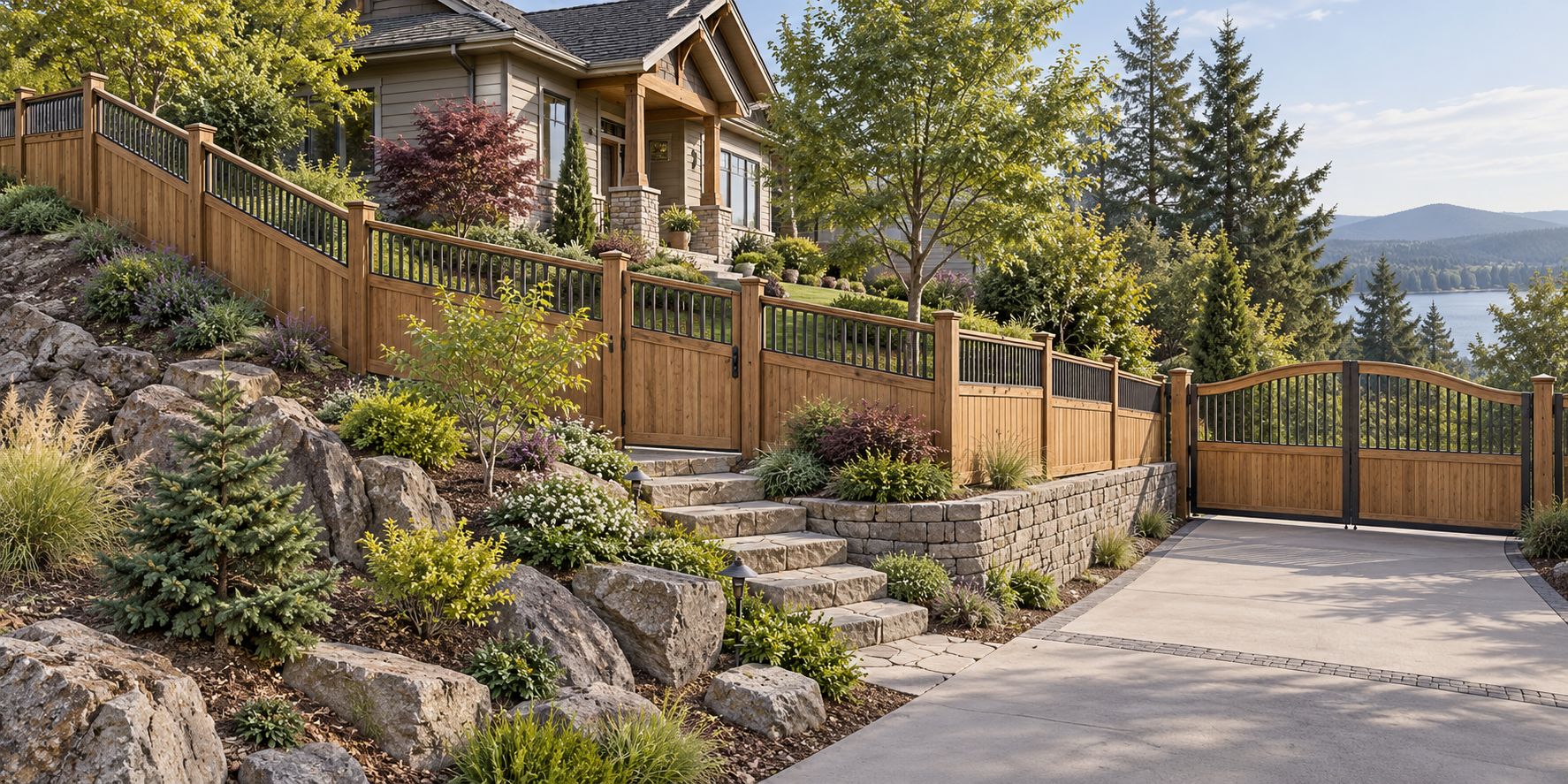
Fence pricing is driven by the run, not just the material. Length, height, posts, gates, corners, terrain, access, removal, and property-line or approval issues can change a quote before the first panel is installed.
A U.S. market signal
Angi’s 2026 summary reports a typical U.S. project range of about USD 1,860–$4,843, with an average near $3,276. It also reports a broader possible range of roughly $425–$13,700 and a material-dependent signal of about $6–$50 per linear foot, averaging near $23 per linear foot. These figures describe Angi’s market dataset, not a guaranteed bid: the lot size, fence type, height, gates, site work, and inclusions determine where a real project falls. For Canadian work, do not convert this U.S. dataset; a separate Canada-facing price signal is described below with its limits, and local quotes are still needed.
Measure the run and describe each transition
A usable fence measurement should separate straight runs from corners, ends, gates, and transitions to existing work. Ask whether the measured length is centerline, panel-to-panel, or another method and who confirms it before materials are ordered. Height may change along the property, and a slope can create different panel lengths or gaps. A rough perimeter estimate is useful for early planning but not a complete installation scope.
Map pedestrian and vehicle openings separately. Identify which way each gate should swing or slide, how wide the clear opening needs to be, and what must remain accessible. A gate changes posts, hardware, and layout. If the lot has a shared line, verify the boundary and permissions before laying out the run.
Separate material choices from site allowances
Once the dimensions are clear, ask bidders to identify the exact fence system, grade, height, posts, rails, finish, and hardware. List removal and disposal separately from new installation. If the contractor has not confirmed the soil or underground conditions, use a defined allowance with an explanation of its trigger rather than an unexplained surcharge.
Ask what each price assumes about clearing, grading, roots, rock, access, equipment, and landscape restoration. Two fences with the same length and material can require different labor if one site is clear and level and the other is steep or obstructed. These differences should appear in the scope, not be hidden behind a vague per-foot total.
Compare the finished result
Before accepting a bid, check that the proposed height, gate locations, line, and finish meet the homeowner’s goal. Ask whether panels will step or follow a slope and how they meet a wall or existing fence. Confirm who checks property and permit questions and what happens if an approval requires a different layout.
Break the quote into parts
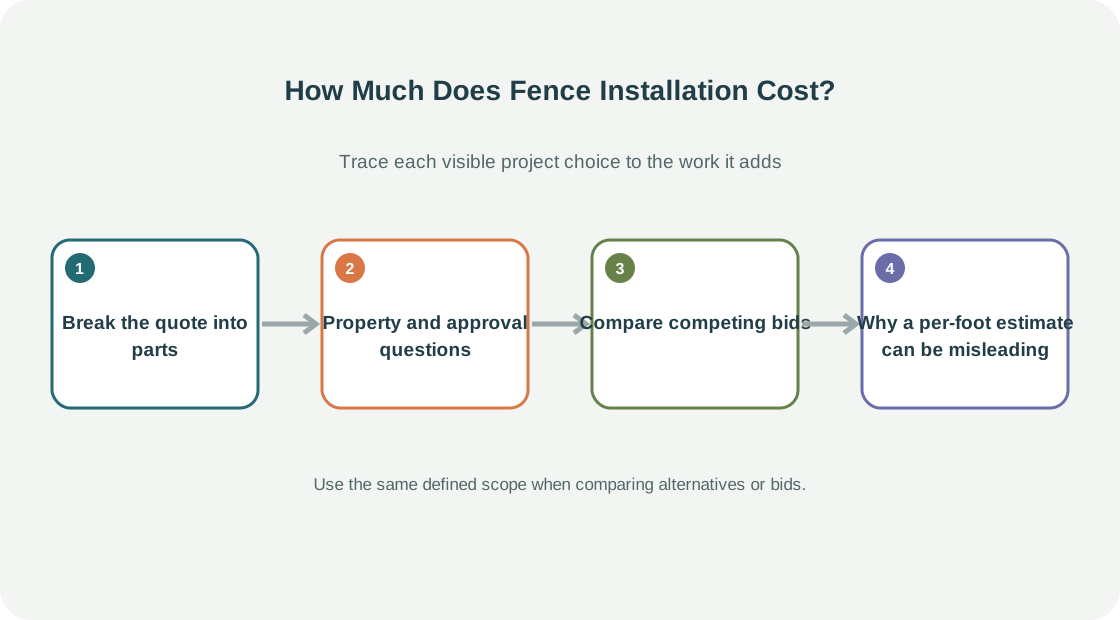
Ask for surveying or layout assumptions, clearing and grading, posts and footings, panels or rails, gates and hardware, corners, transitions, old-fence removal, disposal, equipment, access, finishes, taxes, and approvals. A long straight run on open ground is a different scope from a short run with many corners, rock, roots, or a heavy gate.
Property and approval questions
Fence height, setback, placement on a boundary, easements, neighbor agreements, HOA or association rules, and permit requirements vary by jurisdiction. The contractor can identify a practical risk, but a fence quote is not a legal boundary determination or a guarantee of approval.
Compare competing bids
Give each bidder the same measured length, height, gate count, material grade, removal assumption, and access information. Then ask what is excluded and what site conditions trigger an allowance. The best comparison is a normalized scope, not the lowest price per foot.
Why a per-foot estimate can be misleading
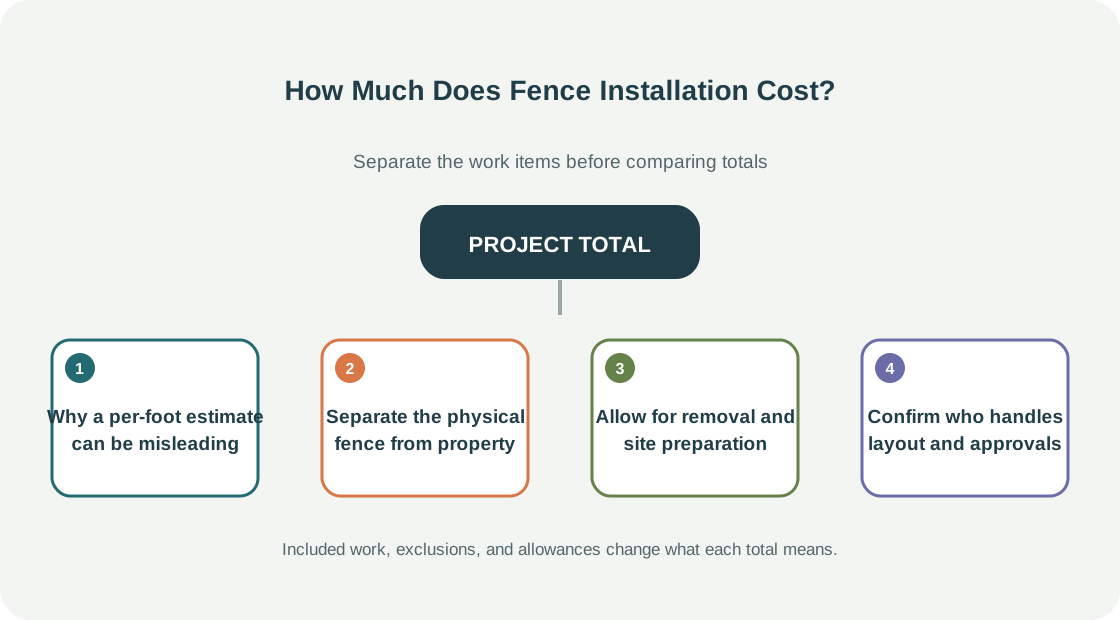
Linear footage is a useful starting unit, but a fence is not a uniform run of identical panels. A quote may contain terminal and corner posts, gates, changes in direction, transitions to existing work, removal, grading, digging, and cleanup. A short fence with a wide driveway gate and several corners can require more setup per foot than a longer straight run. Height and material change the panel, post, and footing assumptions too.
Angi’s U.S. page reports $1,860–$4,843 as a typical whole-project signal and also gives a broad $425–$13,700 range and approximately $6–$50 per linear foot, averaging near $23. These measures answer different questions: whole-project data reflects a range of project sizes, while the per-foot figure compresses variations in gates, layout, height, and site work. The broad high and low totals should not be treated as normal outcomes for a particular property. Use them as source-attributed context and base a real budget on a measured scope.
Separate the physical fence from property decisions
Before construction, confirm the proposed line, ownership, easements, buried services, and any local or association approval that applies. A fence installer may help mark a practical layout, but an installation quote is not a boundary survey or a legal determination of responsibility. If the work follows a shared property line, settle permission and cost-sharing questions before materials are ordered.
Fence height, placement, visibility, and gate swing may be limited by local rules, especially near roads, intersections, shared paths, or pool areas. Requirements vary by jurisdiction and by the purpose of the barrier. Do not assume the same height or gate detail is allowed everywhere. Ask the local authority what applies to your address and ask the contractor which assumptions they used.
Allow for removal and site preparation explicitly
If an old fence is present, tell bidders whether it should be removed, hauled away, or left in place during staged work. Ask whether post concrete, roots, brush, and disturbed soil are included. Reusing holes or posts may not be suitable for the new layout or product system, so identify that as a design and site decision rather than a guaranteed cost saving.
Walk the route with the contractor and point out retaining walls, trees, utilities, slope breaks, sprinklers, and hardscape that should remain undamaged. Ask how those areas will be protected, where equipment and materials will be staged, and what happens if excavation reveals rock, buried debris, or unsuitable ground. A clear change-order method is more useful than an unspecified contingency.
Confirm who handles layout and approvals
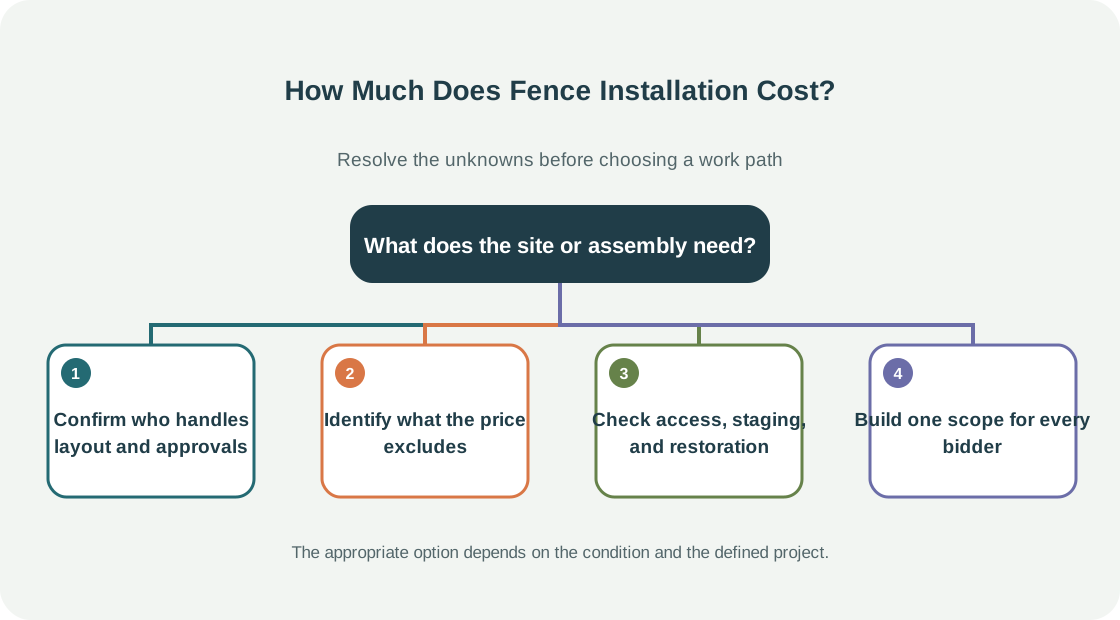
Ask whether the contractor’s measurement is a construction layout only or whether it includes a licensed survey or other boundary service. If the proposed line is close to a property boundary, confirm the location and any shared-use agreement before digging. A fence installer generally prices physical work; an estimate does not determine ownership or settle a neighbor dispute.
Local approvals may depend on fence height, placement, corner visibility, pool use, easements, or association rules. Ask which assumptions the contractor made and whether permit fees or application drawings are included. Verify the current requirements with the responsible authority for the address. Toronto’s pool and deck guides are examples of local processes, not rules for another city.
Identify what the price excludes
Read the proposal for demolition, post concrete, grading, vegetation clearing, utility location, disposal, gate hardware, taxes, finish, and restoration. Ask what happens if the final measured length differs, if a utility conflicts, or if a gate position must move. Confirm who supplies materials and how substitutions are approved.
Check access, staging, and restoration
The route to the fence line can affect delivery and labor. Tell bidders about narrow gates, stairs, long carries, parking limits, landscaping, overhead obstructions, and surfaces that need protection. Ask where materials will be stored and how old fencing, concrete, roots, and soil will be removed. If equipment cannot reach the full run, clarify how the crew will handle the restricted area.
Restoration is easy to miss. Ask whether the quote includes reseeding, replacement of edging, cleanup of concrete debris, repair to irrigation, or return of disturbed soil. Those items may be separate from fence installation but still part of the homeowner’s project budget.
Build one scope for every bidder
Send the same measured plan to each bidder. Mark total length, each gate width and type, height changes, corners, tie-ins, old-fence removal, desired material and finish, and access limitations. Have each proposal identify posts, footings, panels or rails, hardware, disposal, grading, taxes, and approval allowances. Note whether the estimate assumes the line has already been legally established.
Compare not only the total but also the assumptions that could change it: actual length, post spacing or product system, gate construction, removal volume, surface restoration, and any allowance for difficult excavation. Ask bidders to explain how a changed dimension is priced. This is particularly important if the fence line is irregular or the final gate location has not been decided.
The result should be a quote that describes the fence you will receive and the site work needed to install it. A market average can orient a U.S. budget, but only a defined local scope can show whether two bids are actually comparable.
Canada-facing price context
Canada Construction Network’s Canada-facing page reports a $2,780–$6,297 overall project range from 63 listed data points across four provinces. Its provincial summaries and selected fence rows use dollar signs without an ISO currency code, and the page does not explain collection timing or inclusions. Treat these as separate publisher-reported Canadian-context signals, not confirmed CAD prices or representative quotes. Do not merge them with Angi’s U.S. estimates or infer a local bid from the figures.