
Terrain can dominate fence economics. A run that is straightforward on open, level ground may require different layout, excavation, equipment, material handling, drainage coordination, or retaining work on a difficult lot.
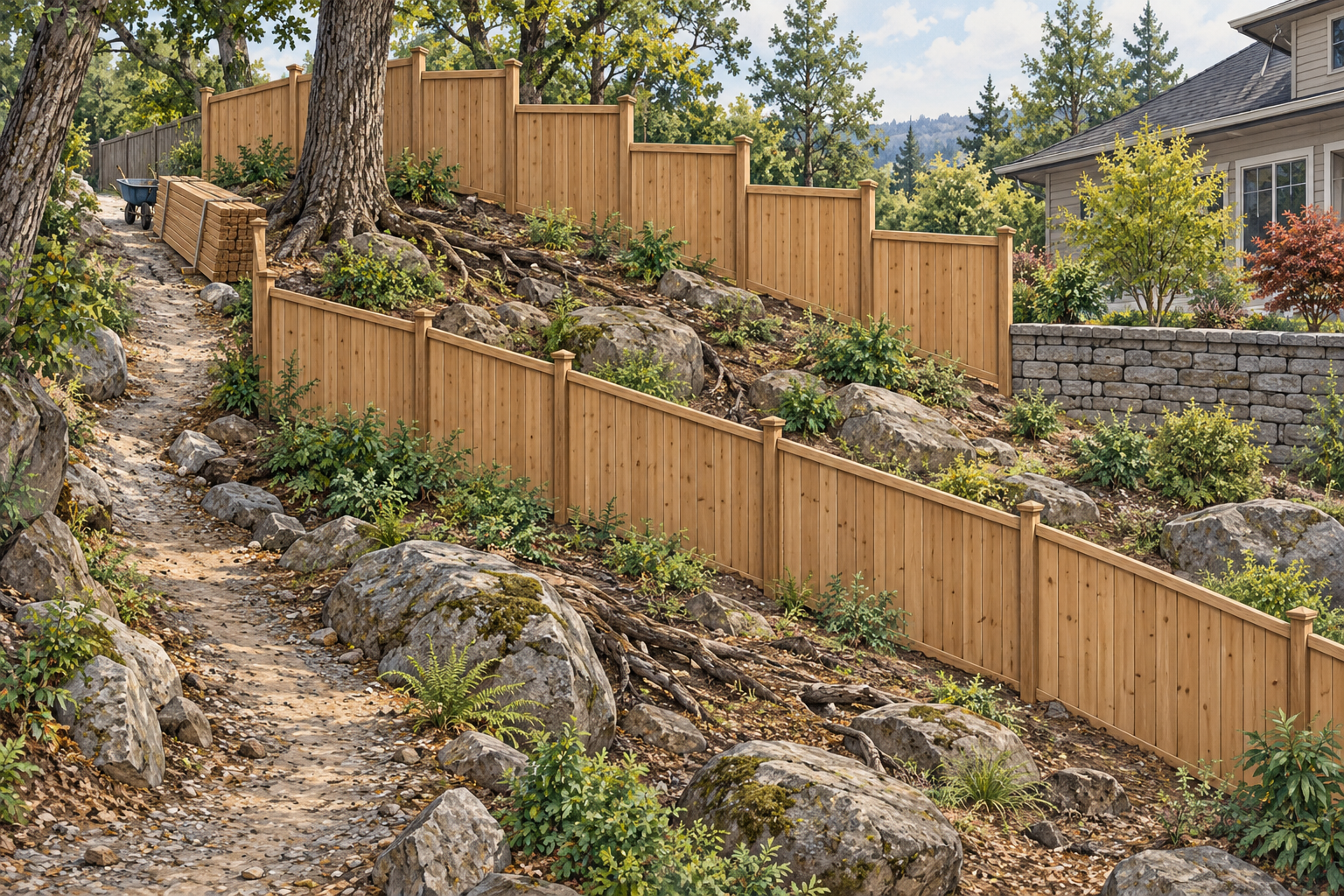
Slope and layout
Ask whether the proposed system follows the grade, steps between posts, or requires another layout approach. The choice affects panels, gates, privacy, transitions, post heights, and appearance. Do not treat a “slope surcharge” as a complete explanation; the bid should describe the work.
Rock, roots, and soil
Rock, roots, buried utilities, wet ground, and hard excavation can increase labor and equipment needs. A post replacement or new footing may require concrete removal and disposal. Any frost or footing prescription must be verified for the jurisdiction and site rather than copied from a generic rule.
Terrain changes the layout as well as labor
On a slope, the contractor may propose panels that follow the grade or sections that step between posts. Each approach changes the bottom gap, top line, appearance, panel dimensions, post heights, and gate transitions. A racked system may not be available for every material or design; a stepped layout may create larger gaps that matter for pets or privacy. Ask for a drawing or marked-up elevation so the homeowner can compare the actual result rather than a generic “slope price.”
Where a fence meets a retaining wall, ask whether posts attach to the wall, sit behind it, or require another design. That interface may involve structural or property questions outside ordinary fence installation. Drainage and erosion also need to be separated from the fence scope: a new barrier should not trap runoff or rely on an unpriced retaining repair.
Excavation uncertainty needs a defined allowance
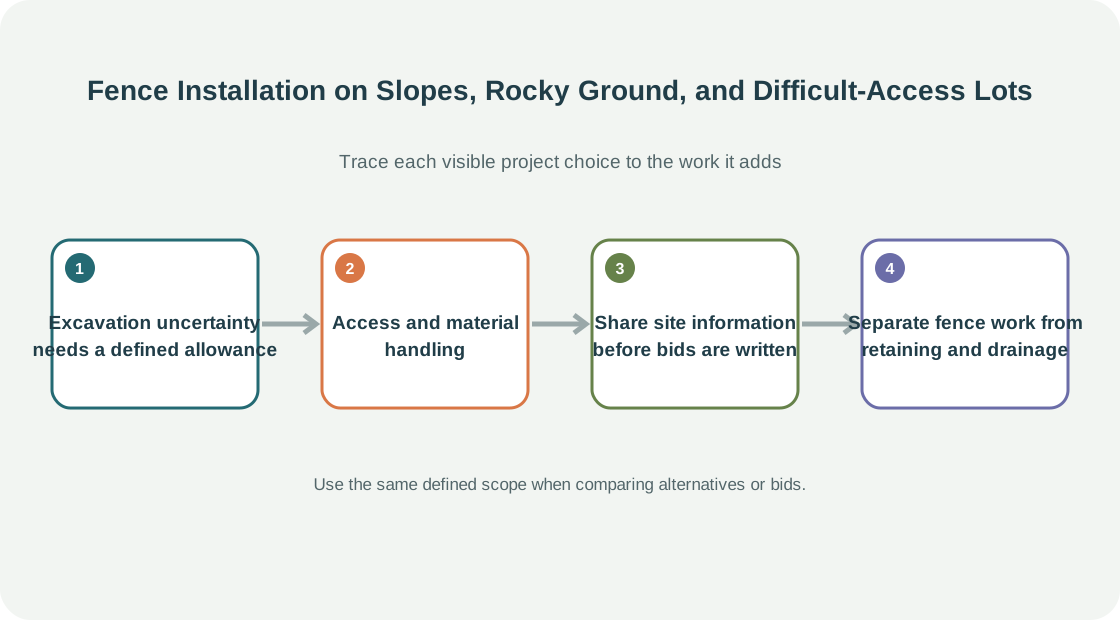
Rock, roots, buried concrete, utilities, and wet or unstable ground can change the method and equipment needed for posts. Ask whether the contractor used a site walk, utility locate, or other information and what conditions remain unknown. If the proposal includes an allowance, it should identify its trigger, quantity or unit basis, and the owner’s approval step. “Difficult soil” alone is not enough to compare bids.
Frost conditions and footing needs are location- and design-specific. Do not use an online depth or generic frost table as a prescription for the project. Ask the responsible professional and local authority which requirements apply. If excavation near a retaining wall or building could affect those structures, have the relevant professional evaluate it before digging.
Access and material handling
The route to the fence line can matter as much as the fence itself. Narrow gates, stairs, long carries, steep slopes, limited parking, mature landscaping, overhead obstructions, and sensitive hardscape affect staging and delivery. Ask how workers and materials will reach the site, where removed soil or old fencing will go, and which surfaces will be protected or restored.
Different materials may respond differently to grade and access. Long rigid panels can require more room to move and may be harder to adapt around obstacles. Smaller modular parts can ease handling but involve more connections and layout. These are project considerations rather than universal cost rankings. Ask the installer to price the actual product and route.
Share site information before bids are written
Walk the route with each contractor and mark slopes, retaining walls, trees, utilities, water channels, access gates, stairs, and existing hardscape. Identify where equipment can be staged and where materials must be carried. If exact property lines or utility paths are uncertain, resolve those questions before posts are placed rather than expecting the installer to absorb the risk.
Ask whether the bidder has priced a site visit or is using a plan or photograph. A remote estimate may be useful for early budgeting but cannot see buried concrete, soil, access restrictions, or subtle grade changes. If the quote is provisional, ask what field measurement or excavation will confirm it.
Separate fence work from retaining and drainage work
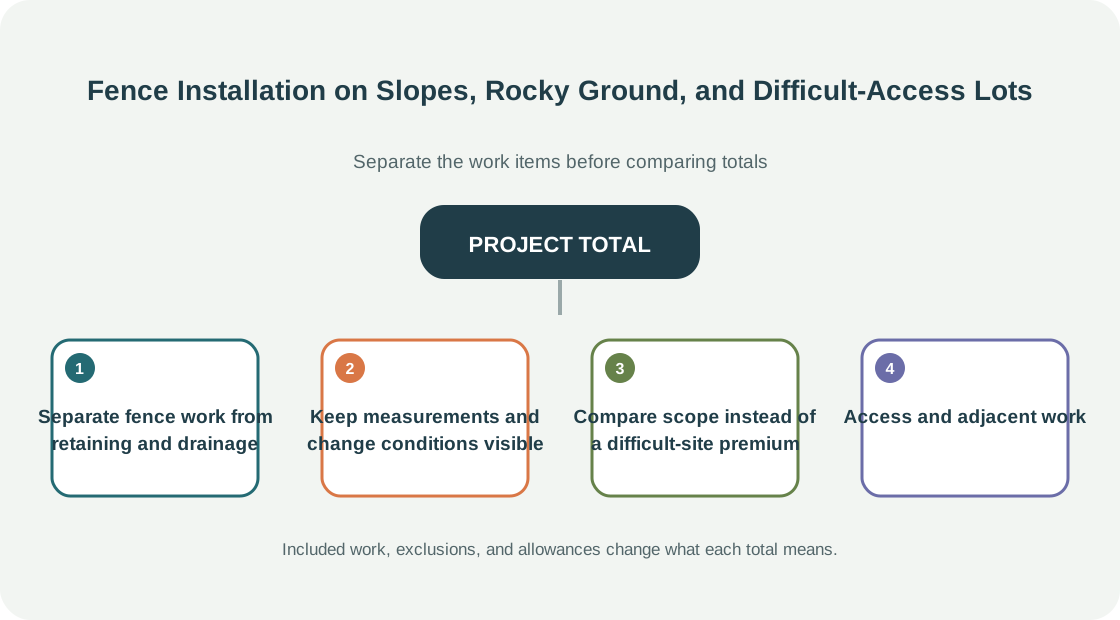
A fence on a slope can interact with a retaining wall, erosion, runoff, or a steep drop. The fence should not be used as a retaining structure unless it was designed for that role. If soil is moving or water is eroding the line, the site condition may need review by a qualified specialist before installation. Price the retaining or drainage project separately so it is not hidden in a fence allowance.
Gate locations deserve extra attention on difficult sites. A slope can affect swing clearance or slide path; a gate may need a level landing or a different location. Ask for the planned opening and travel path in the drawing and include any associated grading.
Keep measurements and change conditions visible
Use a simple site sketch with dimensions, corners, grade breaks, gate locations, retaining features, and access route. Ask bidders to reference the same sketch and identify quantities or conditions they could not verify. If the property line or exact fence height is not decided, price that as an open design question rather than allowing different assumptions into each proposal.
For uncertain excavation, ask whether the bid uses a per-post, per-hour, or defined allowance and what conditions trigger extra work. Require a description of how the contractor will document rock, buried concrete, or an obstruction before proceeding. A clear approval checkpoint can help the homeowner decide whether to continue, move the line, or revise the material choice.
Compare scope instead of a difficult-site premium
Current U.S. market sources identify leveling, site conditions, access, gates, length, and removal as cost drivers, but they do not establish a reliable universal surcharge for a rocky or sloped property. Compare bids by recording the same measured run, grade changes, excavation assumptions, access route, gate locations, removal, and restoration. Ask each bidder to identify the work they expect to perform and the conditions that would trigger a change.
If a quote contains a large contingency, request its reason and basis. If another bidder excludes the same uncertain condition, the lower price may simply have omitted it. A useful proposal says how the contractor will proceed if rock, roots, a retaining conflict, or an inaccessible section changes the work, and whether the owner can pause before the added cost is incurred.
Access and adjacent work
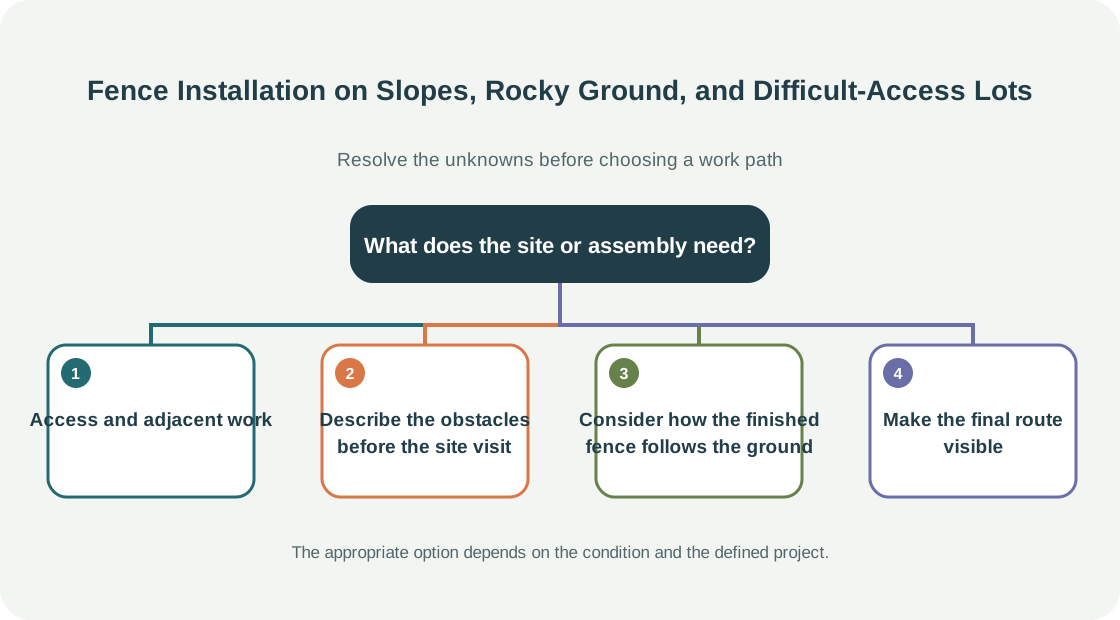
Restricted driveways, long carries, steep yards, stairs, fences, landscaping, and sensitive surfaces can affect mobilization and restoration. If grading, drainage, excavation, or retaining becomes an independent project, it belongs in the site-work scope and should not be hidden inside a linear-foot price.
Current market sources identify leveling, removal, length, gates, and site conditions as drivers, but do not establish a reliable universal difficult-site premium. Ask for contingencies and a written definition of what triggers them.
Describe the obstacles before the site visit
Share photographs and a simple site sketch showing slope, retaining walls, trees, rock, narrow passages, stairs, utility locations, and where materials can be unloaded. Tell the contractor how far materials must be carried and whether there is access from both sides. These details affect labor, equipment, spoil handling, and how sections can be assembled. They also help identify when a fixed online price is unlikely to apply.
A sloped lot can be handled with stepped panels or a fence that follows the grade, depending on the product and intended purpose. Ask the bidder to show the proposed bottom clearance, top line, and transitions. The layout can affect privacy, pet gaps, gate operation, and appearance. If the fence is also intended to serve a regulated barrier function, the design needs a separate jurisdiction-specific check; do not assume a general fence layout meets that use.
For rock or unknown soil, ask what is included in the base excavation assumption and how additional effort is measured and approved. A site contingency should say what triggers it and how the price changes. Likewise, clarify what happens if utilities, roots, or an existing wall prevent the planned post locations. This is more useful than an unexplained allowance that cannot be compared across proposals.
Consider how the finished fence follows the ground
A consistent top line can create varying space below a fence on a slope, while stepped panels can create a different appearance and more transitions. Ask the contractor to show a side view or marked section at the steepest part of the run. If the fence is meant to contain a pet, discuss gaps and changes in grade. If it is intended mainly for privacy, show which sight lines matter. Do not leave these choices to an unpriced field adjustment.
Where a retaining wall is present, clarify whether posts attach to the wall, sit behind it, or require a separate foundation. The wall’s condition and ownership may affect what is possible. Ask who evaluates the existing wall and who is responsible for any repair or reinforcement. Keep fence installation separate from retaining-wall design unless the bid explicitly includes both.
Make the final route visible
Ask the contractor to walk the full alignment with you before ordering materials. Confirm gate locations, changes of height, corners, and any area where posts cannot be placed as planned. If the route changes after materials are ordered, both quantity and appearance may change. Keep the agreed route in a sketch attached to the proposal.