
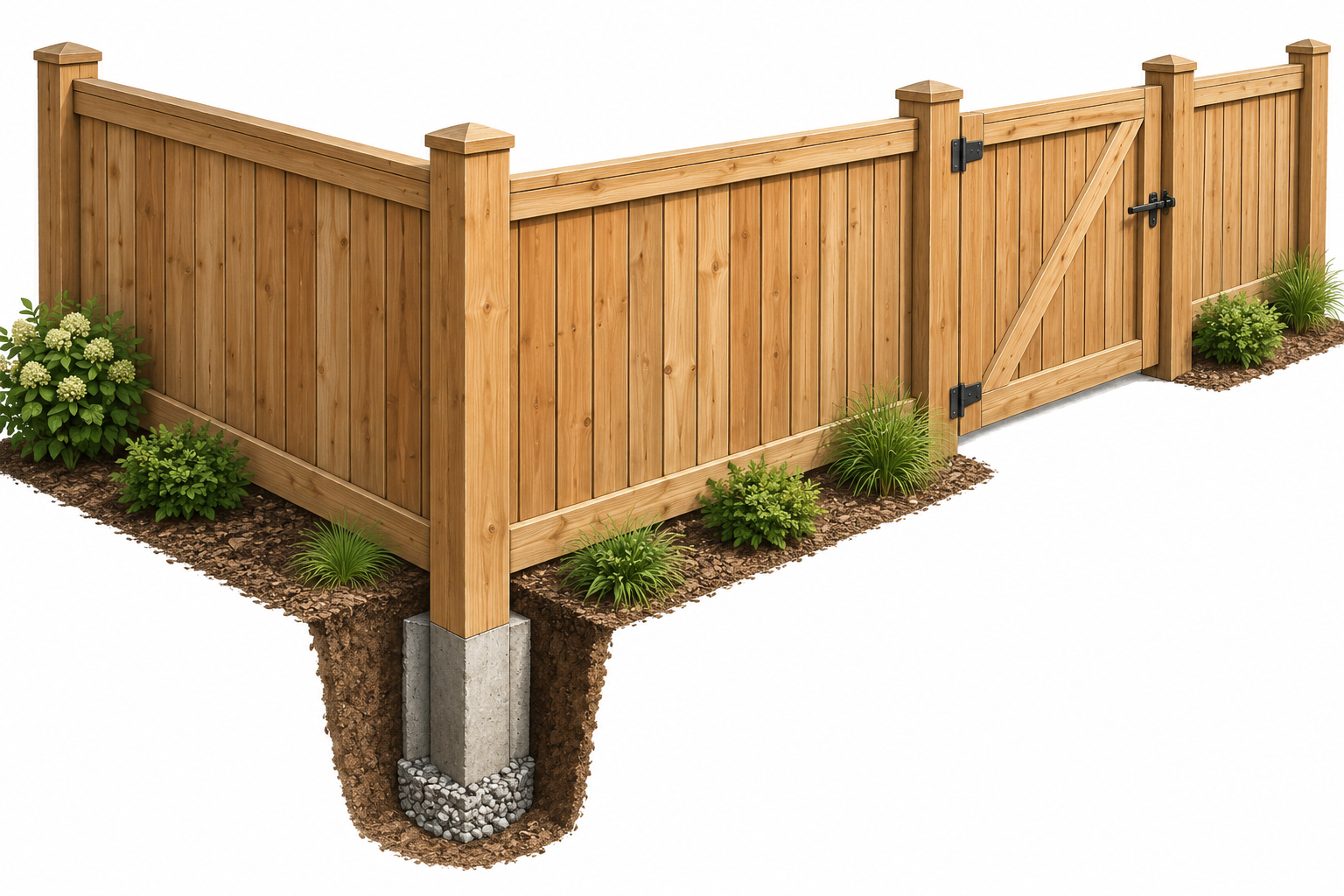
Posts often explain why a fence leans, sags, or fails after wind. Replacing one post can require removing attached panels, digging out concrete, working around roots or rock, and restoring the gate or corner geometry.
What the work may include
The quote can include temporary removal of panels, excavation, concrete or footing removal, a new post and support, reattachment, alignment, gate adjustment, disposal, access, and finish matching. Gate and corner posts may carry different hardware and loads from line posts, so do not assume one price applies to every position.
Angi and HomeAdvisor identify length, height, material, gates, leveling, removal, and site conditions as fence-cost drivers. Those sources do not establish a dependable installed price for an individual post. Ask for a site-specific allowance.
Soil and climate
Rock, roots, wet ground, slope, frost, buried utilities, and restricted access can dominate labor. Any footing or frost-depth prescription is jurisdiction- and configuration-specific; it should come from the responsible professional or authority, not a generic online rule.
One post or a system problem?
If several posts are leaning, decayed, or moving, compare section repair and full replacement. Also check whether panels, rails, gates, and the boundary layout remain worth preserving. A post repair that leaves a failing gate or adjacent posts may only delay the larger project.
Why the visible post is only part of the cost
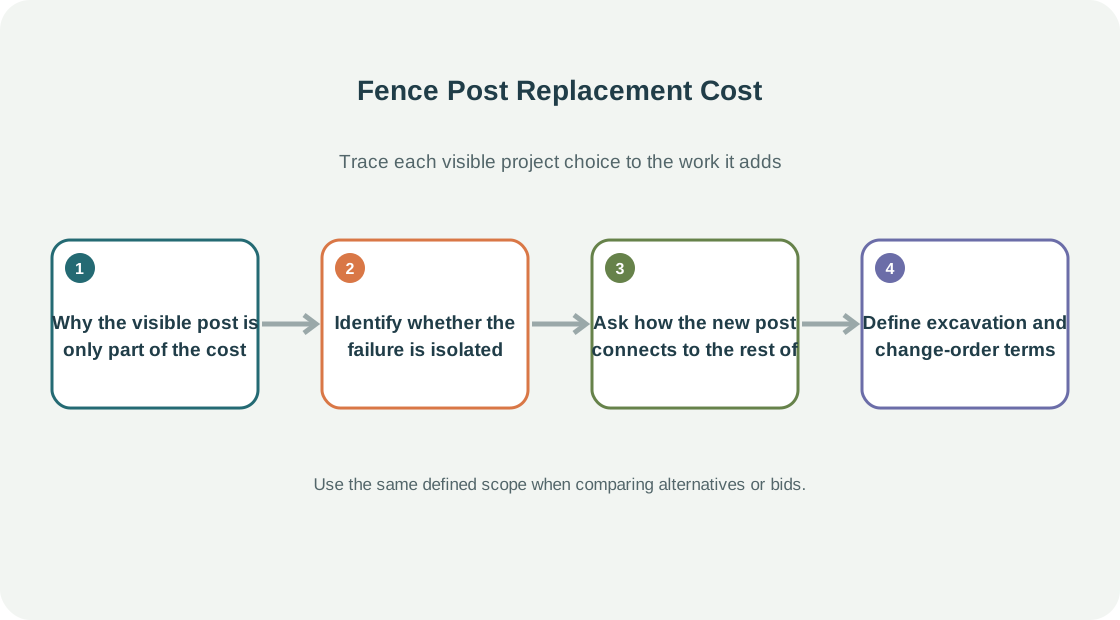
The post is connected to more than the soil. A line post may support one or two panel ends; a corner post changes direction; a gate post must also support hardware and repeated movement. Work can require temporary panel removal, clearing a work area, disconnecting rails, digging around roots or hardscape, breaking out concrete, installing a replacement, and reconnecting the fence. The material price is only one piece of that work.
Ask the bid to identify post type and location, how much fence is removed and reattached, whether concrete or old footing material is removed, how spoil is handled, and how the line will be aligned. A gate or corner post may require a different assembly from a line post, so ask for each position separately when more than one is involved. Clarify whether gate adjustment and latch alignment are included after the post is reset.
Identify whether the failure is isolated
One failed post with sound adjacent supports is a different decision from a run where several posts lean in the same direction. Ask the contractor to inspect connected panels, rails, gate, and neighboring post bases before pricing a single replacement. Soil movement, drainage, impact, corrosion, decay, and gate loading can all contribute to movement, but a visual estimate may not establish the cause.
If several supports are affected, compare the cost of repairing them with replacing the section. Include the value of a straighter layout, updated gate hardware, and any boundary changes, but do not assume replacement will solve a drainage or soil problem unless that work is part of the plan.
Ask how the new post connects to the rest of the fence
The replacement needs to align with the existing run, panel spacing, gate, and corners. Ask whether the contractor will temporarily remove panels or rails, adjust adjacent posts, reset the gate, and restore the line. A post can be plumb while the fence still binds or leaves an uneven gap if the attached components were not checked.
If a contractor proposes adding a post beside the old one or bracing it, ask which condition the alternate method addresses and what remains buried. Those methods are not automatically interchangeable with replacement. Get the proposed outcome, materials, and limitations in writing.
Define excavation and change-order terms
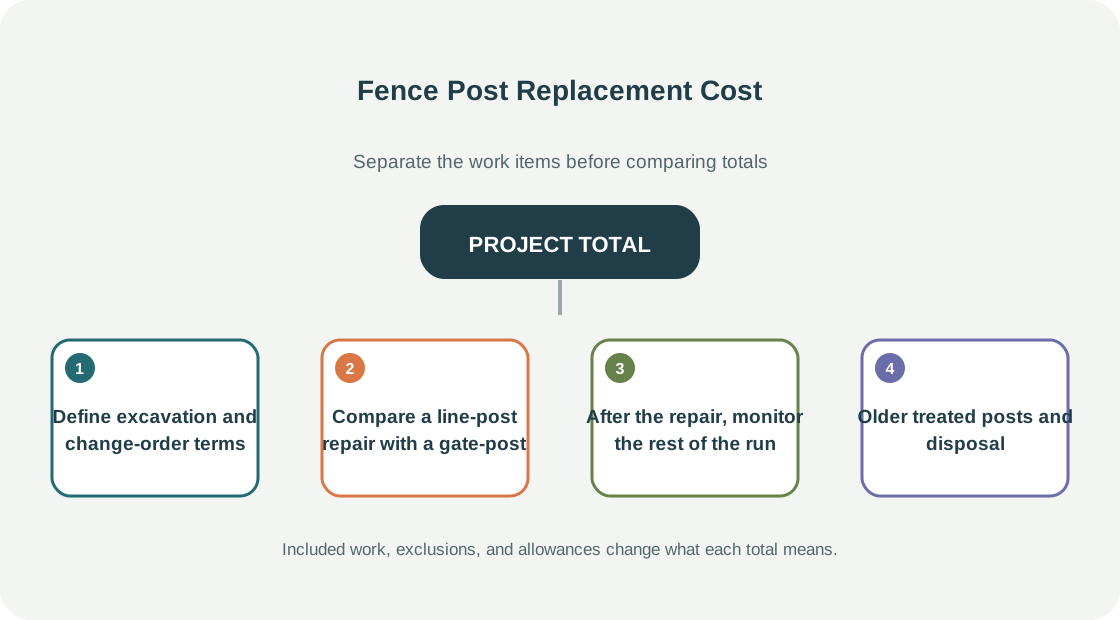
Before work, identify known utilities and features near the post, including irrigation, lighting, paving, roots, and retaining walls. Ask who obtains utility locates where required and who is responsible for damage to adjacent surfaces. The quote should say whether concrete removal, spoil disposal, new concrete, and landscape repair are included.
If the soil or old footing is unknown, establish a change-order trigger: what the contractor will document, how additional excavation will be priced, and whether the owner can pause the work. A clear method helps compare bids and prevents a low initial figure from hiding uncertain excavation.
Compare a line-post repair with a gate-post project
A line post typically supports fence sections, while a gate post also supports hinge and latch forces and must keep the opening aligned. Ask whether the failing post is at a corner, terminal, or gate and whether adjacent posts are stable. A quote to replace a gate post should identify gate removal, rehang, hardware adjustment, and any change to the clear opening.
If the opening is being widened or the gate becomes heavier, the work may require more than replacing like for like. Identify those changes before pricing and ask the professional to confirm the support strategy. A generic per-post price cannot cover all configurations.
After the repair, monitor the rest of the run
Ask what condition should prompt follow-up if adjacent fence sections continue to lean or the gate binds again. Keep the repair location, materials, and warranty information. A new post may correct the local issue, but recurring movement can reflect site or drainage conditions that need another evaluation.
Older treated posts and disposal
Older wood posts can be difficult to identify once weathered or partly buried. Health Canada says Canadian residential fences built before 2004 are likely to contain CCA-treated wood and advises minimizing exposure to damaged or deteriorating material. The U.S. EPA’s guidance is separate: it does not require blanket removal of existing CCA structures, recommends minimizing dust during handling, advises against home burning or reuse as mulch, and points to local disposal requirements.
If treatment is unknown, ask the contractor how excavated and cut material will be handled, whether disposal is included, and which local authority’s directions apply. The evidence does not identify the treatment of an individual post or establish that an intact fence should be removed. Define the work and disposal route before excavation.
Compare replacement and reinforcement proposals carefully
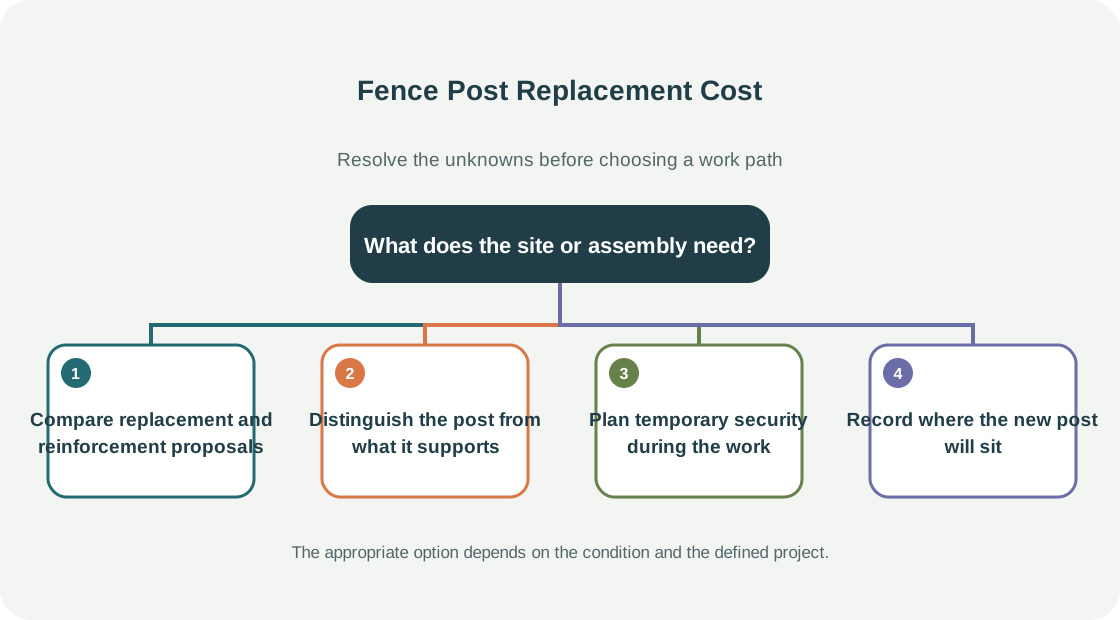
If one contractor proposes replacing a post and another proposes bracing or reinforcing it, ask each to explain the condition being addressed, what remains in place, and how the gate or panels will perform afterward. These are different scopes, not automatically equivalent methods. Have the responsible contractor or qualified professional explain any structural basis and product limitations; a homeowner cost guide cannot select a repair detail for particular soil and fence conditions.
Distinguish the post from what it supports
A post replacement may require temporarily supporting attached rails and panels, removing nearby sections, excavating the old base, setting a new post, and reconnecting the fence. Ask whether the price includes the panels and rails that must be detached and reset. A per-post figure can be misleading if access differs from one location to another or if several connected sections need adjustment.
Ask how the contractor evaluates the failed post and adjacent ground. Rot near grade, loose soil, drainage, impact, and movement can each call for different work. The old post may conceal damage in attached rails or neighboring posts. A bid should state its assumptions about soil, buried obstacles, post type, and disposal, and describe how unforeseen conditions will be documented and approved.
For a wood fence, treated-wood handling depends on the product and age. Older structures may contain chromated copper arsenate (CCA) treated wood; Canadian and U.S. authorities provide specific precautions for CCA. Do not burn old treated pieces or reuse them as mulch. Ask the contractor how removed material will be handled and check local disposal guidance. The presence of an old post does not by itself prove a specific treatment, so avoid assumptions if its history is unknown.
Plan temporary security during the work
Replacing a post can leave a temporary opening or an unsupported panel while concrete or another base cures. If the fence contains pets or secures a yard, tell the contractor and ask what temporary barrier or sequencing is included. Confirm how long the opening will remain and whether another visit is needed to reconnect or adjust the fence. A temporary solution may need to be priced separately from the permanent repair.
For several failed posts, ask whether the work is priced by location or as a continuous section. Multiple replacements may make resetting rails and panels more efficient, but access and ground conditions can differ at each post. A location list with photographs helps the estimate show which posts are included and makes a later change request easier to evaluate.
Record where the new post will sit
Ask for a marked location and confirm it remains on the intended fence line before excavation. The contractor can work from agreed instructions but should not be expected to determine a legal boundary. If the post is close to a utility, retaining wall, or paving edge, identify that constraint before digging and clarify who arranges utility locating or other checks.