
“Deck repair” can mean replacing a few boards, correcting a leaning stair, rebuilding a guard, repairing a ledger connection, or opening up much of the supporting frame. The visible defect is not enough to price the work safely.
Translate a symptom into a priced scope
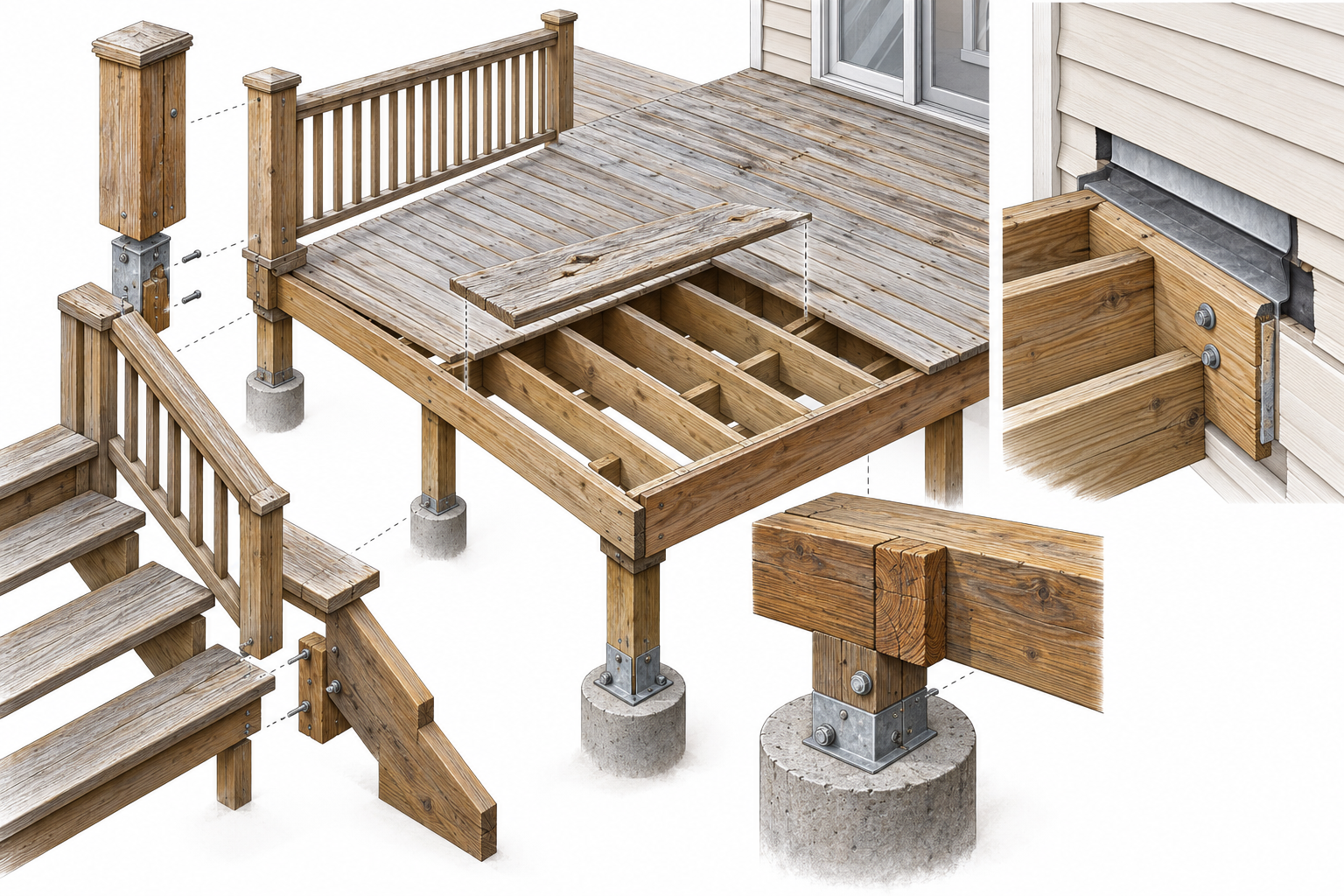
When requesting a repair estimate, name the symptom and the location separately. “One loose board near the stairs” is more useful than “deck needs work,” but the contractor still needs to determine whether the board, fastener, joist, or stair transition is involved. “Guard moves at one corner” should prompt a look at the post connection and framing rather than an assumption that the rail itself needs tightening.
Ask for a written description of the condition observed and the components to be repaired. If a surface must be opened, ask whether the quote includes that work and what condition would trigger a change. The estimate should distinguish a known quantity from an allowance for concealed damage. This helps the owner decide whether to approve a limited repair, pay for a broader inspection, or compare replacement.
Compare the complete service, not one material line
For a spot repair, include travel or minimum service charge, removal, material matching, fasteners, finish, cleanup, and access. For work under the deck, include opening and restoring surface boards or skirting. For a house connection, include wall access and weather protection. For stair or guard work, include transitions and attachment. These scope elements often explain more of the total than the price of the replacement board or post.
If two bids differ, ask each contractor to describe what they believe is damaged and what they intend to leave in place. A smaller quote might be a valid narrow repair or might omit access and restoration; a larger quote might include broader replacement than necessary. A second opinion or independent inspection can help when the project involves structure, movement, or an unclear cause.
Use a repair decision point
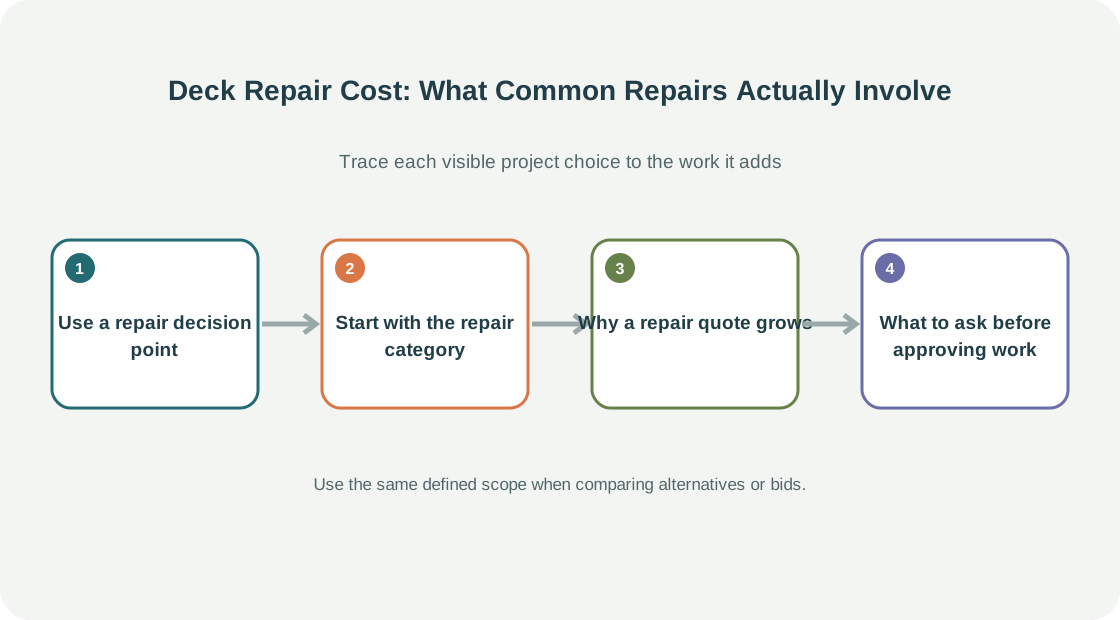
Agree in advance how the work pauses if demolition exposes a different condition. The proposal can define an approval threshold, require photographs, and price additional work separately. This is more informative than approving an open-ended allowance. If the scope grows to include multiple supports, widespread surface replacement, or the house connection, compare the revised total with a coordinated repair or rebuild.
Avoid a universal repair percentage. A small amount of work at a consequential connection can deserve more evaluation than a larger amount of cosmetic board replacement. The choice depends on the component, condition, intended use, and remaining uncertainty.
Start with the repair category
- Surface work: boards, fascia, trim, finish, and isolated fasteners.
- Rails and stairs: damaged components, posts, handrails, guards, treads, landings, or their attachments.
- Framing: joists, beams, posts, bases, or footings affected by decay, movement, corrosion, or settlement.
- House connection: ledger, flashing, wall access, and moisture-management work.
- Project logistics: demolition, disposal, difficult access, temporary support, design, engineering, and approvals.
The American Wood Council’s guide presents a deck as a connected system of footings, posts, beams, joists, decking, ledger, guards, stairs, and connections. NADRA’s evaluation guide likewise treats movement, decay, framing, supports, fasteners, stairs, guards, and drainage clues as inspection subjects.
A continuous walking-surface membrane is a different repair scope from replacing spaced deck boards. The evaluation may need to address the membrane, drains, edges, penetrations, substrate, and its connection to the wall; a board or framing allowance does not price a compatible membrane patch or renewal. Ask a qualified provider to identify the assembly and explain what can be assessed before finishes are removed.
Why a repair quote grows
Removing boards or finishes can reveal concealed decay. A repair may also require matching discontinued material, opening siding to reach a connection, replacing multiple posts instead of one panel, or bringing stairs and guards into the same scope. Small jobs can carry minimum service charges and access costs.
Current research does not establish a reliable national price for each repair unit. Use market figures as broad context and insist on an itemized scope. A precise per-board or per-post promise can be less useful than a clear allowance for inspection, demolition, hidden conditions, and restoration.
What to ask before approving work
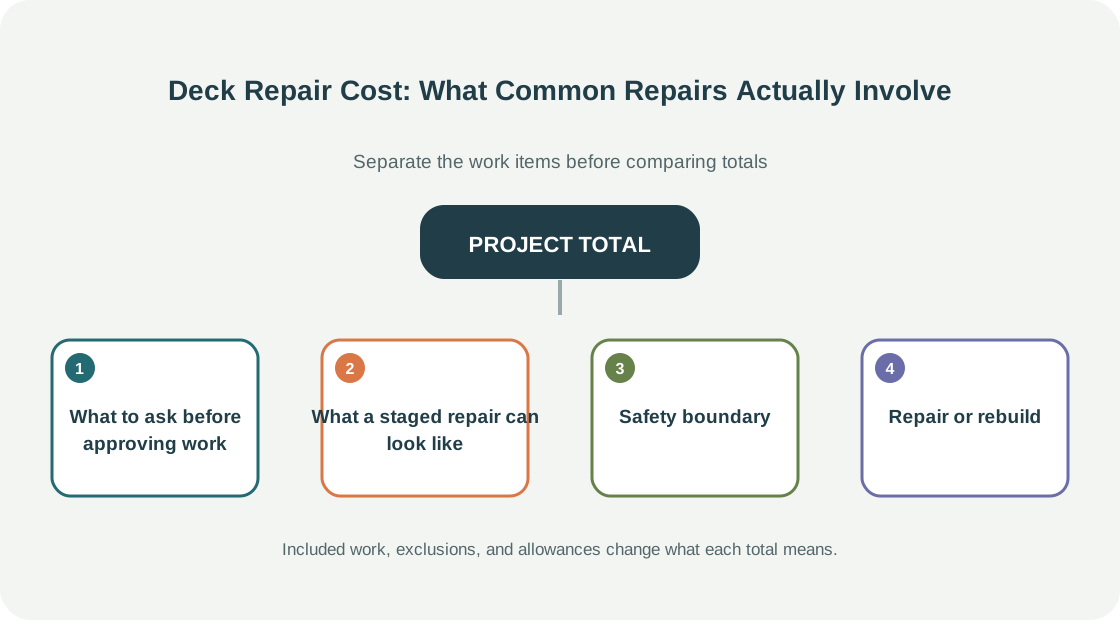
Ask what was inspected, what was not visible, which components are being repaired, how the repair connects to sound existing material, and what would trigger a larger scope. Ask whether the quote includes temporary support, disposal, flashing, finish matching, stairs, rails, permit or engineering allowances, and cleanup.
What a staged repair can look like
For an isolated board problem, a contractor may remove the surface around the defect, inspect the exposed support, replace the board, and restore finish. For a moving guard, the work may need to reach the post connection and deck edge. For a ledger concern, the proposal may need wall access, water protection, connection work, and exterior restoration. The sequence and cost differ because each job reaches a different part of the structure.
Ask the contractor to state which scenario matches the observed condition and what would change that conclusion. If the repair grows after opening the deck, request photographs and a revised scope before authorizing additional work. This gives the homeowner a decision point between a targeted repair, an inspection, and broader replacement.
Safety boundary
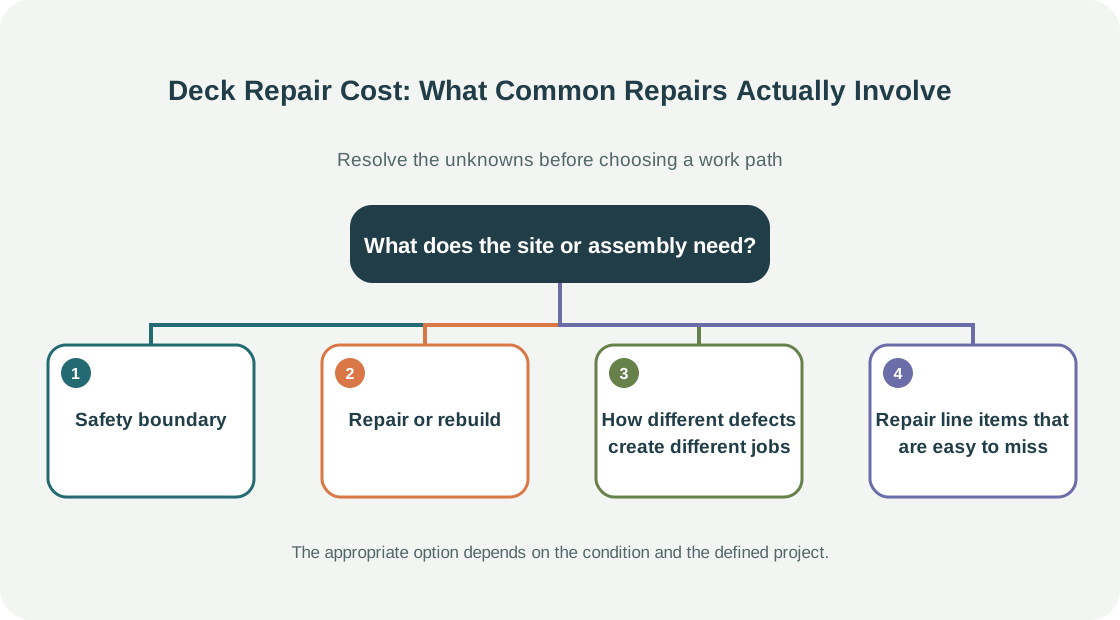
Do not treat a deck as safe because it looks stable, or unsafe solely because one board is weathered. Movement, decay at connections, a damaged guard, a leaning post, or a suspected ledger problem warrants qualified evaluation before continued use or repair planning. Structural repair details and load decisions belong to a qualified professional familiar with the property and applicable requirements.
Repair or rebuild?
Repair is easier to justify when deterioration is localized, the supporting system is sound, the material can be matched, and the repair will not leave incompatible or recurring defects. Replacement becomes more plausible when posts, beams, connections, stairs, or multiple areas have problems, or when the desired layout and materials would require extensive reconstruction. Compare the total future scope, not just today’s smallest line item.
How different defects create different jobs
A worn walking surface can lead to board replacement or resurfacing if the supporting frame remains suitable. A loose guard may require access to its posts and their attachment rather than simply tightening the visible rail. A stair that shifts can involve its stringers, landing, connection to the deck, and handrail. A wet area near the house can point to a ledger or flashing question that is different from a stain on a deck board. These are different scopes and should not be collapsed into one generic “deck repair” allowance.
When you request a quote, describe what changed, where it is located, and whether it is getting worse. Include photos from several angles if they can be taken safely, but do not expect photographs to establish structural condition. Ask the contractor to identify which components were inspected and which remain concealed. If a contractor cannot see a connection or footing, the proposal should say whether opening it is included and what happens if the condition differs from the assumption.
Repair line items that are easy to miss
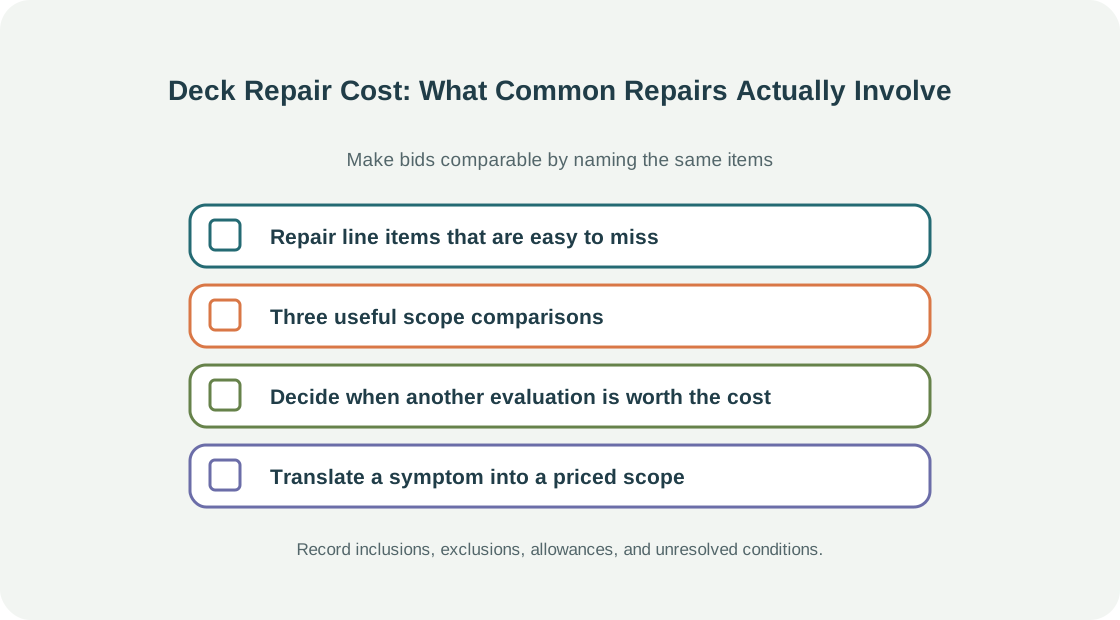
The cost of a repair can include diagnosis and setup before a replacement part is installed. Depending on the job, the quote may need to account for removing boards to reach framing, temporary support, taking down and reinstalling a guard, disconnecting stairs, removing trim, opening siding, hauling old material, and restoring finish. Access and restoration can exceed the cost of the lumber or fastener being replaced.
Ask bidders to separate direct repair work from associated work and allowances. For example, a ledger repair may need wall access and flashing restoration; a post repair may need excavation and landscape repair; a stair repair may need a landing or rail modification. These examples are not repair prescriptions. They help ensure that the quote covers the complete route to a usable finished deck.
Three useful scope comparisons
If the issue appears limited to the surface, compare a spot repair with resurfacing and state what evidence supports keeping the frame. If structural parts are affected, compare the specific component repair with the broader section that would be disturbed to access it. If multiple areas show damage, price the observed repairs together and ask whether an inspection or design step should precede construction.
Use the same footprint, access, stairs, guards, material, demolition, disposal, and finish assumptions when comparing estimates. Ask each bidder to identify the location and quantity of proposed work, not just a total. If one bid includes temporary support or restoration and another does not, the totals are not yet comparable. A documented allowance can help when concealed conditions are unavoidable, as long as it identifies the trigger and approval process.
Decide when another evaluation is worth the cost
A contractor estimate can be appropriate for straightforward, visible maintenance. A system-level inspection or structural engineering opinion may be useful when there is movement, a questionable house connection, multiple failing supports, a major change in use, or a proposed roof, enclosure, or other new load. Those services have different scopes and qualifications; ask what deliverable you will receive and whether it answers the decision you need to make.
The goal is not to inspect every deck for every small cosmetic issue. It is to avoid pricing structural work as surface work or paying for broad replacement when a problem may be isolated. A good repair estimate explains the observed defect, the work that reaches it, the conditions that remain unknown, and the point at which the owner should reconsider the scope.