
Deck age is a poor standalone replacement rule. The better question is whether the existing structure can support a responsible, durable repair and whether that repair fits the homeowner’s next several years of use.
Choose a realistic comparison horizon
The relevant time horizon is how long the owner expects to use the deck and whether its layout still works, not an assumed universal service life. If a homeowner expects to move soon, immediate disruption and visible condition may matter most. If the household plans to stay, recurring repair access, maintenance, and future features may matter more. Do not assign a specific number of future years to components that have not been evaluated.
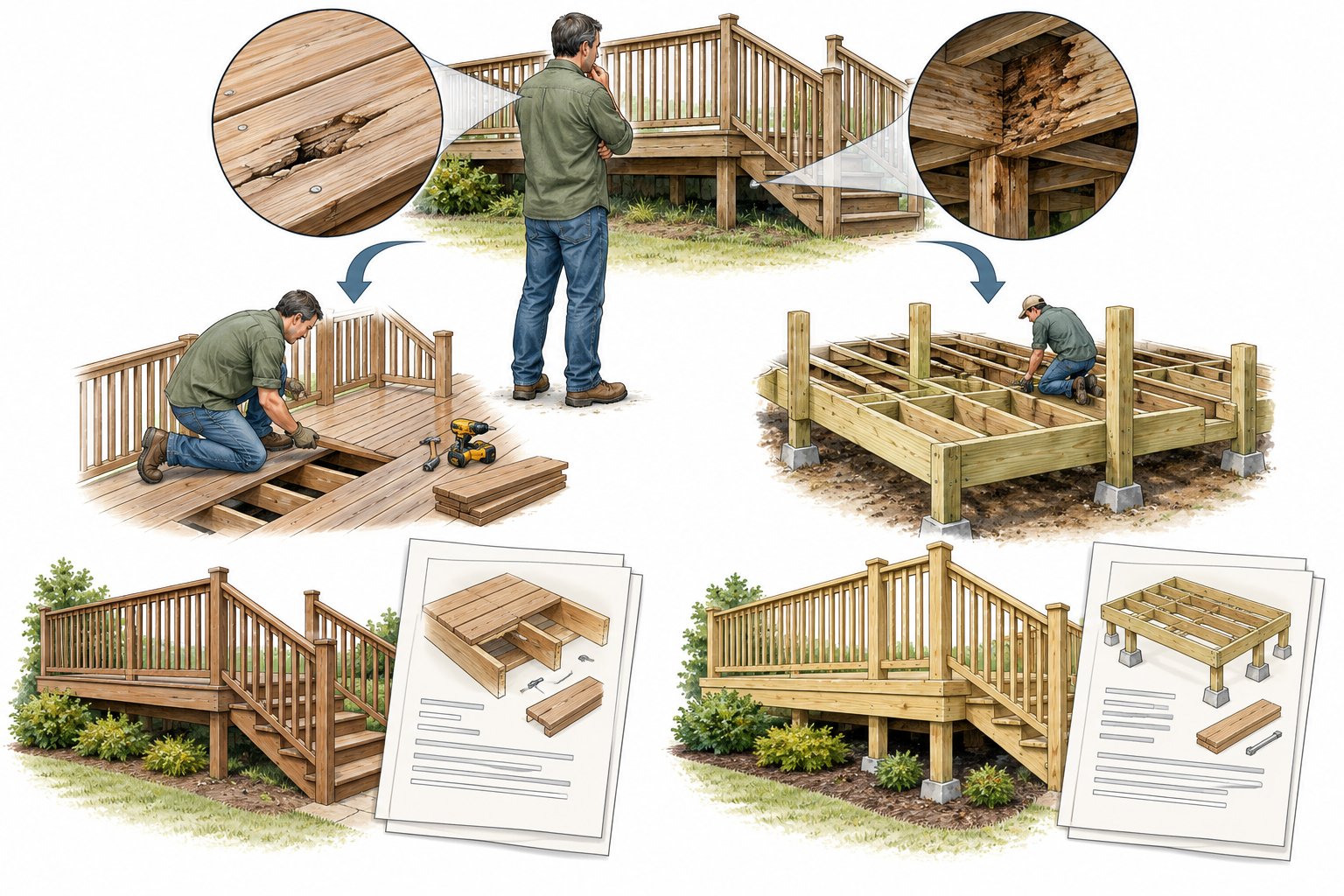
For the repair path, list the immediate scope and the parts left untouched. For replacement, include demolition, disposal, site restoration, and approval work. If a new surface requires framing changes, include them in the resurfacing or replacement price. Consider how long the deck will be unavailable and whether stairs or an entrance must be rerouted during work.
A short example of scope normalization
Suppose one contractor quotes new decking and another quotes a complete rebuild. The totals do not answer the repair-or-replace question until both identify the same footprint, board product, stairs, guards, access, demolition, disposal, and finish. Ask the resurfacing bidder what evidence supports keeping posts, beams, footings, and the house connection. Ask the rebuild bidder which condition makes retaining them unsuitable. Then compare the added cost of the frame work against the value of a new layout or system.
This is not a formula that proves one bid is right. It exposes the assumptions that drive each option and identifies what further inspection may be worthwhile before signing.
Avoid decision shortcuts
Deck age, a percentage of damaged boards, or a contractor’s general statement that a structure is “old” is not enough by itself. A single visible defect may be localized; several subtle symptoms may point to a larger issue. Ask what was inspected and which areas remain inaccessible. If the deck moves or a guard or connection is compromised, safety evaluation takes priority over comparing cost totals.
Conditions that favor repair
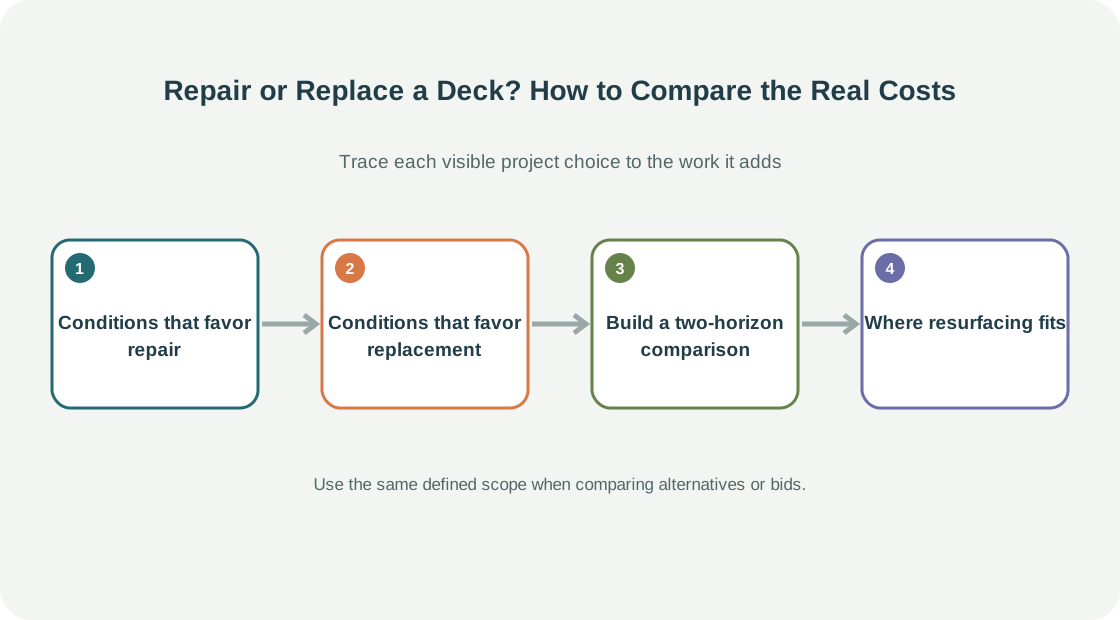
Repair is more plausible when the problem is localized, the footings and supports are sound, connections are serviceable, the remaining framing can be inspected, and the replacement material can be matched. A surface-only project may make sense when the frame is suitable for the chosen decking system and no stair, guard, or house-attachment issue is being hidden.
Conditions that favor replacement
Replacement deserves serious comparison when deterioration is widespread, several structural components are affected, connections are obsolete or unreliable, repairs have become recurrent, the layout no longer works, or opening one area is likely to expose problems throughout the frame. Replacing the visible boards does not solve an unsound ledger, footing, beam, post, or guard attachment.
If the project is in a U.S. mapped flood-hazard area, add coverage and local approval as separate questions. FEMA’s June 2025 National Flood Insurance Program claims guidance distinguishes exterior decks and patios from qualifying porch additions; the structure’s label or attachment alone does not determine coverage. Check the actual policy and claim facts with the insurer, then ask the local floodplain administrator what current requirements apply to the proposed repair or replacement. This federal guidance does not determine coverage under another policy or in Canada.
Build a two-horizon comparison
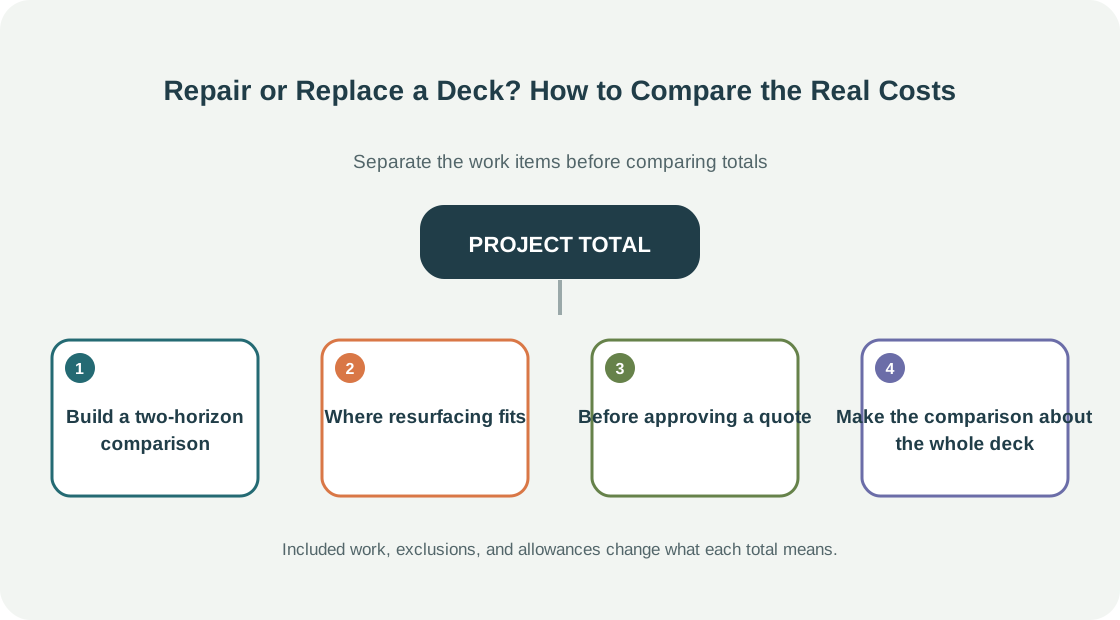
Compare the immediate repair with a replacement over a realistic ownership horizon:
- Add inspection, demolition, access, temporary support, disposal, restoration, and approval costs to the repair.
- Note which repaired components remain old and may need attention next.
- Price the replacement with the same stairs, guards, finishes, access, and site work.
- Include disruption, usable time, maintenance, and the value of changing the layout now.
There is no defensible universal age or percentage-damage cutoff. NADRA’s checklist supports evaluating the deck as a system, including movement, decay, supports, connections, stairs, guards, and drainage clues. Use that kind of evaluation rather than a formula based only on years or visible surface area.
Where resurfacing fits
Resurfacing can be a middle option when the frame is genuinely suitable and the new decking system’s support, fastening, and exposure requirements are satisfied. It is not a shortcut around inspection. Removing boards may reveal hidden decay or change the scope.
Before approving a quote
Ask which parts were inspected, which are concealed, what evidence supports reuse, and what conditions would change the price. Get separate line items for surface, rails, stairs, framing, house connection, foundations, demolition, disposal, finishes, design, and permits. A qualified professional should address structural safety and any temporary-support or load question.
Make the comparison about the whole deck
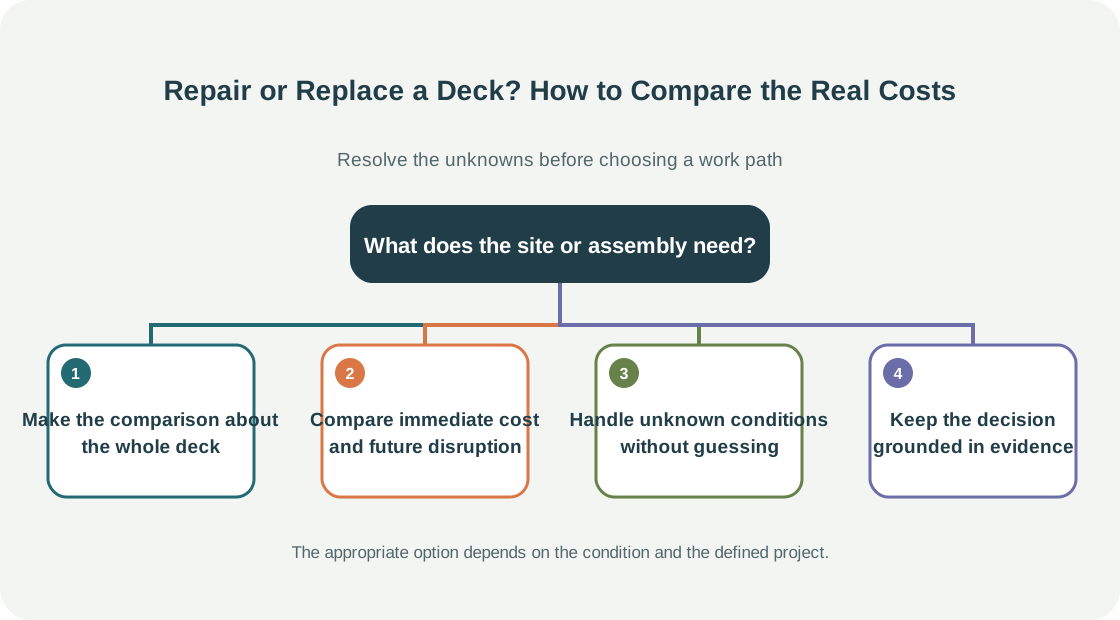
Start with an inventory, not a percentage. Note the condition of the walking surface, railings, stairs, posts, beams, joists, footings, house connection, and drainage. Record which parts are known to be serviceable, which need repair, and which have not been inspected. A deck with widespread surface wear and a suitable frame may be a candidate for resurfacing; a deck with movement at multiple supports or an unresolved attachment problem needs a broader structural decision.
| Decision factor | Repair may fit when | Replacement deserves comparison when |
|---|---|---|
| Distribution of damage | Defects are limited and surrounding parts remain sound. | Several areas show related movement, decay, corrosion, or failed connections. |
| Frame and foundations | A qualified evaluation supports retaining them for the proposed use. | Supports or footings are uncertain, damaged, or unsuited to the planned design. |
| Surface system | A compatible repair material is available for the existing structure. | Matching parts are unavailable or the selected system requires broad framing changes. |
| Future plans | The footprint, access, and features still work. | The homeowner wants a different layout, stairs, cover, access, or use. |
| Remaining uncertainty | Concealed areas can be inspected or priced with a defined contingency. | The estimate depends on extensive assumptions about hidden conditions. |
The table organizes evidence; it is not an automatic verdict. An isolated defect can still require major work if it affects a critical connection. Multiple cosmetic defects do not prove that the underlying structure must be replaced. A qualified inspection should separate visible condition from structural conclusions.
Compare immediate cost and future disruption
For the repair option, list today’s work and the components that will remain. Include inspection, demolition, access, temporary support where appropriate, disposal, restoration, and the cost of matching material. Then list follow-on work only when it is supported by observed condition or a qualified assessment; do not invent a replacement schedule for parts that were not evaluated.
For replacement, define the same footprint, elevation, access, stairs, guards, finishes, and site assumptions. Add the value of a changed layout only if the homeowner wants that change. Replacement can involve demolition, hauling, excavation, landscape restoration, and approval work that a surface-only proposal may omit. Compare disruption and access to the home along with the bid total.
The two options may rely on different technical assumptions. Resurfacing retains the frame and may fit only if its condition and the selected product’s installation requirements are suitable. Full replacement may address widespread deterioration but still depends on site, foundation, drainage, and approval decisions. Ask the bidder to state what is included instead of describing one path simply as “repair” and the other as “new deck.”
Handle unknown conditions without guessing
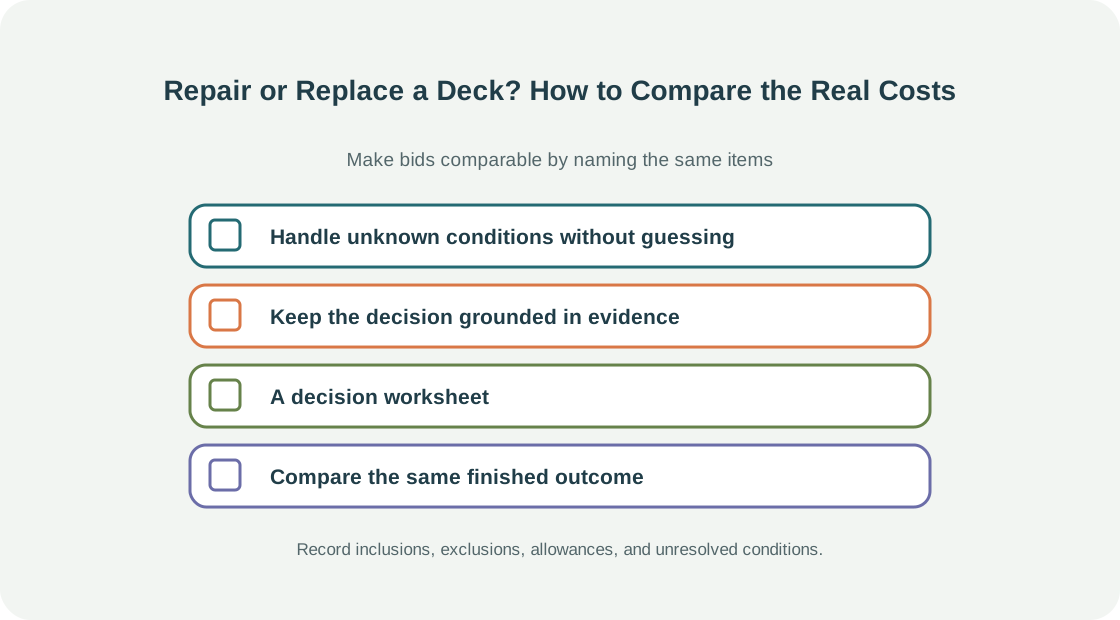
If the deck has not been opened or the ledger and footing condition is unknown, ask what evaluation can reduce uncertainty before making a large commitment. If demolition is the only way to see a component, ask for a written unit or change-order method and owner approval before extra work. A broad contingency is useful only when the trigger, decision authority, and price basis are understandable.
Deck age can be context for planning an inspection, but it is not a universal replacement threshold. Material, exposure, construction, maintenance, and repair history differ. A fixed percentage rule can also miss important differences: a small repair to a critical connection and many cosmetic board replacements are not equivalent risks.
Keep the decision grounded in evidence
The strongest comparison records what was observed, what was inspected, and what remains unknown. A quote can support a cost decision but should not be treated as an independent safety certification. If the two paths depend on different assumptions about the ledger, supports, or footings, resolve that difference before comparing totals.
A decision worksheet
Before choosing, answer these questions with the contractor or evaluator:
- What is visibly damaged, and what is concealed or not yet assessed?
- Is the house attachment, support system, and foundation included in the evaluation?
- What exact parts will remain after the repair, and why are they suitable?
- Does the selected surface or railing require changes to the retained frame?
- How do demolition, removal, access, stairs, rails, finish, and restoration compare?
- What project changes would trigger additional work, and who approves it?
- Which future features—cover, enclosure, hot tub, or layout change—should be decided now?
If those answers are missing, the next step is usually better scope definition rather than selecting a contractor from headline totals. When safety, structural adequacy, or temporary support is in question, use a qualified professional for that decision.
Compare the same finished outcome
A repair estimate and a replacement estimate should describe what will be usable afterward. For repair, list each area being corrected and whether the contractor will match or replace the surface finish. For replacement, list demolition, disposal, the new frame or retained supports, stairs, rails, and the finish. If one option restores only the walking surface while the other includes a new guard and stairs, compare those outcomes separately before deciding from the total.
The timing of work also matters. A repair may be a short-term choice when a larger project is planned, but repeated work on separate visits can add mobilization and make finish matching harder. Replacement may involve approvals, design, and a longer disruption. Ask each contractor to identify which assumptions could change the recommendation, such as a concealed connection defect, unsuitable existing support, or an approval requirement. The estimate should leave those as explicit contingencies rather than silently treating the visible condition as the whole deck.