
An inspection is useful when a homeowner needs to understand condition before buying, repairing, resurfacing, changing loads, or continuing to use an aging deck. It is not the same as a contractor estimate, a structural-engineering design, or a safety certification.
What should be examined
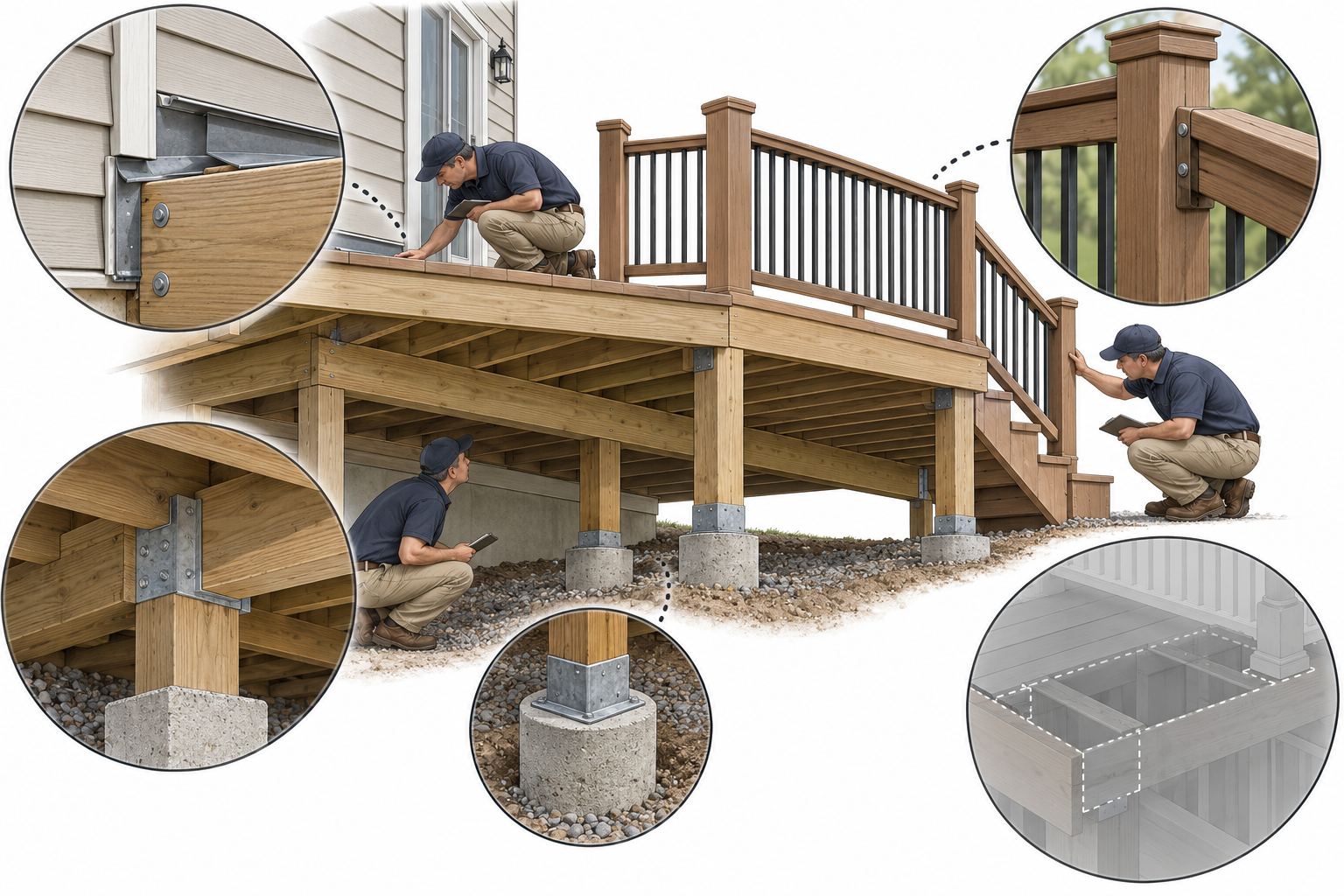
A system-level evaluation should consider the house connection or ledger, flashing and water-management clues, joists and beams, posts and footings, fasteners and connectors, decking, stairs, landings, rails and guards, visible movement, decay, corrosion, and access to concealed areas. NADRA’s guide uses this kind of component checklist to identify reasons for qualified follow-up.
The American Wood Council’s deck guide is helpful for understanding component relationships and load paths in its stated prescriptive U.S. context. It does not authorize a conclusion about a particular deck, current local code, or Canadian applicability.
Inspection versus engineering
A deck inspector or qualified contractor may document visible condition and recommend repairs. A structural engineer may be needed when load capacity, unusual framing, major movement, a new roof or enclosure, a ledger redesign, foundation movement, or temporary support is involved. The qualifications and scope of these services vary by jurisdiction and provider.
General home inspection and statutory programs are different scopes
A general home inspection may include a deck as part of the property site, but Canada’s federal consumer guide describes it as typically visual and non-invasive, limited to areas the inspector can see or access. It is not automatically a deck-specific structural assessment, an evaluation of concealed membrane or framing conditions, or a repair estimate. Before booking, ask what deck components the contract covers, what access is available, and what the written report will deliver.
Some jurisdictions also have separate periodic inspection laws for qualifying multifamily buildings. California, for example, has different statutory programs for qualifying multifamily rental buildings and condominium projects. Applicability depends on the building and the responsibility for maintaining the affected elements; these laws are not a general inspection rule for every single-family deck. Ask the association, property manager, or relevant local authority who coordinates any required program.
What changes the price
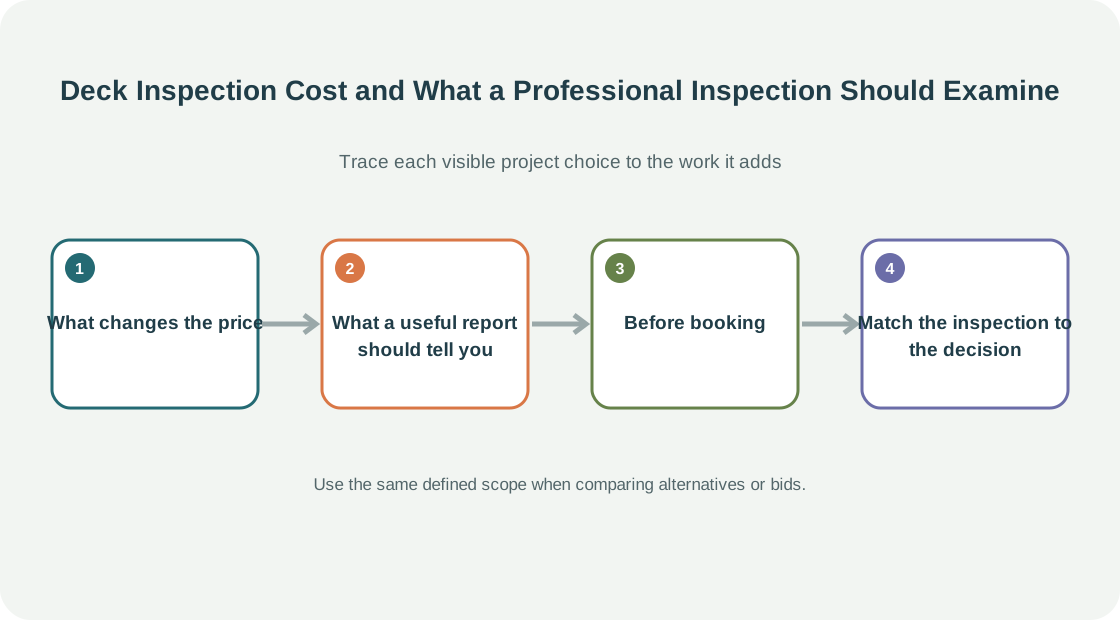
Inspection pricing depends on deck size and height, access, stairs and multiple levels, the amount of concealed structure, travel, documentation, and whether a written report or engineering opinion is requested. Current evidence does not establish a reliable national inspection fee. Ask whether the price covers only a visual review or includes opening finishes, measurements, calculations, drawings, or follow-up.
What a useful report should tell you
Look for a clear description of inspected and inaccessible areas, observed conditions, urgency, recommended next evaluation, repair-versus-replacement implications, and limitations. A report should not claim that photographs or one symptom prove structural safety.
Before booking
Explain why the inspection is needed—purchase, repair, resurfacing, added roof, storm damage, or continued use—and ask who is qualified for that scope. If a defect suggests collapse or fall risk, keep people off the affected area until an appropriate professional evaluates it.
Match the inspection to the decision
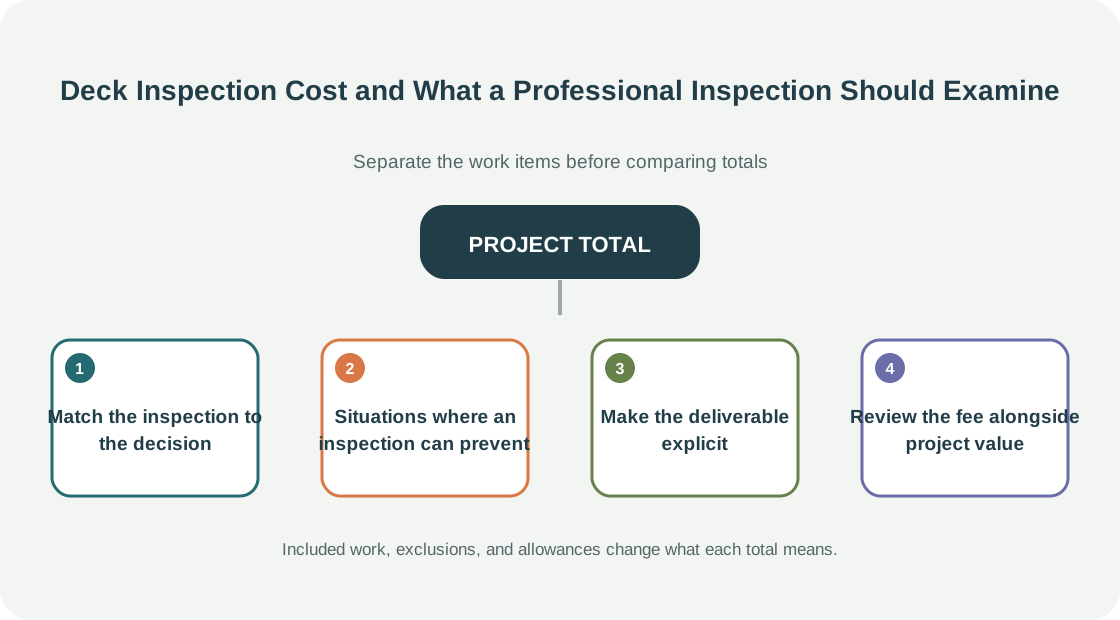
An inspection is most useful when the homeowner can state what decision depends on it. A buyer may want to know what needs attention before purchase. An owner considering resurfacing may need evidence about the frame and house connection. A project adding a roof or enclosure may need a structural evaluation beyond a visual condition report. After a storm or impact, the question may be whether visible movement has affected other supports. These scopes are related but do not produce the same deliverable.
Before booking, ask the provider to describe the areas examined, access limitations, report format, exclusions, and whether the service includes measurements or photographs. Clarify whether the provider will inspect only visible components or whether limited disassembly is included. If opening a finish requires owner authorization, ask how that affects the findings. A report based on inaccessible framing should say so rather than imply that every connection was verified.
Situations where an inspection can prevent wasted work
Before resurfacing, a qualified inspection can help determine whether the visible surface is the only issue and whether a proposed new board system fits the frame. Before adding a cover, screen wall, or hot tub, the decision may require structural input beyond ordinary repair estimating. During a home purchase, an inspection may identify areas that need follow-up; it should not be represented as a guarantee that no concealed problem exists.
The service is also useful when several bids disagree about the same symptom. Ask the evaluator to describe the observed condition and identify which repair decisions remain open. An independent scope can help contractors price a shared problem instead of each bidding a different assumption. Make sure the evaluator’s qualifications and independence are suitable for the question.
Make the deliverable explicit
Ask whether the provider supplies a written report, photographs, a component list, an urgency ranking, and recommendations for next steps. Clarify whether they will measure the deck, review prior plans, inspect the attachment from inside or outside, or return after repairs. These are not automatically part of a visual visit. The estimate should state the limitations, including components hidden by finishes or inaccessible from the ground.
If the provider recommends engineering, ask what question the engineer should answer: capacity, movement, connection design, foundation condition, or another issue. A referral does not necessarily mean the deck must be replaced. It may identify the next level of evaluation needed before a cost decision.
Review the fee alongside project value
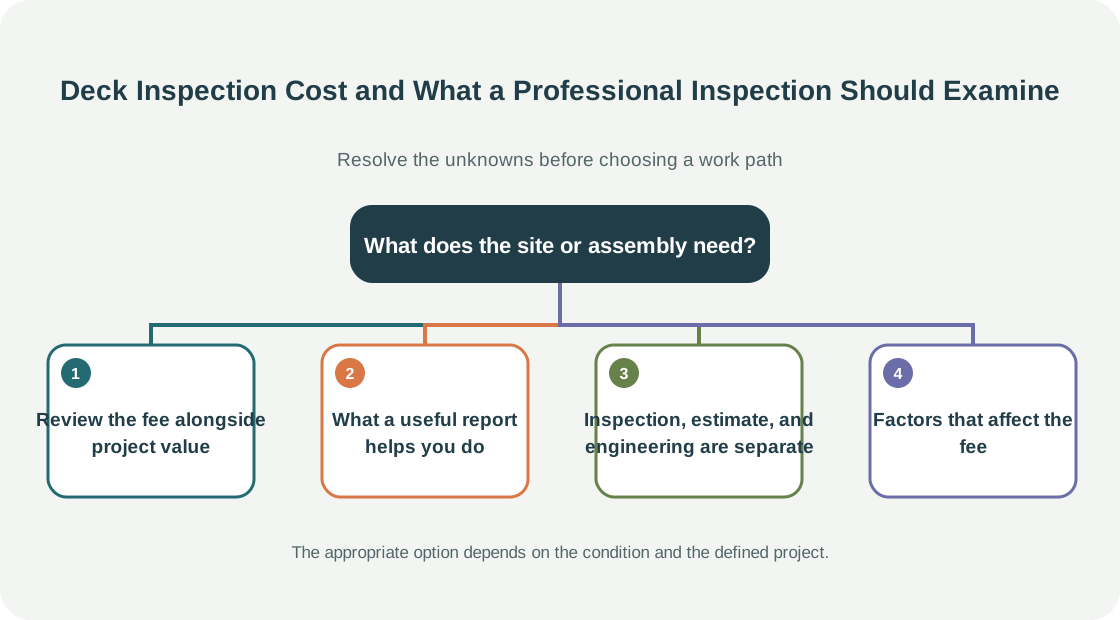
The fee is one part of deciding whether to inspect. Compare it with the cost of proceeding on an uncertain resurfacing or repair scope, but do not treat inspection as an automatic savings guarantee. Ask whether travel, report preparation, follow-up calls, disassembly, engineering calculations, or permit drawings are separate services. Current evidence does not establish a national inspection-fee range, so request a local scope-based price.
What a useful report helps you do
A practical report should identify the deck configuration and major components considered, distinguish observations from conclusions, and note where further evaluation is needed. It should describe the location of concerns clearly enough for a contractor to prepare a scope. If a repair is recommended, ask whether the report explains what must be repaired and what remains uncertain. If replacement is suggested, ask what conditions support that conclusion and whether a narrower repair was considered.
The report may also help normalize bids. A list of affected stairs, guard sections, posts, framing, or house-connection questions gives contractors a shared starting point. It cannot guarantee that demolition will reveal no additional conditions, so ask how hidden findings will be documented and approved. Avoid relying on a vague “passed” or “failed” label without the observations and limitations behind it.
Inspection, estimate, and engineering are separate services
A contractor estimate is usually organized around work the contractor may perform. An inspection focuses on condition within its defined scope. Engineering may address load path, capacity, unusual configuration, redesign, or a specific repair detail. Some providers offer more than one service, but ask what professional is responsible for each opinion and whether there are conflicts or limitations.
The American Wood Council’s DCA 6 is a prescriptive U.S. guide that can help explain wood-deck components and relationships. It is not a report on an existing structure and does not establish which local code applies. NADRA’s checklist is a useful evaluation aid, but it is not a substitute for project-specific expertise where structural conclusions are needed. Canadian and U.S. rules, qualifications, and permit processes vary.
Factors that affect the fee
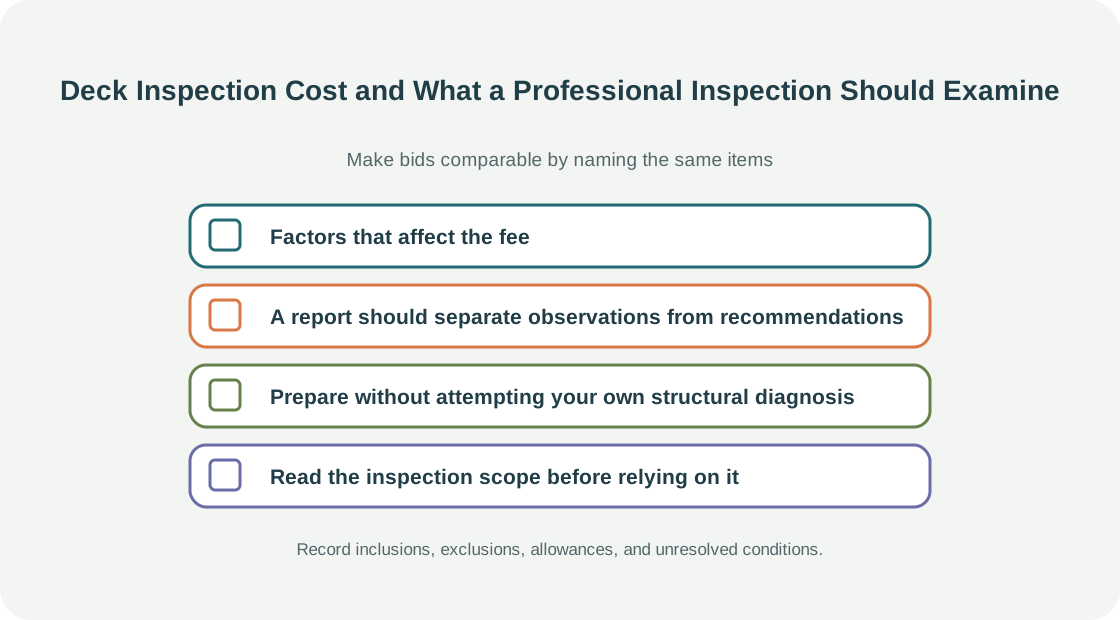
The service price may depend on size, height, levels, stairs, guard configuration, access beneath the deck, travel, documentation, and whether the provider is asked to review drawings or return after repairs. A visual inspection, written report, and engineering analysis may be priced differently. Current evidence does not provide a reliable national fee range, so ask local providers to quote the same scope rather than apply a general average.
If the initial inspection identifies another service, request its scope and cost separately. An inspector may recommend opening a small area, a contractor may price repair work, or an engineer may need to address a design question. Those next steps do not necessarily mean the original inspection was incomplete; they may answer different questions outside its agreed scope.
A report should separate observations from recommendations
Look for the location and description of each concern, the method of inspection, the inaccessible areas, and the recommended next step. A report might identify a soft board or movement without determining the cause; a separate engineer may be needed to answer a capacity question. Ask the provider to state these distinctions clearly.
If you plan to use the report with contractors, ask whether it includes enough detail for them to identify the same work. A short verbal summary can be useful but may not support comparable bids. Confirm whether written follow-up or questions are included in the fee.
Prepare without attempting your own structural diagnosis
Share the deck’s age if known, repair history, intended use, changes under consideration, and any event linked to new movement or damage. Point out water stains, loose rails, soft surfaces, settlement, or unusual sounds from places that can be observed safely. Do not remove structural components or put people on an area that appears to move or be damaged to gather better information.
Ask when the provider expects to deliver findings and whether the report includes a discussion of priorities. If there is an immediate concern about collapse or fall risk, restrict use and contact an appropriate professional rather than waiting for a routine estimate. The purpose is to obtain the right level of evaluation for the decision, not to turn an inspection into a blanket safety guarantee.
Read the inspection scope before relying on it
Ask who performs the inspection, what qualifications or local credentials apply, what areas are accessible, and whether the report includes photographs and a prioritized list of findings. A brief visual visit, a permit-related inspection, a structural engineering assessment, and a contractor’s repair estimate have different purposes. The same provider may offer more than one service; the deliverable should make clear which one is being purchased.
The inspector may not be able to see behind finishes, below soil, or inside a concealed connection. Ask how inaccessible areas are recorded and whether limited opening or testing would be separately authorized and priced. The report should distinguish an observed condition from a suspected cause and a recommended next step. It should not imply that every hidden condition has been ruled out merely because no defect was visible.
Before scheduling, share the deck’s age if known, prior repairs, recent movement or water entry, planned changes, and any areas that feel different underfoot. These details help focus the visit without substituting for the inspector’s own observations. Afterward, use the findings to request comparable repair bids; do not ask several contractors to price vague phrases such as “make safe” without identifying the reported condition and expected deliverable.