
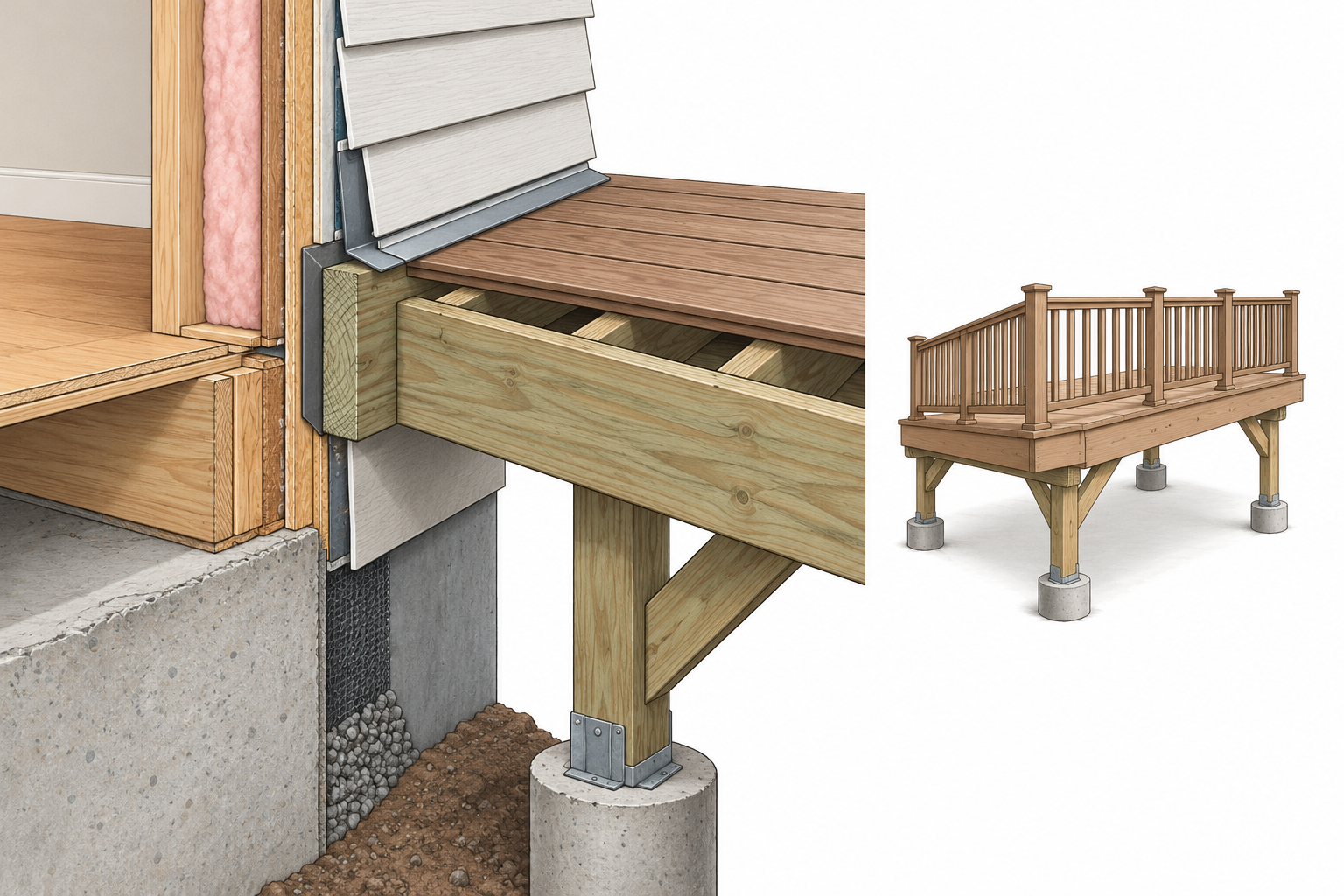
The ledger is the part of an attached deck that connects its framing to the house. A problem in that connection can involve fastening, flashing, wall construction, moisture intrusion, or the capacity of the house framing—not just one loose screw.
Why the scope can expand
The American Wood Council’s guide treats ledger attachment and flashing as consequential parts of a deck system. Its stated details assume particular construction, loads, and a U.S. code context. If the house framing differs, the connection cannot be assumed to fit the guide. Siding or exterior finishes may need to be opened to inspect or correct the wall interface, and concealed moisture damage may require restoration.
NADRA’s evaluation guide also places the house connection, fasteners, movement, decay, and drainage clues within a system-level review. Visible staining or a gap may indicate a concern, but it does not identify the repair design.
Common quote components
Ask the contractor to separate investigation and access, temporary support if required, removal, ledger or connection work, flashing and water management, wall repair, replacement framing, fasteners and connectors, disposal, engineering, permits, and finish restoration. A freestanding or differently supported design may be an alternative, but it is a redesign—not an automatic low-cost workaround.
Local requirements matter
Deck connection rules depend on the existing wall, loads, configuration, jurisdiction, and current adopted requirements. Toronto’s local guide shows how a deck or porch application can require footing, column, beam, stair, guard, and site-plan information. Canada’s NRC explains that model-code publications do not determine which provincial, territorial, or municipal rules apply to a particular project.
What an attachment problem can involve
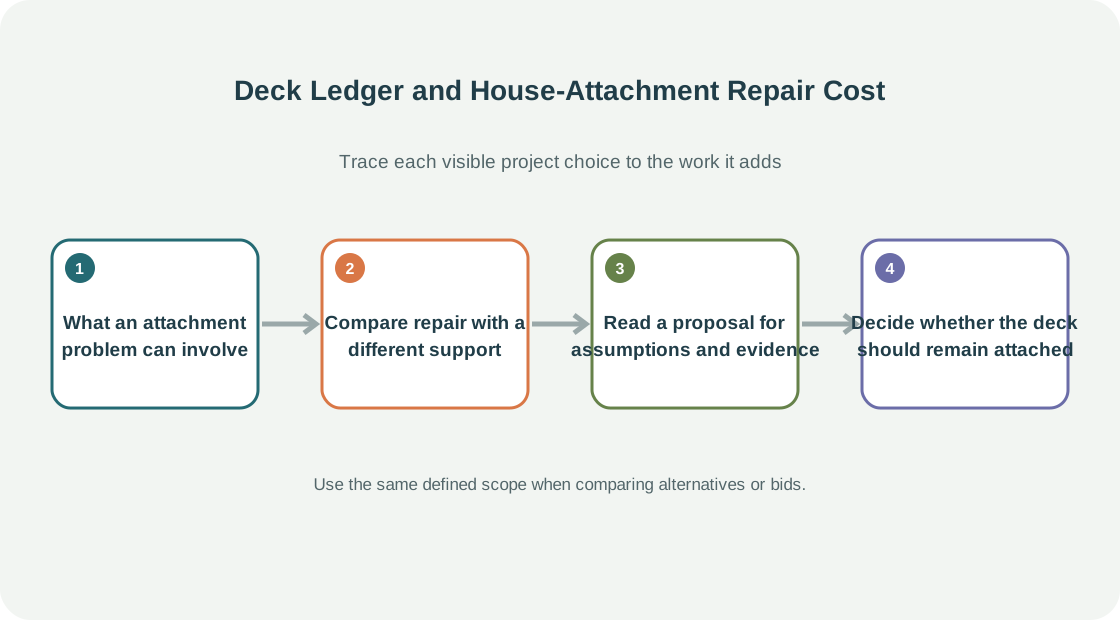
The deck-to-house connection is a load path and a weather interface. A repair may involve access to framing behind exterior finishes, removal of trim or siding, repair of deteriorated material, new connection components, flashing, and restoration of the wall surface. The visible gap, stain, or fastener is only an observation; it does not by itself establish the defect or the right repair.
Ask the contractor to describe what was inspected and what remains hidden. If the estimate assumes that wall framing is sound, ask how that assumption will be checked and what happens if it is not. Clarify whether work includes opening and closing the exterior wall, protecting against water during the repair, replacing finish materials, and coordinating separate trades. This is especially important when the deck is high, access is limited, or interior finishes may be affected.
Compare repair with a different support strategy
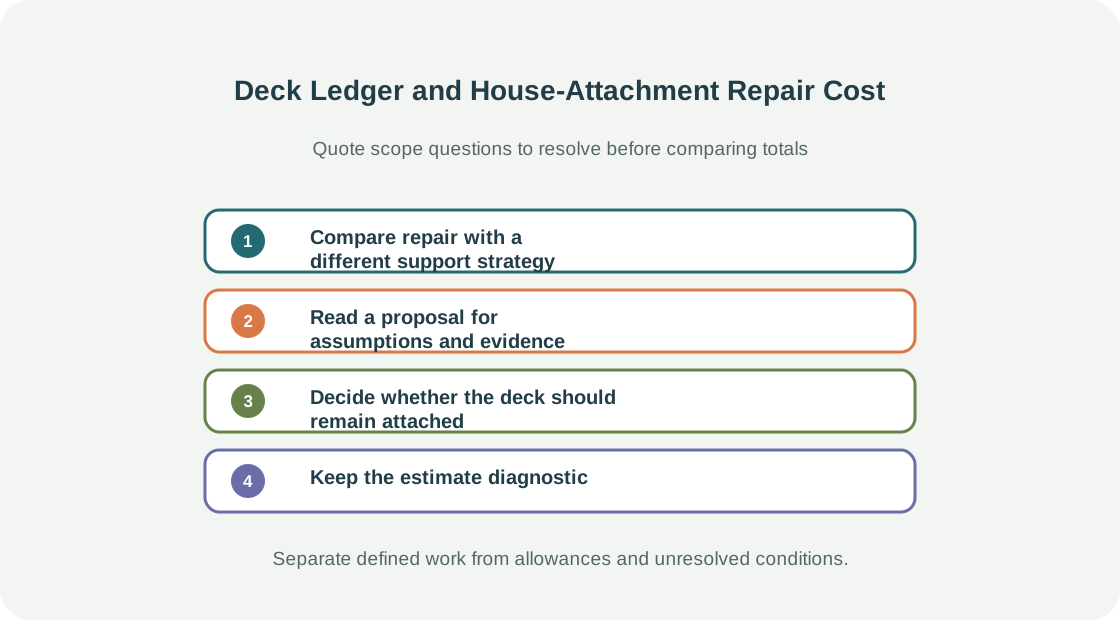
An attached deck may sometimes be redesigned with another support arrangement, but converting it to a freestanding configuration is not a minor shortcut. It can require new posts and footings, lateral stability work, excavation, changes near property lines, and local review. Ask for the complete scope and design responsibility rather than comparing a ledger repair to partial removal of the connection.
If the deck is being replaced, the owner may have more flexibility to choose how it relates to the house. That choice depends on site constraints, access, drainage, desired footprint, and applicable design requirements. The American Wood Council guide supplies a U.S. prescriptive context for wood decks; Toronto’s permit material and Canada’s NRC code publications illustrate that location and authority matter. Neither determines a connection design for a specific house.
Read a proposal for assumptions and evidence
Compare the described observations, not just the recommended material list. Ask whether the contractor saw the ledger, wall framing, flashing, and interior or exterior water conditions, or whether the estimate assumes they are sound. If two proposals disagree, ask each provider to explain what they observed and what information is still missing. An independent inspection or engineering evaluation may help separate a repair decision from a contractor’s production scope.
The work boundary should also address weather protection. If siding or wall materials are opened, ask how the building is protected during the project and how the final finish is restored. If the connection is below a window, door, or finished interior, identify who coordinates that work. A ledger repair quote that omits wall closure and flashing may not represent the cost of a complete repair.
Decide whether the deck should remain attached
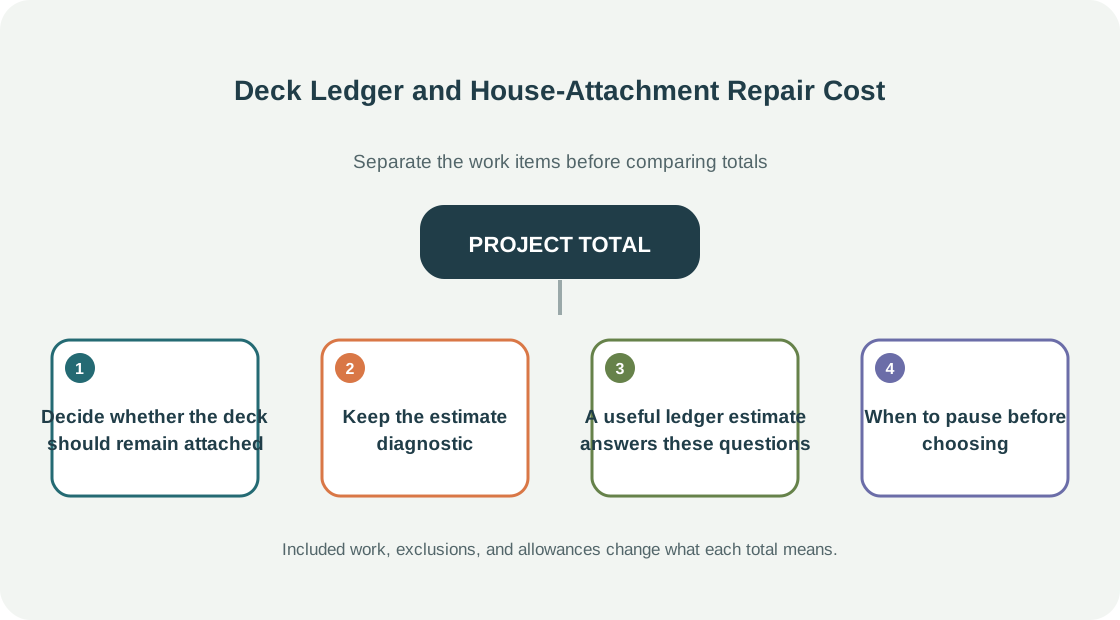
A redesign may compare the current attachment with an alternate support arrangement, but the comparison should use the same deck size, elevation, stairs, and intended use. New footings or posts can affect excavation, access, yard layout, drainage, and local approvals. A freestanding option may avoid some wall work while adding support work elsewhere. Ask for drawings or a written description of each alternative and the professional responsible for design.
Keep the estimate diagnostic
Request line items for investigation, access, temporary support if needed, removal, connection work, flashing and water management, wall restoration, disposal, engineering, and approvals. If the provider has not confirmed concealed-damage extent, ask whether the quote is fixed or conditional. A useful contingency defines the discovery that triggers it and how the owner authorizes added work.
Ask bidders to describe the evidence behind a recommended repair: where movement or moisture was observed, which areas were opened, and which conditions remain unverified. A material list without an explanation of the existing problem makes it hard to judge whether the work addresses the cause. A price can also be incomplete if it omits siding, trim, or finish repair after structural work.
A useful ledger estimate answers these questions
- What was visible at the wall and deck connection?
- Was siding or trim opened, or does the proposal assume the wall framing is sound?
- What flashing and water-management work is included?
- Is the deck supported during the repair, and who determines that plan?
- Are engineering, permits, and wall restoration separate?
- What concealed condition changes price, and who approves the added work?
If the answers differ across bids, the proposals are not yet comparable. Ask for clarification or an evaluation that resolves the unknown before committing to structural work.
When to pause before choosing
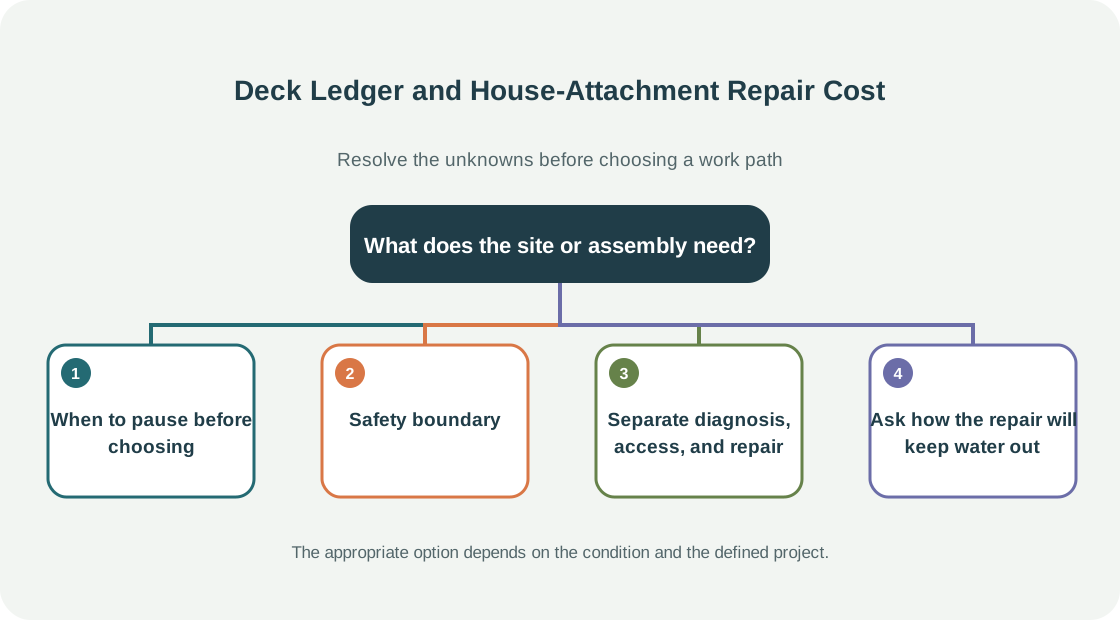
New separation, visible movement, persistent water intrusion, decay near a connection, or a repair that changes how the deck is supported warrants qualified review. Keep people off an area where a deck appears to move or the connection may be compromised. Do not attempt to tighten, remove, or replace structural attachments based on generic details. The next useful step may be an inspection, engineering opinion, or local code review; those costs should be considered separately from construction.
When comparing proposals, make sure each addresses the same diagnosis, wall access, repair boundary, restoration, and contingency. A repair is not comparable with a new support strategy unless both provide the intended deck use and disclose what remains. The estimate should leave the homeowner able to explain what changes at the house interface and what would cause the scope to grow.
Safety boundary
Do not use a generic fastener pattern, photograph, or online rule to declare an attached deck safe. If movement, separation, decay, or suspected water intrusion is present, limit use and obtain a qualified evaluation. Engineering and code verification are appropriate when the existing connection or proposed repair is outside a straightforward, documented scope.
Separate diagnosis, access, and repair
The visible water stain or loose deck edge may be far from the actual defect. A quote can involve removing siding or trim to see the house connection, correcting water-management details, replacing damaged ledger or framing, and restoring the exterior finish. Ask which diagnostic openings are included, what temporary protection will be provided, and whether the proposal includes rebuilding the wall finish after the connection is repaired. A low price that omits access and restoration may not represent a complete repair.
Request photographs or a written condition description before and after concealed work when practical. The contractor should explain how the deck is supported during the repair and which affected areas are included. If rot extends into house framing, the work may cross into a different trade or require a design professional. Clarify the process for pausing, documenting the condition, and approving a change order before additional work proceeds.
For comparison, ask each bidder to state whether the price assumes a sound house rim or band, accessible fasteners, removable siding, and no concealed damage beyond the visible area. These are assumptions, not findings. Keep permit, engineering, and finish restoration as separate line items if the bidder cannot define them until opening the assembly. The point is to understand what uncertainty remains before signing, not to force a fixed price for hidden work.
Ask how the repair will keep water out
A lasting house connection involves more than fastening a replacement member. Ask how the proposed work coordinates the ledger or attachment, flashing, siding, and water that reaches the wall above the deck. The contractor should identify which layers are opened and restored and how the finished detail sheds water. Product and code requirements depend on the exact wall and framing conditions, so do not treat a generic bead of sealant or surface patch as a universal solution.
Clarify whether the quote assumes the wall framing is sound and what happens if it is not. If the contractor must remove cladding to confirm the condition, ask who documents the opening and who repairs it afterward. Keep the structural repair, exterior-envelope restoration, and interior repair separate when different trades are involved. The handoff matters: an unfinished opening can expose the house while the owner waits for the next trade.