
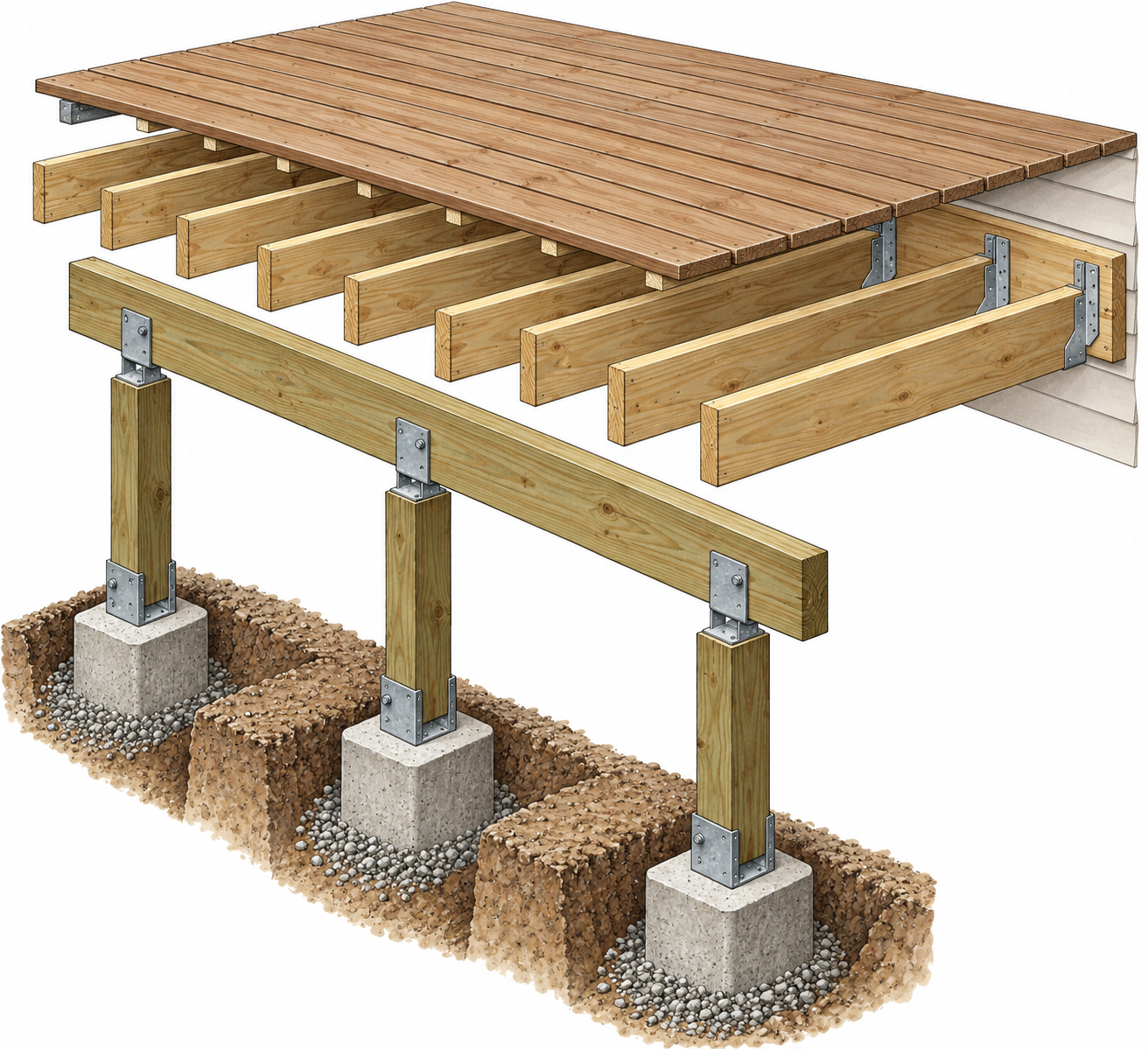
The surface of a deck can hide the components carrying it. Posts transfer load to footings, beams support joists, joists support the decking, and the connections hold those pieces together. A problem in one area can change the repair scope elsewhere.
What can drive the quote
- Joists: decay, damage, deflection, spacing, or poor support can require access beneath the surface.
- Beams and posts: rot, corrosion, settlement, movement, or damaged connections can affect the load path.
- Footings: excavation, rock, roots, frost, drainage, and access may cost more than the replacement material.
- Temporary support: Work on load-bearing members may need a professional plan and controlled temporary support.
- Restoration: Decking, skirting, landscaping, siding, or finishes may need removal and replacement.
The AWC guide presents these components as part of a prescriptive wood-deck framework, but its tables and details depend on stated assumptions and a U.S. code context. NADRA’s inspection checklist supports looking at the system, not diagnosing a component from a photo.
Why there is no useful universal component price
Current evidence does not establish dependable national prices for “one post” or “one beam.” A line item may be affected by minimum labor, equipment, shoring, excavation, disposal, engineering, material grade, and hidden deterioration. Ask for a broad scope allowance and the conditions that would change it instead of relying on a per-piece number.
When a repair becomes reconstruction
Compare repair with reconstruction when multiple members are affected, the deck has moved, footings are unreliable, the ledger is questionable, or opening one section suggests widespread decay. If the homeowner wants a roof, enclosure, hot tub, or larger footprint, treat that as a new design and load question.
Separate each part of the load path
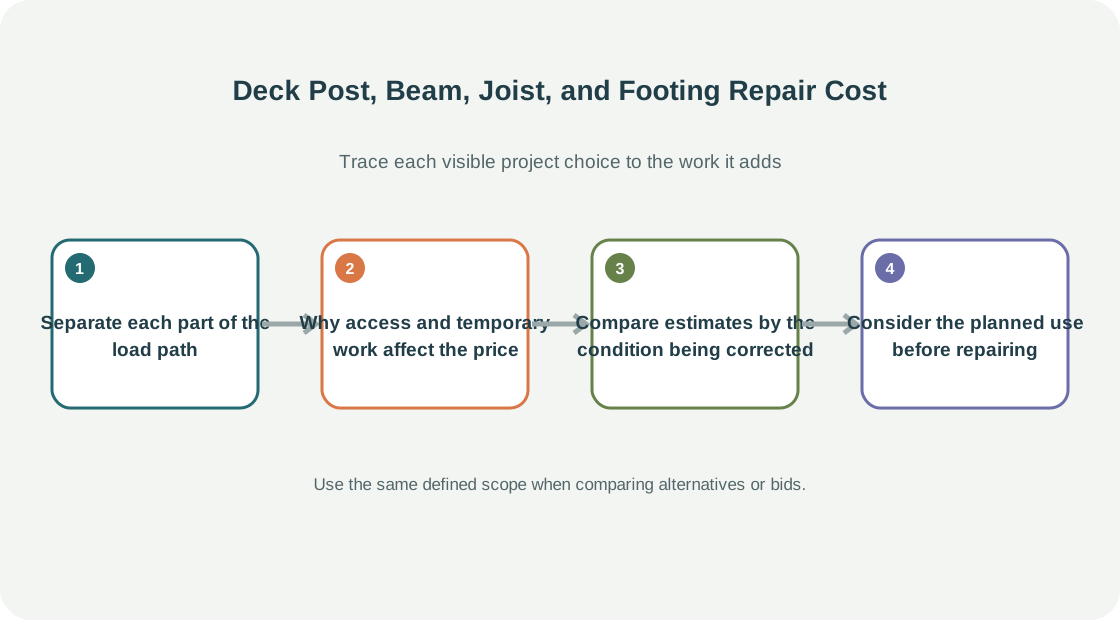
The components have related jobs, but their repair scopes differ. A footing transfers loads into the ground; a post carries support upward; a beam collects framing loads; joists support the deck surface; and connections keep parts aligned and attached. A visible crack, soft spot, or leaning post does not identify which component failed or whether adjacent parts are affected. The inspection and quote should name locations and components rather than use a blanket phrase such as “rebuild the frame.”
Ask whether the evaluation included the underside, post bases, beam connections, joist ends, ledger, fasteners, and areas concealed by skirting or decking. If access is blocked, identify what must be removed and whether it is included in the estimate. Note visible movement, water accumulation, corrosion, or impact, but leave diagnosis and repair design to a qualified professional.
Why access and temporary work affect the price
Structural work can require taking up surface boards or skirting, disconnecting stairs or guards, moving stored items, and restoring finished surfaces. A repair beneath a low deck may have restricted access; an elevated deck may require different access and protection. Excavating a footing can disturb landscaping, paving, utilities, or drainage. These conditions can affect labor and equipment more than the replacement member itself.
If a load-bearing element must be altered, temporary support may be part of the professional repair plan. Its need and method are configuration-specific, so this guide cannot prescribe it. Ask the contractor or engineer who is responsible for the plan, how long the work area must remain restricted, and whether temporary work is included.
Soil, roots, rock, water, settlement, and frost conditions can change footing work. Ask how the contractor will respond if excavation reveals a different condition than assumed. Any footing or support detail must be determined for the project and applicable jurisdiction; do not use a generic online dimension as a price specification.
Compare estimates by the condition being corrected
One quote may replace a single joist while another proposes broader framing work. Ask each bidder to identify the observed defect, affected members, access needed, and parts left in place. If the contractor cannot inspect a footing or connection before opening the deck, the proposal should state how that uncertainty will be resolved. A line item called “structural repair” is too broad to compare without locations and quantities.
The project can also include finishes and site work that are not part of the replacement member: removing decking, moving skirting, restoring stairs, disposing of old material, protecting landscaping, and repairing surfaces after access. Request these as separate items. Where a professional evaluation or permit is needed, note whether it is included or separate from construction.
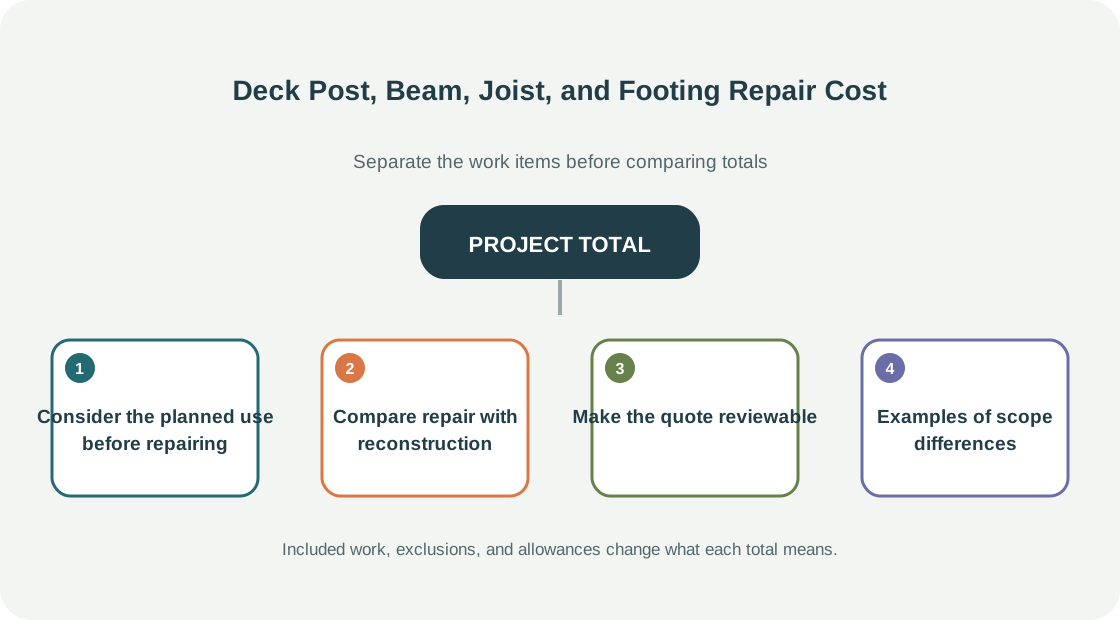
Consider the planned use before repairing
If the homeowner intends to add a roof, enclosure, hot tub, or larger area, tell the evaluator before the framing repair is designed. A repair that restores the existing arrangement may not serve a future configuration. The appropriate loads and requirements are project-specific; a generic deck-cost guide cannot determine them.
When several members are affected, compare a coordinated repair with reconstruction. Include what the repair retains, what is new, and what would be required to alter the layout later. A structural professional can explain whether retaining part of the system is suitable; cost alone does not establish that decision.
Compare repair with reconstruction
For a localized issue, request a component-specific proposal that explains the part being replaced, access, temporary work, and restoration. If several posts, beams, joists, or footings are affected, ask for a second scope that considers the larger framing system. Reconstruction deserves comparison when work would disturb many components, the deck has moved, the support basis is unknown, or future changes would require a different design.
Use matching assumptions for demolition, haul-away, surface material, stairs, guards, finishes, engineering, and approvals. If the repair retains old members, record which ones and what condition was observed. If replacement changes footprint, height, attachment, or use, identify those differences instead of treating it as a cost-only comparison.
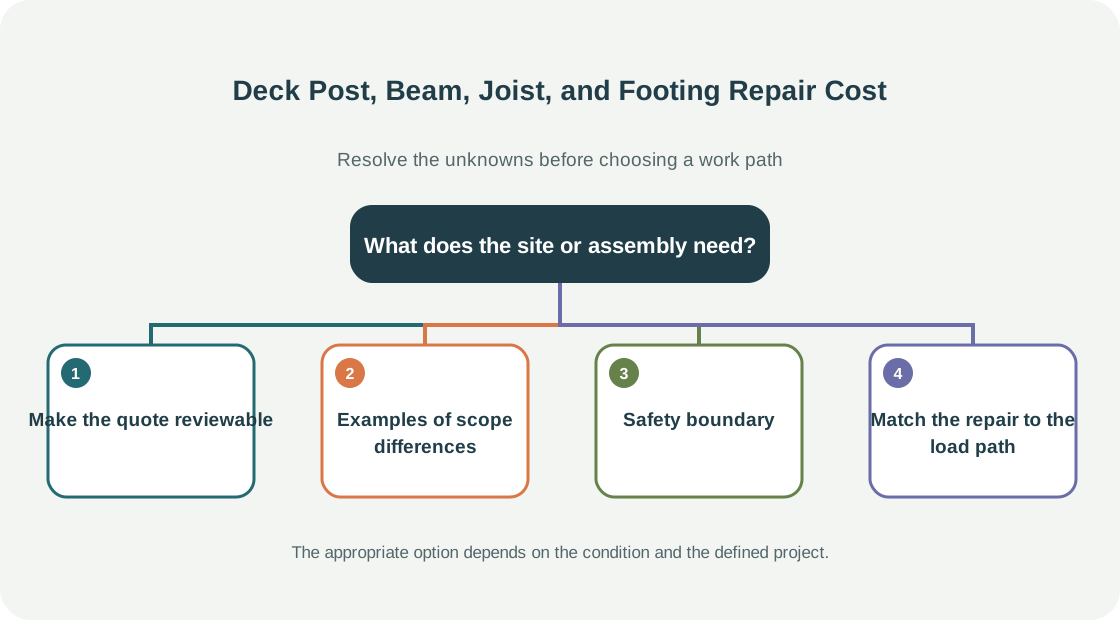
Make the quote reviewable
Request a drawing or component list showing the work location, whether the deck remains in use during the project, which finishes will be removed, what evaluation supports the scope, and how concealed damage will be priced. Ask which professional will answer design, temporary-support, and code questions. A contractor’s estimate and an engineer’s opinion may be complementary services rather than alternatives.
A useful proposal also identifies disposal, landscape repair, taxes, exclusions, and inspection or permit fees. If the initial scope cannot be priced without opening the structure, agree on an authorization checkpoint before extra work proceeds. This reduces the risk that a seemingly small repair becomes a large project without a documented reason and owner decision.
Examples of scope differences
A joist repair may require removing a few boards and supporting or replacing one member, while a footing repair can involve excavation, concrete removal, and landscape restoration. A beam or post repair may affect several connected members and require a broader evaluation. These examples explain why “per member” pricing is weak; they do not prescribe a repair method or establish a universal cost.
Ask the contractor to identify the location and quantity, what access is required, whether support work is needed, and which finishes must be restored. If several components are included, request a sketch or numbered list so the owner can see how the repair follows the load path.
Safety boundary
Do not remove or support structural members based on a generic internet sequence. Keep people off a visibly moving or damaged deck and obtain qualified structural evaluation. A professional should determine the repair approach, temporary-support requirements, and applicable approvals.
Match the repair to the load path
A post, beam, joist, footing, and connector each transfer loads differently. A repair estimate should name the affected members and connections rather than grouping everything under “framing.” Ask whether the work is a localized replacement, a reinforcement, or a redesign, and which adjacent members must be inspected. If more than one component has moved or deteriorated, a single-part repair may not address the reason for the movement.
The visible size of a defect does not establish how much structure is affected. Footings can be concealed, decay can extend behind a connection, and a leaning post can reflect movement elsewhere. A professional may need to evaluate the condition before a contractor can define quantities. Price that assessment separately from construction if the scope is not yet known. Do not load or occupy an area that is visibly unstable while waiting for a bid.
For competing estimates, compare temporary support, removal and disposal, replacement member dimensions and material, connectors, protection of nearby finishes, and restoration of stairs or decking removed for access. Ask whether design, permit, inspection, and finish work are included or handled by others. If a bidder proposes a different repair method, request the reasoning and any design responsibility in writing. Two totals are not equivalent if one includes engineered details and the other assumes field judgment.
After completion, retain the repair description, product information, inspection record, and photographs with the deck’s maintenance history. This does not guarantee future performance, but it gives a later inspector or owner a clearer record of what was changed and what remained in place.