
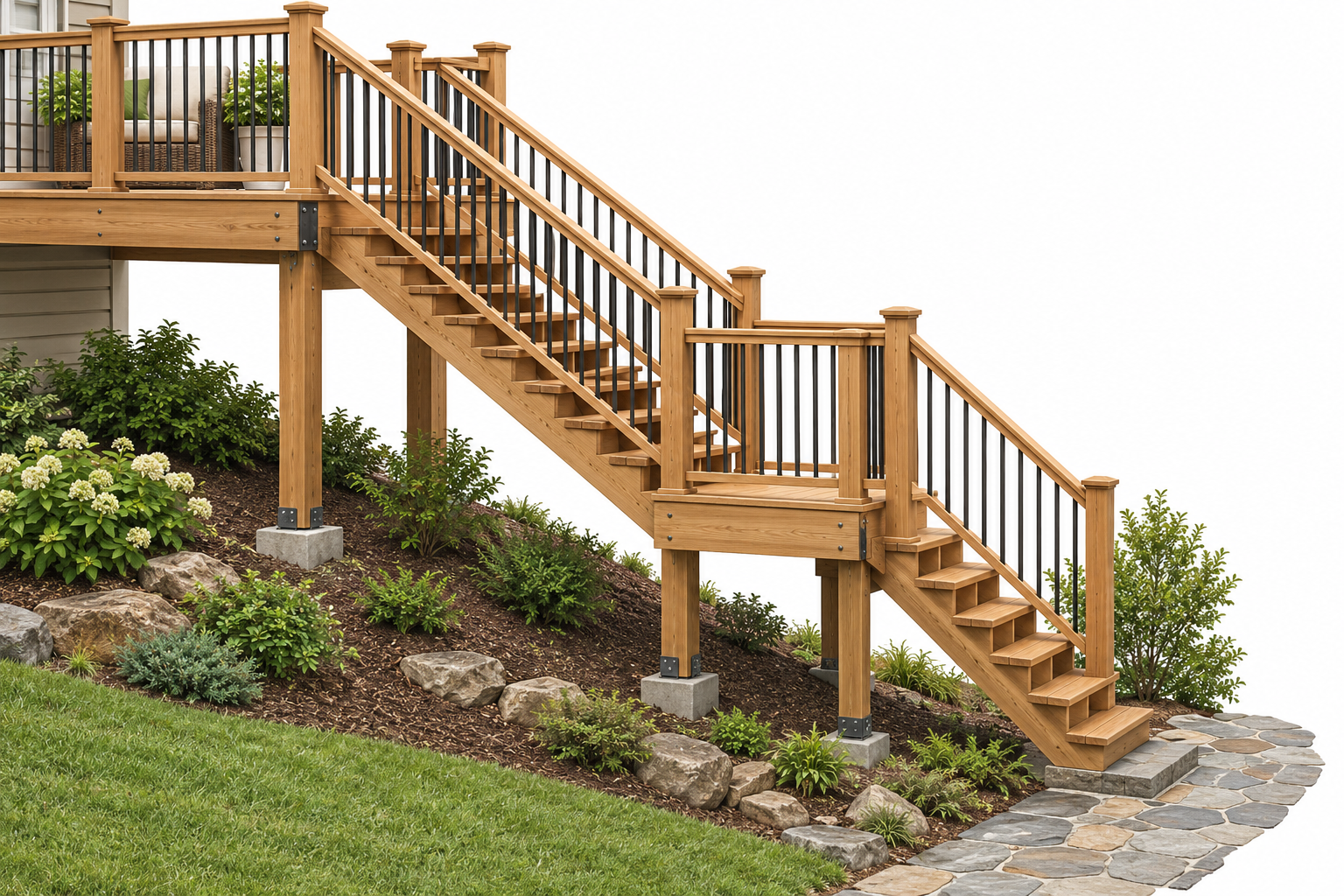
Exterior stairs combine stringers, treads, risers, landings, foundations, handrails, and guards. A repair that appears limited to one tread can expand when the stringers, landing, posts, or geometry are no longer suitable.
What changes the scope
Count the stair flights and landings, measure access and height, and identify whether the stair is attached to a deck or porch structure that also needs work. Rot, settlement, movement, poor drainage, damaged stringers, and loose rails point to different scopes. Material choice can affect treads, fascia, fasteners, and future maintenance.
The AWC guide treats stairs, guards, framing, footings, and connections as part of a prescriptive wood-deck system. Trex’s guide shows why even a surface product can have product-family requirements for stair support and fastening. Those examples do not establish a universal stair design.
Why prices are difficult to generalize
Current evidence does not establish a dependable national price for a stair flight. Labor, demolition, height, access, landings, railings, foundations, material matching, and required redesign can dominate. Ask for separate line items rather than accepting a price per step that omits rails, landings, or restoration.
Code-sensitive work
Stair width, tread and riser geometry, headroom, handrails, guards, landings, and lighting can be subject to current local requirements. Toronto’s guide illustrates that a permit application may request stair and guard information. Check the responsible authority for the specific jurisdiction and configuration.
What “one stair repair” can mean
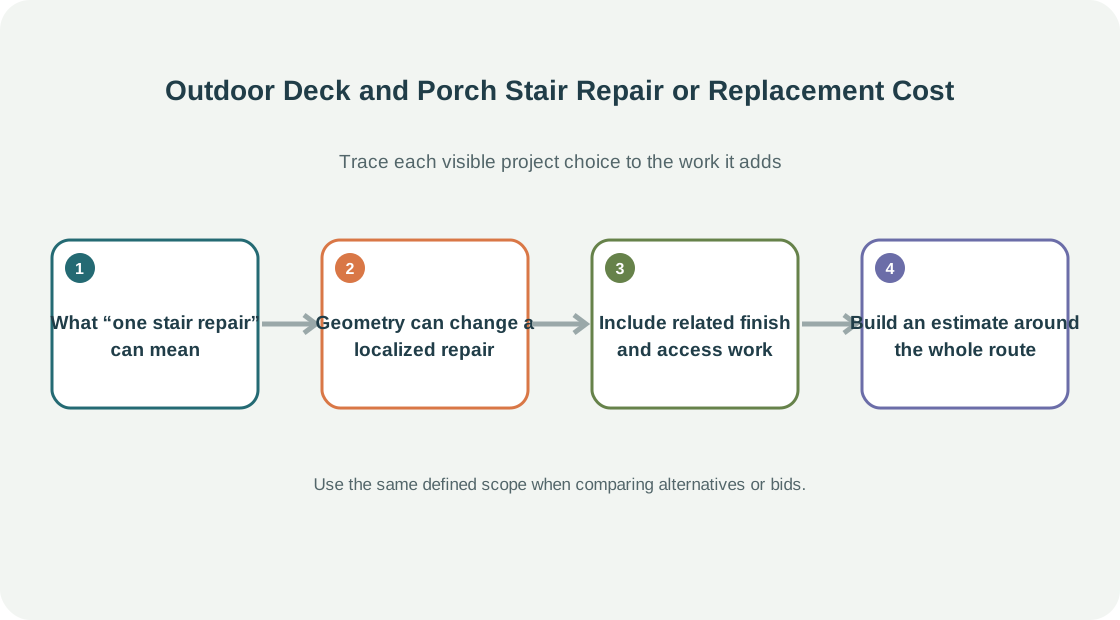
An exterior stair is an assembly. Treads provide the walking surface, stringers support them, landings provide transitions, and handrails and guards serve different functions. The stair also connects to the deck or porch and may depend on posts, footings, or a landing surface at the ground. Replacing one tread does not correct a soft stringer or a loose landing connection. Ask the contractor to identify which parts were evaluated and which the quote includes.
Stairs with multiple flights, turns, or landings have different material and layout requirements from a short direct run. Height and access affect demolition and installation. If the stair is attached to a porch with deteriorated flooring, a moving deck, or a settlement concern, the estimate may need to include adjacent work. Ask whether landing, handrail, guards, and connections at both ends are included before comparing a “per-step” price.
Geometry can change a localized repair
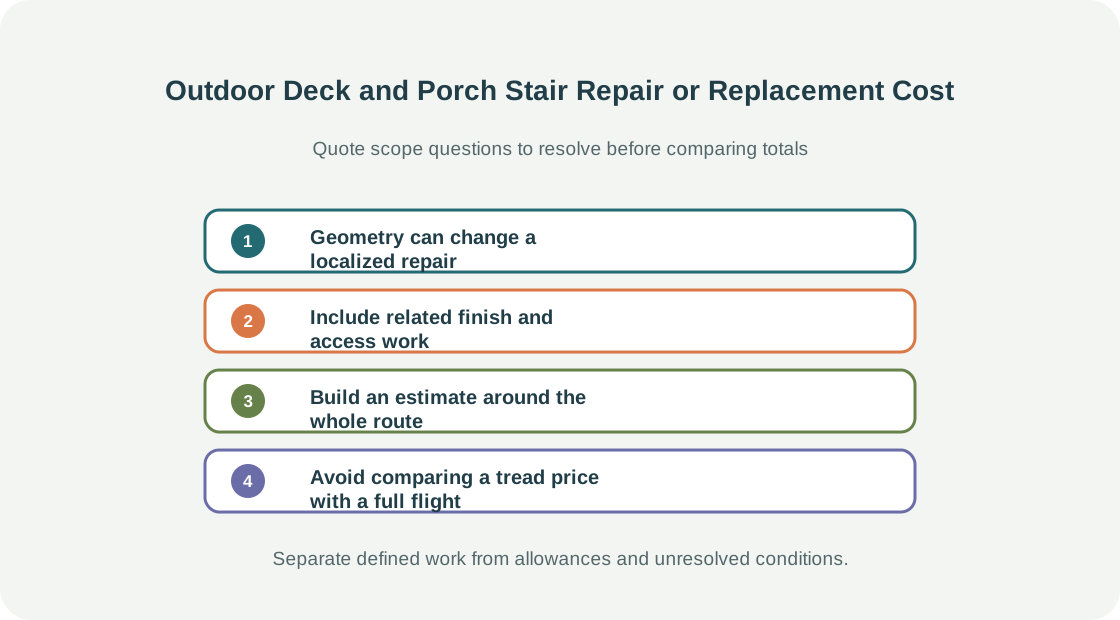
Existing tread and riser geometry may vary from one step to the next or transition awkwardly at a landing. A contractor may find that changing one part affects the remaining stair. Requirements for width, rise, run, handrails, guards, headroom, and landings depend on configuration and jurisdiction. Toronto’s deck-and-porch guide illustrates that local applications can require stair and guard information; it does not establish universal dimensions.
If a repair changes stair geometry or height, ask who checks applicable requirements and whether the whole flight must be included. A generic online dimension should not be used to design the stair. The AWC guide is a prescriptive U.S. wood-deck reference, not a project-specific determination for every material or Canadian jurisdiction.
Include related finish and access work
An estimate may need removal and disposal of old treads or rails, temporary access control, protection of landscaping, repair of the deck edge, and finish matching. If the stair is difficult to reach or sits above finished landscaping, ask how materials and debris will be moved. If lighting is desired, separate electrical design and installation from stair carpentry so each part has a clear responsible trade and scope.
For replacement, ask whether the new stair uses the same orientation and landing, whether posts or footings are included, and whether the rail system is compatible with the proposed stair. A material change can affect tread fastening, edge treatment, and future maintenance. Trex’s 2026 guide includes product-family stair support and fastening guidance; those details are specific to Trex products and must not be transferred to other brands.
Build an estimate around the whole route
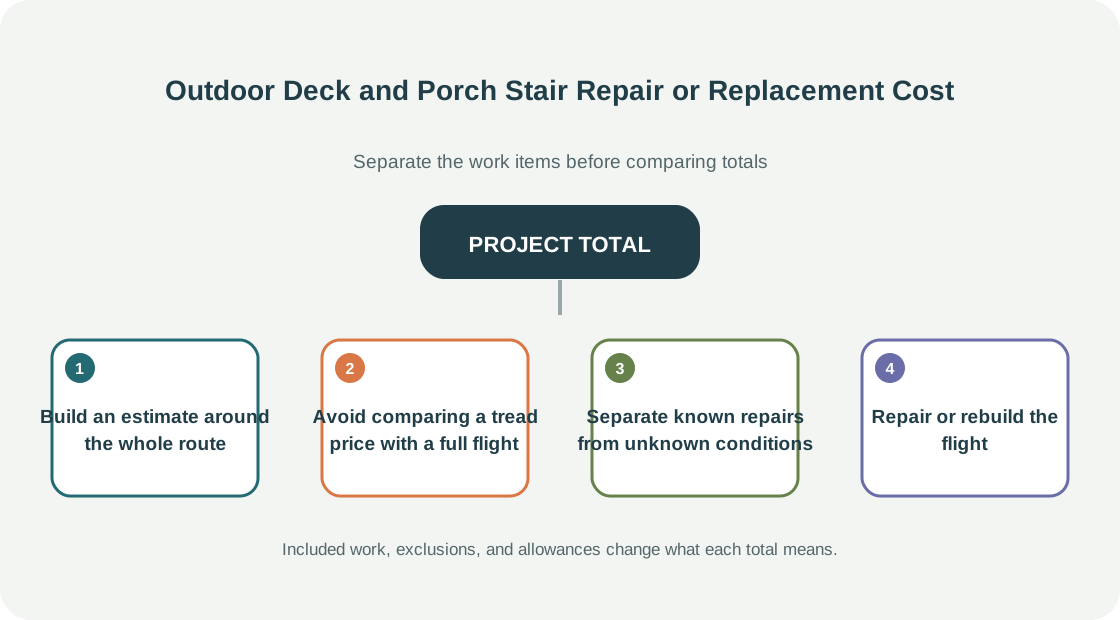
Ask bidders to measure the stair height, number of flights, landing size, direction changes, and connection points. Identify whether existing stairs can remain while the deck surface is replaced or whether removal is required to reach the framing. Include handrails and guards, not only treads. A stair that opens onto a sloped or paved area may need transition or restoration work beyond the carpentry.
If an exterior stair is the main access to the deck or porch, include the period when it will be unavailable and any alternate route. Ask the contractor what protection or temporary access measures are included. These considerations can affect schedule and cost even if they do not change the permanent structure.
Avoid comparing a tread price with a full flight
A per-step figure may exclude stringers, landing, rails, demolition, disposal, access, finish, and required redesign. Ask what each quote includes and whether it is a spot repair, replacement of the whole flight, or a new layout. A bid that includes new handrails and landings may have a higher total while delivering a different completed stair.
Separate known repairs from unknown conditions
Ask whether the price assumes sound stringers, landing, deck connection, and ground support. If the contractor needs to remove treads to inspect those parts, define what is included and how a concealed defect changes the estimate. This is more useful than a general contingency for “stair problems.”
If a rail or guard is visibly loose, include it in the evaluation rather than treating the stair surface as the only issue. If lighting is added, keep its electrical price and approval separate. A quote should describe the finished route from deck to ground, not only the count of replacement treads.
Repair or rebuild the flight
Localized repair is more plausible when the defect is limited, stringers and connections remain suitable, and replacement parts fit the existing geometry. Rebuilding the flight deserves comparison when multiple treads or stringers are damaged, the landing moves, the guard or handrail needs replacement, or the stair no longer connects cleanly to the deck. If a wider deck project is planned, coordinate stair scope with the deck repair or resurfacing estimate.
Ask for a marked-up sketch and line-item scope identifying flights, landings, treads, stringers, railings, connections, excavation, disposal, finishes, and approvals. Get the contractor to explain what observation would make the price change after removal. When a stair flexes, moves, or has a compromised guard, keep it out of use until an appropriate professional evaluates the condition.
Safety boundary
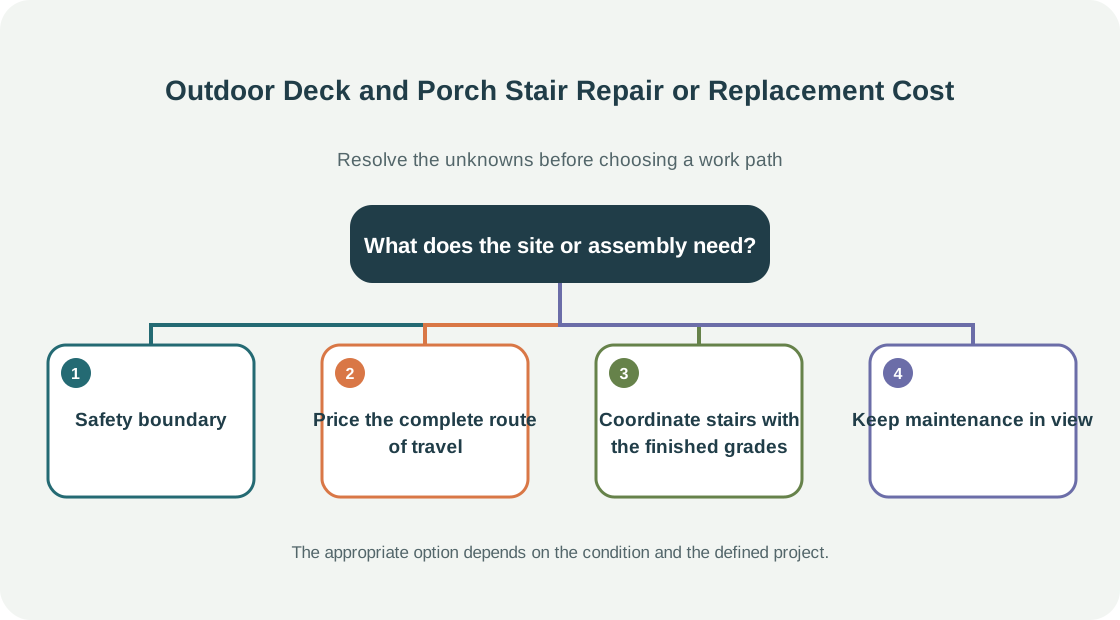
Do not rely on a generic online dimension or attempt structural stair changes from a checklist. If stairs flex, move, have damaged rails, or show rot at supports, restrict use and obtain qualified evaluation. Include any electrical lighting work as a separate scope.
Price the complete route of travel
A stair run connects two finished elevations, so a small change in landing height can alter its rise, number of steps, footprint, and relationship to a door or path. Ask the contractor to measure both elevations and show the proposed landing and stair location. A quote based only on replacing visible treads may omit stringers, supports, guards, handrails, or the landing that makes the route usable.
Consider how the stairs will be used: carrying furniture, moving bins, reaching a yard, or serving as the primary daily entrance. These uses can change preferred width, surface, lighting, and handrail arrangement. They do not override local requirements, which should be checked for the specific site. If the proposed stair changes access near a property line, retaining wall, or utility, confirm the layout before work is priced as final.
For a repair, ask whether the contractor will inspect the upper and lower connection, supporting framing, landing, and any water-damaged area. Replacing a tread does not resolve a loose stringer or settlement at the base. For a new run, compare demolition, excavation or footing work, finish surfaces, railing, and restoration of nearby landscaping. Keep a drawing or measurements with the quote so each bidder is pricing the same number and placement of steps.
Coordinate stairs with the finished grades
A stair can be priced accurately only after the upper surface and lower landing elevations are understood. If paving, landscaping, or a retaining edge will change, coordinate that work before the final stair layout. Ask which trade establishes the finished grade and whether the stair bid includes adjustment after the adjacent work. Otherwise a completed run may not meet the intended path or door threshold.
Include guard and handrail transitions in the drawing, particularly where the stairs join a deck edge or porch. Confirm how a gate or fence will affect the path if one is nearby. If lighting is planned, price wiring and fixtures separately and clarify who coordinates them with the stair assembly. Keep the estimate tied to a measured layout rather than an assumed number of steps.
Keep maintenance in view
Ask how the chosen tread and finish will be cleaned, inspected, and repaired, especially where water collects at the stair base. If the stairs serve as the main entrance, discuss keeping a safe route open during construction and whether temporary access is needed. Include that plan in the quote.