
The surface material changes more than appearance. It can affect preparation, fastening, cleaning, refinishing, board replacement, heat and moisture behavior, and whether an existing frame is compatible with the new boards. Compare the whole ownership decision rather than assuming one material class is always cheapest.
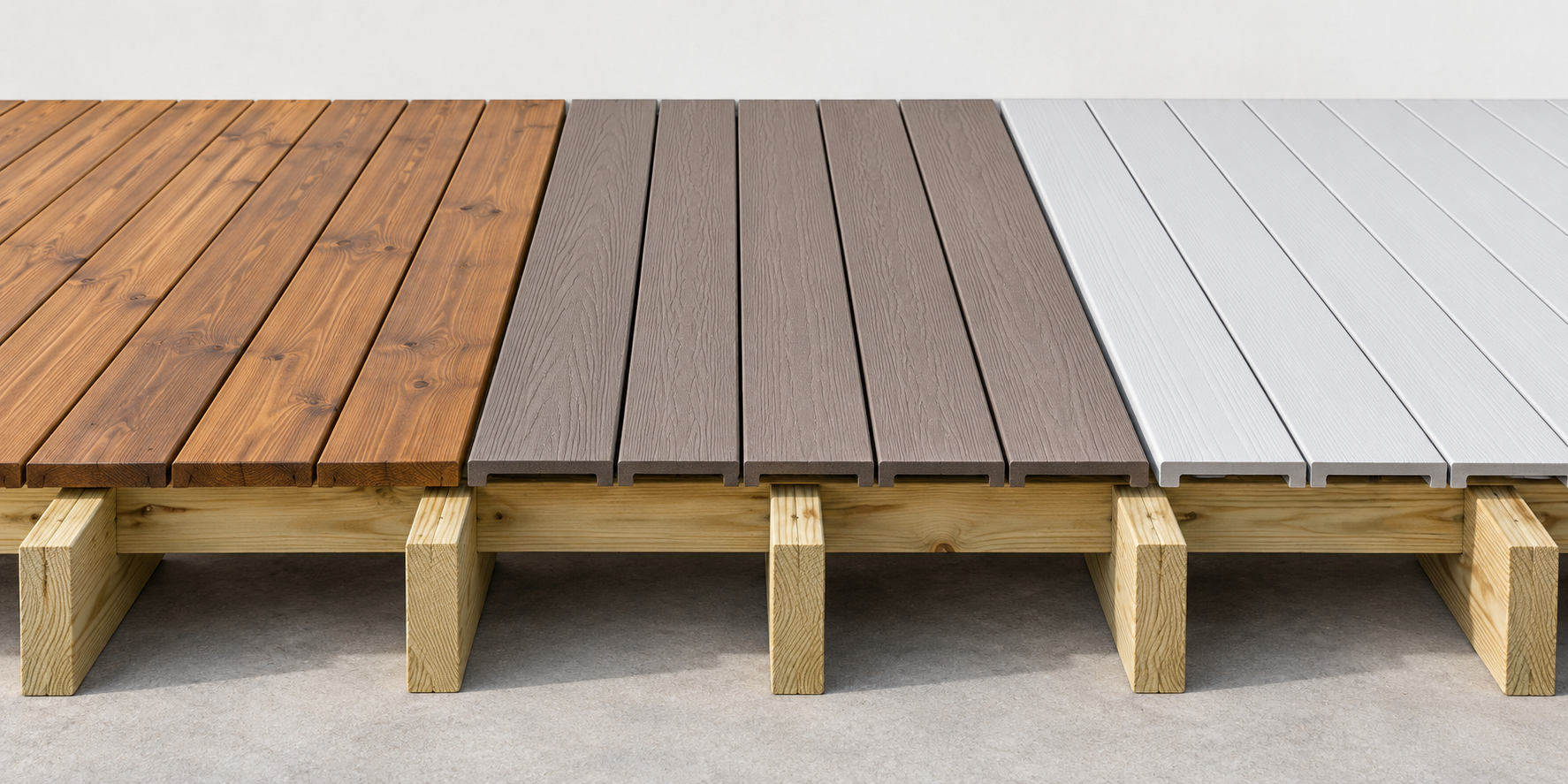
What is being compared
Wood decking is a family of species and treatments. Composite and PVC decking are also product families, not single uniform materials. Grade, profile, color, fastening system, availability, and warranty conditions can change the quote substantially. The frame remains a separate structural system; surface boards should not be treated as framing.
Upfront cost
Published U.S. deck summaries report broad total-project and board-price ranges, but they do not create a reliable universal ranking for every wood, composite, or PVC product. Request separate line items for decking, fasteners, fascia, labor, disposal, and any frame changes. A higher surface price may be offset—or overwhelmed—by access, stairs, railings, demolition, or an unsuitable frame.
Canadian prices need Canadian market evidence or local quotes. Exchange-rate conversion of a U.S. estimate is not Canadian pricing.
Maintenance and repair
The USDA Forest Service explains that exterior finishes are selected for appearance, weather and moisture protection, cleanability, wood properties, and expected service life. Finish performance depends on the surface, product, climate, and exposure, so a universal recoating schedule is not reliable. Wood may need cleaning and refinishing; composite and PVC still require product-appropriate cleaning and can have appearance or replacement issues of their own.
Ask how a damaged board would be replaced years later. Check whether the original profile, color, fastener, and trim remain available. A small repair is easier when the system has accessible replacement parts and the boards can be removed without damaging adjacent work.
Compatibility is a project question
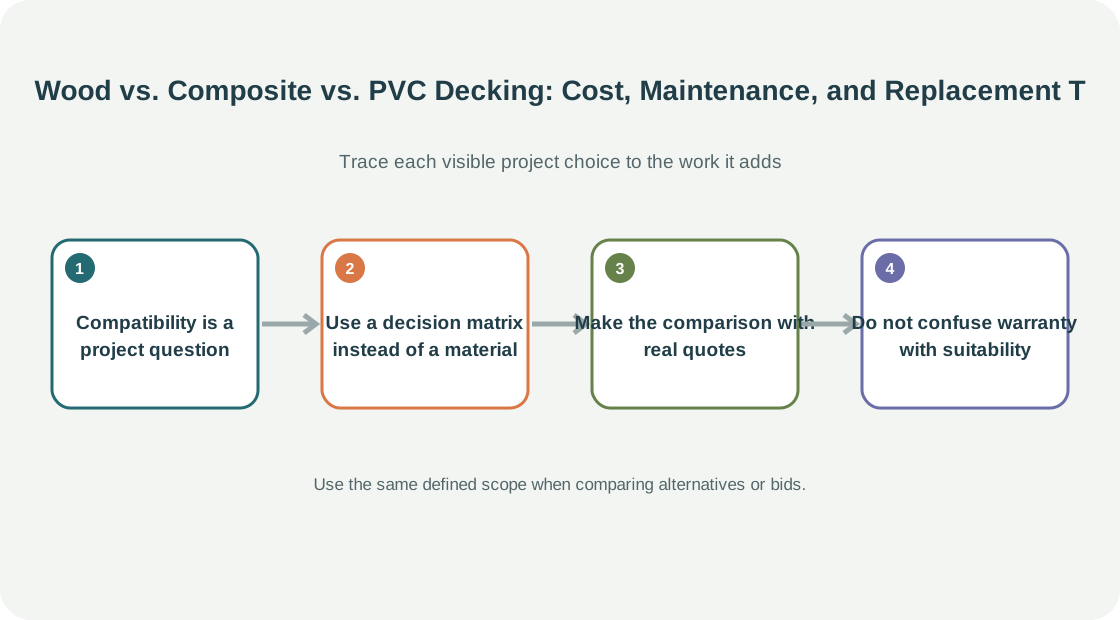
Trex’s installation guidance says its decking is a non-structural surface over code-approved structural framing and that joist spacing, support, gapping, fastening, and product family matter. That is a product-specific example, not a universal composite rule. Before resurfacing, match the selected product’s current installation guide to the existing frame and stairs; do not infer compatibility from board appearance or deck age.
Use a decision matrix instead of a material ranking
Consider the priorities that actually matter to the household. If appearance and willingness to refinish are central, compare wood species, treatment, and finish options. If reduced routine coating work matters, ask what cleaning and inspection remain for the exact composite or PVC product. If future repairs matter, check profile and fastener availability. If the deck is exposed to heat, salt, moisture, or wildfire risk, request documentation for the named product and site rather than relying on a general category label.
These questions may lead different households to different materials. A family that wants a particular wood appearance may accept periodic finish work. Someone who dislikes repainting may favor a manufactured surface but should still plan for cleaning and replacement parts. Someone replacing a few damaged boards may discover that product matching, not maintenance, is the deciding cost. There is no universal winner without a price, site, product, and ownership horizon.
Make the comparison with real quotes
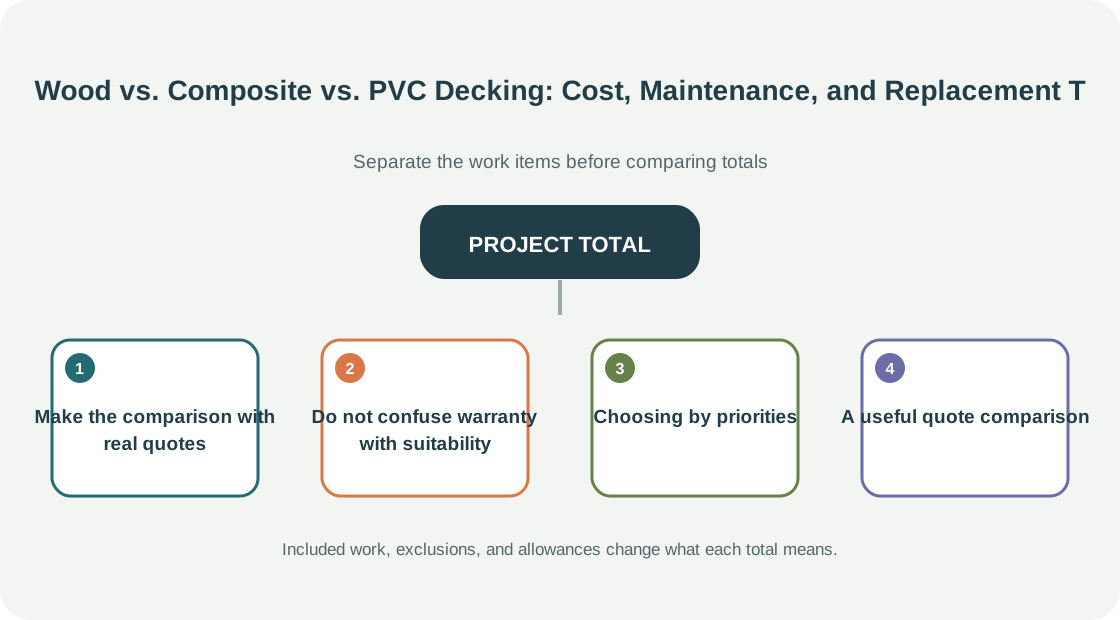
Use the same deck footprint and structural scope for each material. Ask for separate estimates for boards, fasteners, fascia, labor, demolition, disposal, stairs, rails, and frame changes. If a quote uses a different joist layout or fastener system, ask whether the design is product-specific and who is responsible for it. If the existing frame is being reused, have the contractor identify what was inspected and what remains concealed.
Then list expected owner tasks and repair questions for each product. Which surfaces need routine cleaning? Are there limits on cleaners or pressure washing? Can a board be replaced without dismantling adjacent work? How are warranty claims affected by installation or exposure? These answers provide a more useful lifecycle comparison than speculative service-life multiplication.
Do not confuse warranty with suitability
A product warranty is limited by its written terms and does not establish that the supporting deck is sound, the installation complies with local requirements, or a material suits every climate. Review exclusions and required maintenance for the exact profile and color. If the deck is near salt water, receives heavy sun, or is in a wildfire-prone area, ask for relevant product documentation and separate local hazard advice.
Choosing by priorities
- Choose a material only after comparing installed scope, not board price alone.
- If low routine finishing work matters, ask what cleaning and inspection the product still requires.
- If future repairability matters, ask about replacement profiles, fasteners, and color availability.
- If heat, slip, fire exposure, or saltwater matters, request product-specific documentation rather than a class-wide promise.
- In a wildfire-prone setting, treat hazard mitigation as a separate, site-specific decision. Canadian WUI guidance uses construction class, slope, distance, and test criteria; it is not a universal decking code.
A useful quote comparison
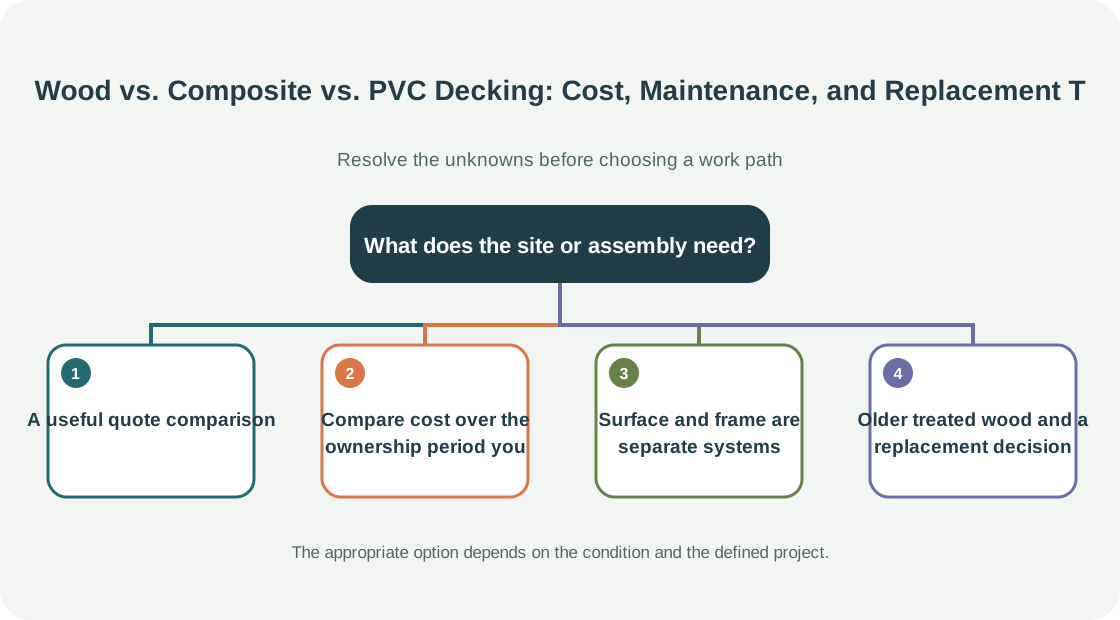
Have each bid identify the decking product and profile, frame condition, joist spacing, fastener system, stairs, fascia, removal, disposal, finishing, warranty assumptions, and any engineering or approval allowance. That list reveals whether the apparent material comparison is actually comparing different project scopes.
Compare cost over the ownership period you expect
Instead of asking which material lasts longest, estimate the costs and work that matter during your likely ownership period. List the installed quote, expected cleaning, any finish maintenance, repair access, and the product’s current warranty conditions. Do not assign a precise service life without a source and product match. A homeowner expecting to move soon may value a different balance than someone planning to keep the home and willing to maintain wood.
For each bid, ask what happens when one board is damaged. Can it be removed without taking up a large area? Is the fastener system accessible? Is a replacement profile available from the manufacturer? Will a new board visibly differ in color from weathered material? Composite and PVC systems can also have product-specific colors, profiles, and clip availability. A material that needs less routine coating can still be expensive to repair if the exact profile is discontinued or inaccessible.
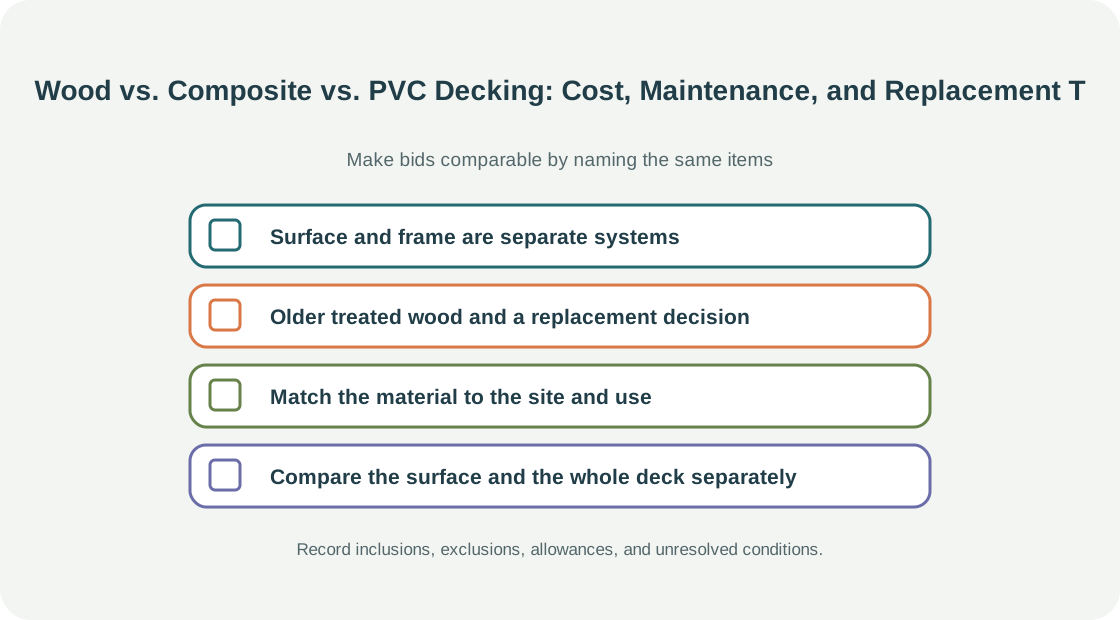
Surface and frame are separate systems
A new surface does not reset the condition of the deck below it. The supporting joists, beams, posts, footings, connections, and drainage still need to suit the deck and the selected product. Trex’s 2026 guide is one product-specific example: it identifies its decking as non-structural, requires board ends to bear on framing, and states product-specific fastening and framing requirements. The guide includes U.S.-oriented span and gapping requirements; those details should not be generalized to other brands or treated as Canadian code rules.
If an existing deck is being resurfaced, ask whether the quoted evaluation checks the framing and connections or merely estimates board replacement. If a product requires changes to support spacing, blocking, stairs, or fasteners, include those in the material comparison. A lower board price can lose its advantage when compatibility work, demolition, or added framing is required.
Older treated wood and a replacement decision
Some older outdoor decks may contain CCA-treated lumber, but age and appearance do not identify a particular board. Health Canada says Canadian decks, fences, and play structures built before 2004 are likely to contain CCA-treated wood, while aged material may look untreated. It advises minimizing exposure to damaged or deteriorating wood and replacing damaged pieces. The U.S. EPA separately says production of CCA-treated wood for most homeowner uses ended in 2003, does not require blanket removal of existing structures, and advises against home burning or reuse as mulch. Both sources direct readers toward careful handling and local disposal rules within their respective jurisdictions.
If boards are being removed, ask whether treatment is known or needs confirmation, how dust and debris will be managed, and where material will be disposed of under current local rules. This does not mean an existing deck must be removed because it may be older treated wood. It is a handling and disposal consideration in the resurfacing scope, alongside the condition and compatibility of the frame.
Match the material to the site and use
Consider how the deck is exposed: wet shade, full sun, snow, salt, tree debris, or frequent foot traffic can change cleaning and finish needs. Do not use one broad claim such as “composite never needs maintenance” or “wood always costs less.” Ask for current documentation for the exact board and fastener system, including cleaning limits, stated warranty exclusions, heat or slip information if those matter to the household, and any requirements for ventilation or drainage.
Then compare the same project boundary. Each quote should identify the frame condition, board product and grade, fastening, fascia, stairs, railings, removal, disposal, finish, access, and any design or approval costs. If the proposals do not describe the same structure, there is not yet a valid material-only comparison.
Compare the surface and the whole deck separately
A material decision can happen at two different stages. For a new deck, compare how each surface changes the installed project while keeping the footprint, frame, stairs, and railing consistent. For an existing deck, first establish whether the frame can remain; the cost of a new surface alone is not a useful replacement budget if framing or stair geometry also changes. Ask bidders to show the surface allowance and any assumed framing work separately so a material upgrade does not conceal a structural change.
Bring samples to the actual site if color, texture, barefoot use, shade, or glare matters. A sample cannot predict every exposure condition, but it helps reveal whether a finish that looked attractive in a catalog suits the space. Ask how the product behaves at board ends, transitions, stairs, and fascia, because those details affect both appearance and future repair. Record the exact product family, profile, color, and fastening method on the estimate.