
Resurfacing usually means removing existing decking and installing a new walking surface, sometimes with fascia, stairs, or railings. It is economical only when the supporting structure is suitable for continued use and compatible with the selected product.
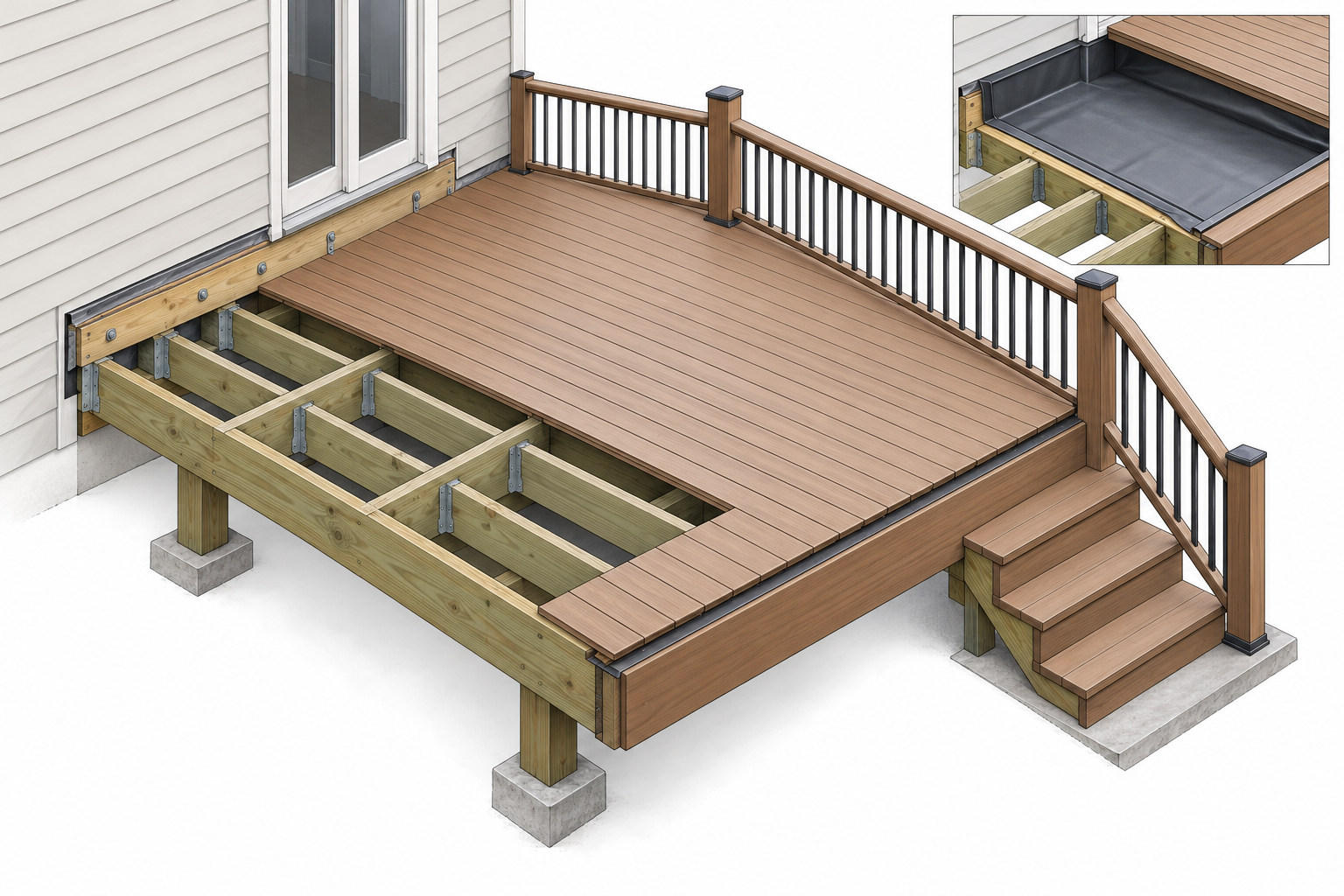
Board resurfacing and membrane renewal are different projects
Board resurfacing assumes a spaced walking surface over a frame. A continuous waterproof membrane, sometimes protected by pavers or another traffic surface, is a separate water-control assembly with its own drains, edges, guard attachments, substrate, and wall junctions. Removing boards or replacing them does not price or renew that membrane. If a proposal switches from boards to a membrane or protected traffic surface, have the assembly and drainage reviewed and request a separate scope rather than comparing it with a board-resurfacing estimate.
What must be checked first
Inspect joists, beams, posts, footings, ledger or other house connection, flashing, fasteners, stairs, guards, and drainage clues. NADRA’s evaluation guide treats these as part of a deck-system evaluation. Age or a clean-looking surface does not establish that the frame is sound.
Inspect before selecting a surface product
The decision to retain a frame is a separate decision from selecting a new board. Ask for an evaluation that covers the supports, house connection, footings, stairs, guards, and drainage clues. If a component is hidden by fascia or skirting, note that limitation and decide whether it should be opened before the product is ordered. A clean top surface does not show the full condition below.
Request the selected product and current installation guide before accepting a reuse price. A Trex board, another composite profile, and PVC decking may have different support, fastening, edge, and stair requirements. If the installer proposes changing joist spacing or adding support, ask for a separate line item and the design basis. Avoid carrying one manufacturer’s details into another product.
Plan for transition and finish details
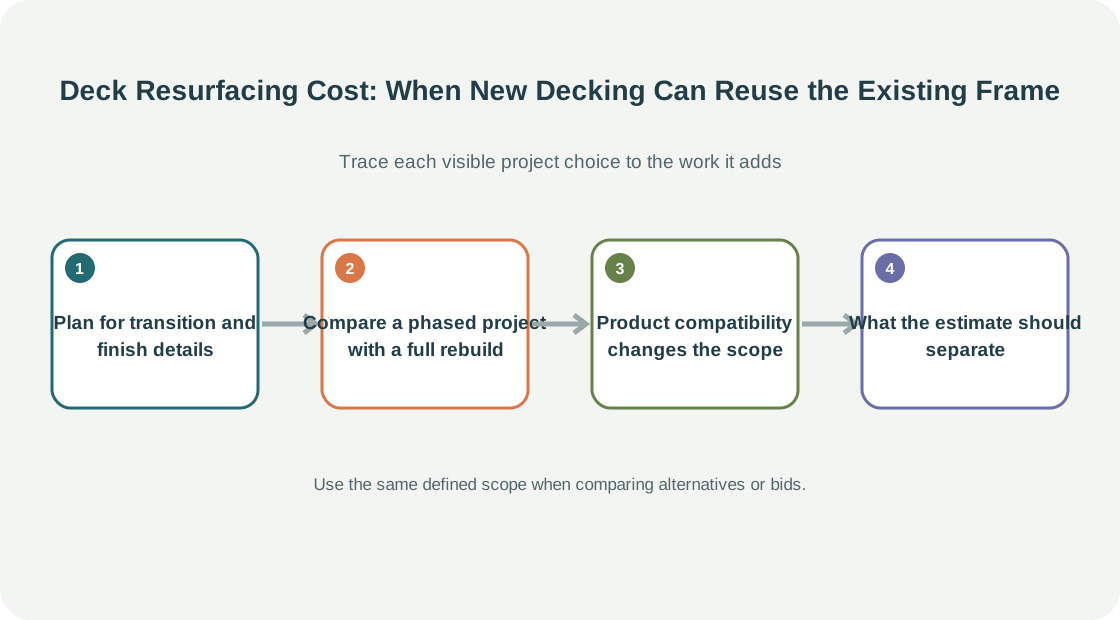
Resurfacing affects the deck’s edges as well as its field boards. Identify fascia, stair treads, landings, railing post attachments, door thresholds, skirting, built-in seating, and any drainage outlets. Ask whether they will remain, be removed and reinstalled, or be replaced. If new boards change thickness, the transition at stairs and doors may need adjustment.
Material appearance also changes the comparison. New boards may not match weathered rails or adjacent porch flooring. If the homeowner wants a consistent finish, price rail or fascia work separately. If the surface is composite, ask about color availability and future matching; if it is wood, ask how new boards will be finished and whether the whole surface will need treatment.
Compare a phased project with a full rebuild
Where the frame is suitable but stairs or railings are not, a mixed project may be a reasonable option. Price the surface, stair, and guard scopes separately, then compare them with a complete replacement. Include removal and disposal, temporary access, landscape protection, and restoration for both alternatives. A phased approach can preserve costs now but may require repeated contractor visits and finish transitions later.
If the homeowner plans a roof, enclosure, or heavier feature, evaluate that before resurfacing. Installing an attractive surface first and redesigning the frame later may create avoidable removal and replacement work. Future use should be part of the current professional review, not inferred from the board material.
Product compatibility changes the scope
Trex guidance describes its decking as a non-structural surface installed over code-approved structural framing. It also makes support spacing, fastening, gapping, product family, and stair conditions product-specific. A different board material may require frame changes, extra support, new fasteners, or a different stair treatment. Check the current instructions for the exact product; do not transfer one manufacturer’s details to another system.
What the estimate should separate
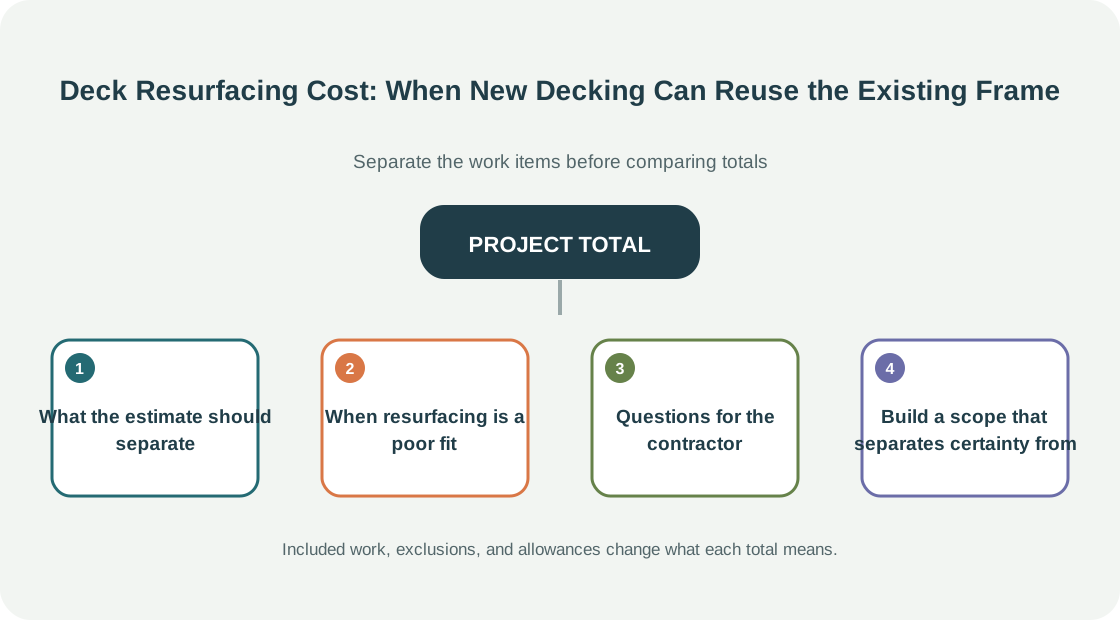
Ask for line items covering removal, disposal, inspection or opening-up work, board and fascia installation, stairs, railings, fasteners, frame corrections, flashing, finish, access, and cleanup. Include an allowance for hidden damage discovered after demolition. If the frame needs widespread correction, compare the result with a full replacement rather than treating every added repair as a minor change order.
Market summaries provide broad U.S. deck context, but they do not establish a reliable universal resurfacing price. Canadian costs require Canadian quotes or evidence, not currency conversion.
When resurfacing is a poor fit
Resurfacing is a weak choice when the ledger or footings are questionable, several structural members are deteriorated, stairs or guards cannot be adapted, water management is failing, or the new surface would require an incompatible support pattern. A roof, enclosure, hot tub, or other major load change also requires a separate professional evaluation.
Questions for the contractor
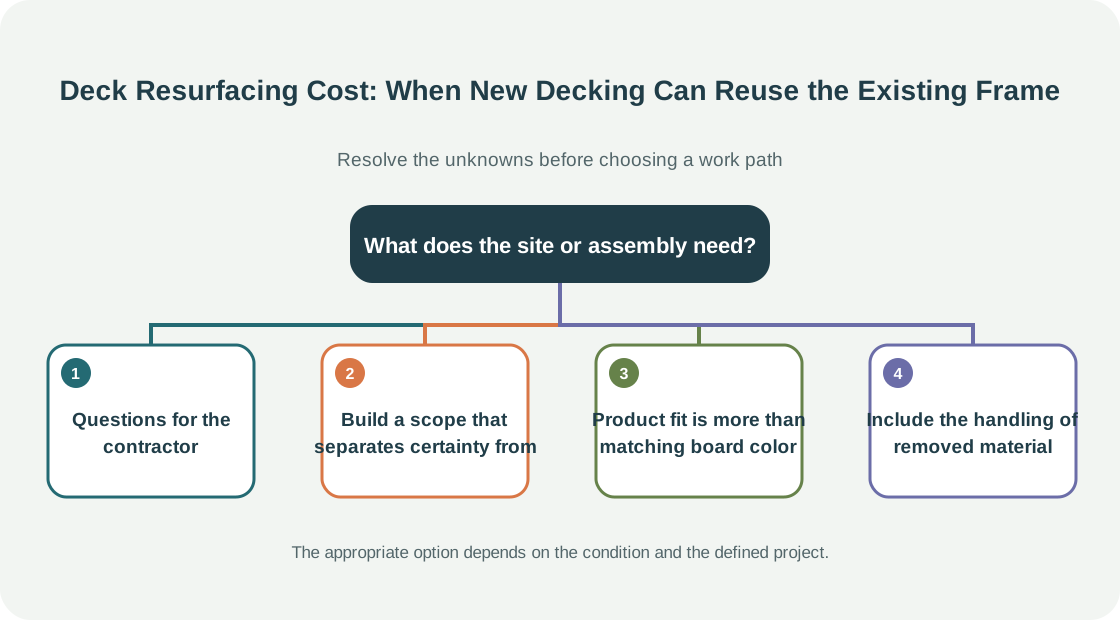
Ask what evidence supports frame reuse, which parts were concealed, how the selected product is supported, whether the stairs are included, what happens if joists or flashing fail inspection, and whether the price includes disposal and restoration. A good resurfacing quote explains the boundary between a new surface and the existing structure.
Build a scope that separates certainty from contingency
Ask the contractor to identify what can be seen before demolition and what will remain concealed. A written proposal can set out a base price for the visible scope and a separate process for damage found after boards are removed. The contingency should name the conditions that trigger it, how additional work will be priced, and whether the owner approves each change before it proceeds. An undefined allowance makes it difficult to compare bids or control the project.
Separate components that may be disturbed even if they are not part of the new surface: guard posts, stair stringers, fascia, flashing, drainage outlets, and nearby siding. Ask whether the contractor will remove and reinstall these items, replace them, or leave them untouched. If a railing or stair cannot meet the selected product’s current support requirements, the quote should identify the needed change rather than treating it as an incidental add-on.
Product fit is more than matching board color
The selected surface has installation requirements that affect the supporting frame. Trex’s current 2026 guide describes its decking as non-structural, says each board end must rest on a framing member, and gives product-specific fastening and framing requirements. It states a maximum decking overhang of 3/4 inch for the guide’s addressed system. These are Trex instructions for the covered products, not universal decking details or a local code determination. Check the current guide for the exact product and configuration before pricing a reuse plan.
Compatibility includes board profile, joist support, fasteners, drainage, stairs, edge treatment, and the relationship between the deck surface and doors or transitions. If the old frame does not match the selected system, estimate the required alterations before concluding that resurfacing is less expensive than rebuilding. A mixed scope with new surface, frame modification, and partial replacement may still be sensible, but it should be compared transparently.
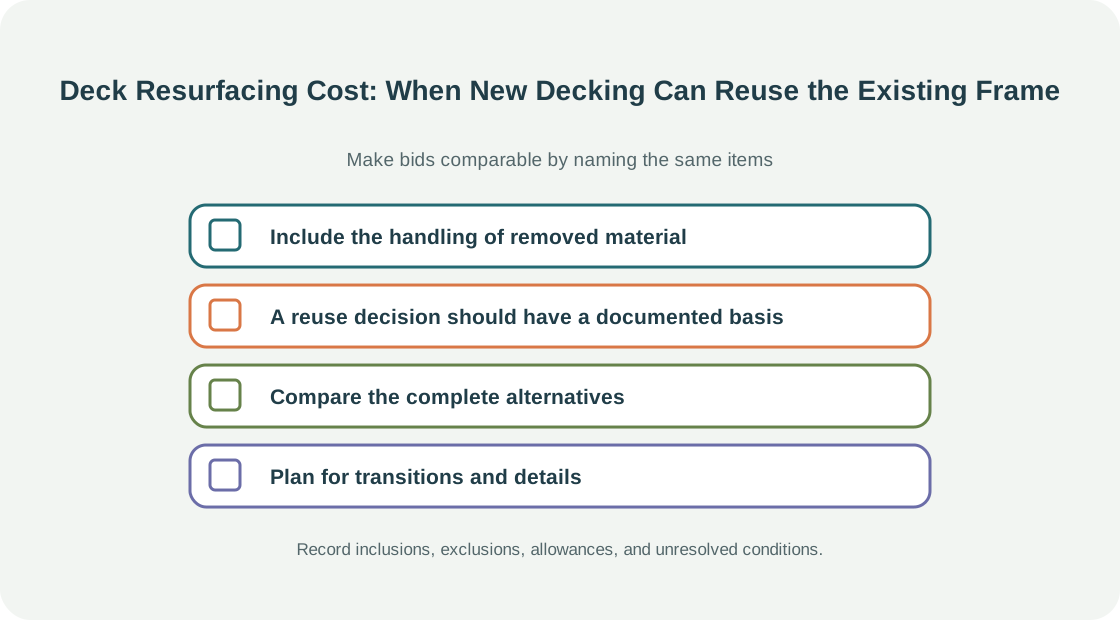
Include the handling of removed material
Older decks may contain treated lumber, but appearance does not confirm the preservative. Health Canada says a Canadian residential deck built before 2004 is likely to contain CCA-treated wood, while aged material can resemble untreated wood. It advises minimizing exposure when damaged or deteriorating wood is handled and replacing damaged pieces. The U.S. EPA gives separate U.S. guidance: existing structures do not require blanket removal, dust should be limited when handling, treated wood should not be burned at home or reused as mulch, and local disposal rules should be followed.
If treatment is uncertain, ask the contractor to explain the handling and disposal plan for removed boards and debris, including who checks current local requirements. Do not assume the whole deck must be removed because it may be older treated wood. The relevant decision is how to complete the chosen repair or replacement scope with appropriate care and local disposal.
A reuse decision should have a documented basis
Ask the contractor to record the frame condition, product compatibility, areas not visible, and any repairs required before boards are installed. If the proposal relies on an inspection by the same contractor, clarify what it covers and whether a written report or photographs are available. If the deck has movement or a questionable connection, an independent structural opinion may be useful before pricing a retained-frame project.
Reuse is an economic assumption, not a guarantee of future performance. If concealed conditions are found, the owner needs a price and approval process for the repair, not a blanket authorization to replace whatever is uncovered. The proposal should identify that boundary before demolition.
Compare the complete alternatives
Ask for three amounts where site conditions support them: spot repair of identified defects, resurfacing with a documented frame-reuse assumption, and full replacement. The comparison should include the same deck footprint, board product, stairs, guards, demolition, haul-away, finishes, and restoration wherever possible. State which items differ, such as retaining old footings or changing the layout.
The cheapest starting estimate may become the most expensive after widespread deterioration is exposed. Conversely, a full rebuild is not justified merely because the surface looks tired if a professional evaluation supports reuse and the selected product fits. Treat the proposed scope, documented inspection, and contingency terms as the basis for the decision—not age, a quick visual impression, or one average price.
Plan for transitions and details
Replacing the field boards can expose small details that affect the finished appearance and cost. Ask whether the quote includes fascia, stair treads, picture-frame borders, breaker boards, skirting interfaces, and removal or resetting of railing posts. A new board thickness may change the relationship to doors, thresholds, stair risers, and adjoining paving. The contractor should explain which of these details were measured and which remain subject to site verification.
Also clarify how surface water drains during and after the work. A change in board spacing, slope, or edge trim can affect where water falls, while resurfacing does not repair an underlying drainage or house-wall defect. If the deck is attached, keep flashing and ledger questions separate from the surface replacement. A project can be a viable resurfacing job only after its supporting conditions and product-specific framing requirements are established.