
Home changes can make familiar activities easier to carry out, but a change that looks helpful on a checklist may not fit the person or household. Start with the resident’s own routines and preferences, then price the smallest complete project that supports the activity. A diagnosis alone cannot determine what work is needed or whether a particular layout will help.
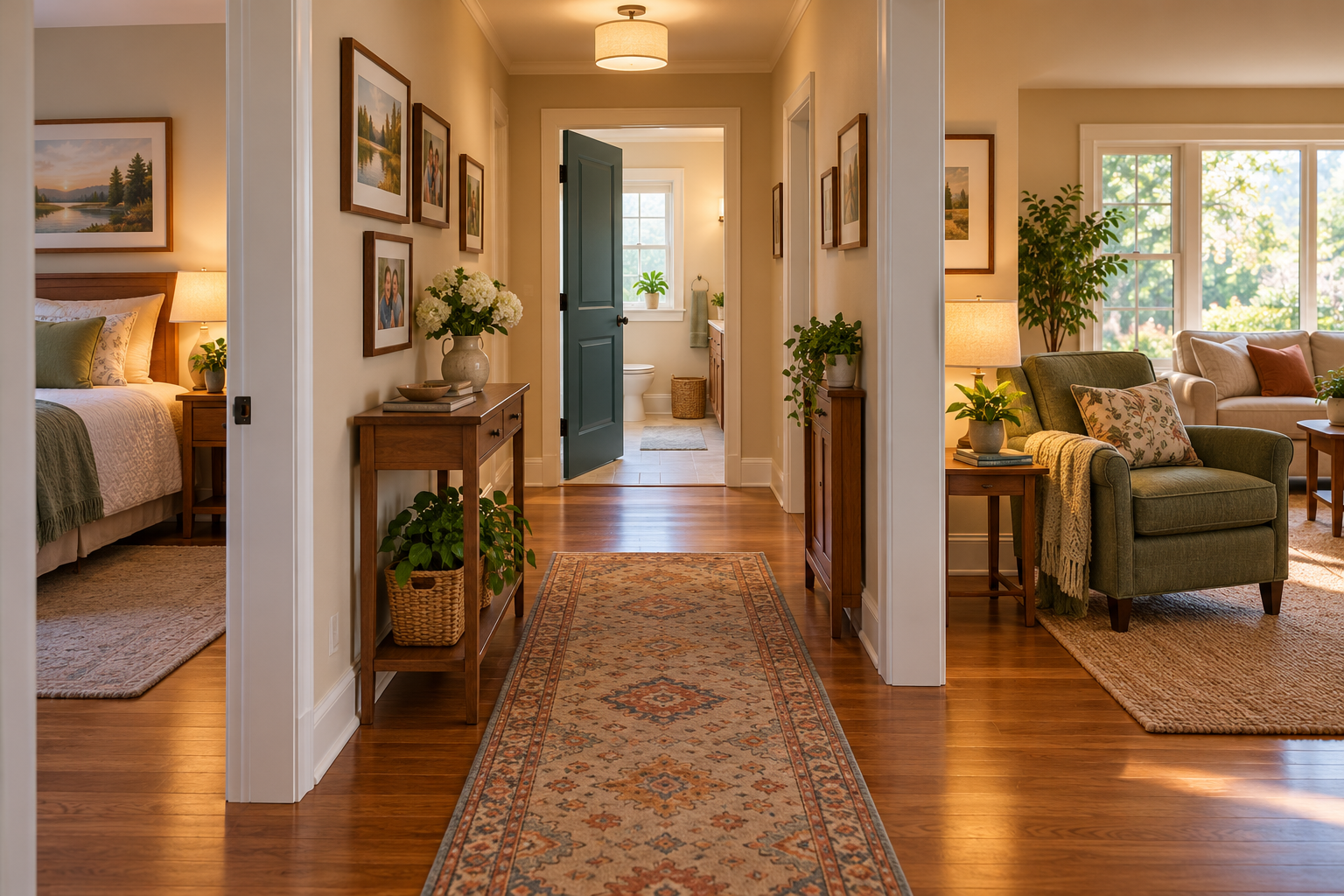
Start with an activity the resident wants to keep
Choose an ordinary activity that has become harder: finding a bathroom, turning on a light, locating clothing, using a familiar kitchen area, or moving between a bedroom and a shared room. Ask the resident what matters to them and involve them in decisions as much as they wish and are able. A caregiver can describe where extra time, confusion, or assistance occurs, but that perspective should complement the resident’s experience.
Observe the route and task at the time they normally happen. Note the lighting, contrast, noise, storage, door operation, controls, furniture, and what the person expects to find. A useful project brief describes the desired activity, the starting point and destination, who else uses the area, and what already works. It does not assume every familiar object is clutter or that all visual cues should be changed.
The Alzheimer Society of Canada advises balancing household safety with independence and familiarity. Dementia Australia gives examples such as keeping useful items visible, using simple labels, and arranging furniture around established movement patterns; these are design considerations from Australian public guidance, not requirements or a universal layout. Try an adjustment with the resident before committing to disruptive work when that can be done safely.
Get an assessment that can become a contractor scope
An accessibility-informed professional can help connect the person’s activities with the building. The American Occupational Therapy Association describes occupational therapists as one source of recommendations based on a person’s function, goals, and interests. An assessment may be helpful when several rooms, equipment, transfers, or caregiver positions interact. It is not a substitute for a contractor’s measurements, structural review, or local code check, and the role or fee is not the same in every area.
Ask what the assessment will deliver before paying for it. Useful outputs may include:
- the activity and route being addressed, including the resident’s priorities;
- barriers that are observed and which are assumptions to revisit;
- possible low-disruption changes and any larger construction alternatives;
- relevant dimensions, equipment, and caregiver-space considerations for the proposed work;
- questions that need a contractor, electrician, engineer, fire-safety official, or program administrator;
- a way to check whether the finished change works for the resident.
If a professional assessment is not available, a household can still prepare a factual scope for a local contractor: describe what happens, where it happens, what has already been tried, and what must remain usable during construction. Avoid asking a contractor to diagnose the cause of a behavior or guarantee a cognitive or safety outcome.
Compare a small adjustment with installed work
The first option may be to change the environment without remodeling: move a frequently used item to a familiar location, improve a confusing label, reduce glare, or adjust lighting. A targeted installation may change a control, doorway, storage, floor transition, or room finish. A larger project may coordinate a route or bathroom across several spaces. Each option should be compared against the same activity and the disruption it introduces.
Reversible changes can be useful while the household learns what fits, but “temporary” does not mean stable or appropriate for every person. Fixed work may integrate better and need fewer repeated visits, but it can permanently change familiar surroundings and commit the household to maintenance. Ask whether a proposed feature solves the task now, what it might make harder, and what would prompt reassessment. If the barrier is a route, doorway, bathing space, or general fall hazard, use the assessment guide, the phasing guide, and the relevant fall-prevention article for those separate decisions.
Keep the comparison specific. A light or contrast change should be judged where the resident moves and in the lighting conditions they use. A storage change should be checked during the activity, not just from a floor plan. A room remodel should show the route, door swings, furniture, controls, and caregiver position together. Focus on supporting the familiar task with the least disruptive work that is adequate.
Keep familiarity and participation in the scope
Some households may consider changing visual patterns, using contrast at selected controls, labeling storage, or making a frequently used item easier to see. These examples appear in dementia-organization guidance, but the sources do not set contrast ratios, construction dimensions, or prove that one treatment suits everyone. A strong pattern may be distracting for one person and familiar or meaningful to another. Test the change with the resident and keep a way to reverse it if it is unwanted or does not help.
Explain the reason for each change in plain language and give the resident time to respond when possible. Discuss who will move furniture or personal items, where those items will go, and how the household will restore a familiar arrangement if a trial fails. Do not treat a caregiver’s convenience as the only outcome. The project may need to balance the resident’s independence and dignity, the helper’s position, other occupants’ needs, and construction disruption.
Separate the cost layers
There is no reliable single price for a “dementia-friendly remodel.” A diagnosis or room name does not specify the work. A local budget should separate the parts that can be priced and state what remains unknown:
| Cost layer | What to define |
|---|---|
| Assessment and design | Who observes the activity, measures the route, prepares a plan, and coordinates follow-up |
| Building work | Carpentry, door or storage changes, electrical or lighting work, floor and wall changes, plumbing, and local approvals as applicable |
| Finishes and disruption | Demolition, patching, paint, flooring, dust control, temporary access, cleanup, and restoring or relocating household items |
| Equipment or alerts | Product, compatible installation, programming, training, batteries, subscriptions, repairs, and replacement |
| Ongoing ownership | Maintenance, service response, cleaning, future assessment, removal, and changes if the household’s needs or layout change |
For each proposal, ask for the same task description and room assumptions. Request itemized base work, plausible alternatives, allowances for concealed conditions, and clear exclusions. A low equipment or product price may omit installation, building work, or recurring service. Keep U.S. and Canadian bids in their own currencies and markets; do not convert one country’s example into the other’s budget. The whole-home cost guide explains how to compare broader project scopes without relying on one generic estimate.
Treat alerts and technology as a separate choice
An alert may tell a caregiver that a door opened or a device needs attention; it does not change the route itself or guarantee that an event will not occur. Consider who receives the signal, how quickly someone can respond, whether the resident finds it intrusive, and what happens if power, internet, batteries, or a subscription fail. If a system is proposed, price the device, compatible installation, testing, service, and a practical fallback separately from physical construction.
The Alzheimer’s Association describes door signals and other cues as options for a household assessment and says they cannot guarantee that wandering will not occur. Its guidance also says never to lock a person in at home. Do not block an exit or make a door change that leaves emergency egress unusable. Have local fire-safety and building requirements checked, and do not assume an alert is a replacement for a usable route or a household response plan. For broader work on visual and audible interfaces, see lighting, controls, and sensory-access changes and low-vision or hearing modifications.
Check permissions, approvals, and assistance before work
Renters, condominium owners, and homes with shared structure may need written permission before changing a door, wall, wiring, or common route. Ask the contractor which permits, inspections, structural reviews, and product requirements apply locally. A caregiver guide or an accessibility assessment does not certify a project as code-compliant.
If assistance may affect the budget, confirm the actual program, person, property, expenses, funding sequence, and application timing. The U.S. assistance guide and Canadian tax-credit and program guide distinguish conditional assistance from a guaranteed award. A diagnosis alone does not establish program or tax eligibility. Where the project creates a separate caregiver unit, the caregiver remodeling guide explains why that housing choice has its own construction and eligibility questions.
Reassess after the change
Before work starts, agree how the household will judge the result: can the resident find the route or item, complete the activity with the intended level of help, and use the space without an unwanted loss of familiarity or privacy? Revisit the same conditions after installation. Ask the resident what feels easier or harder, note unexpected effects, and check whether another occupant or caregiver must change their routine. Change or remove a feature that creates a new barrier.
Research does not establish that modifications produce one outcome for everyone. A U.S. observational study of 340 community-dwelling older adults with dementia found associations between home modifications and lower self-efficacy and positive affect. The study could not show that modifications caused those differences, and its abstract did not identify the types or timing of the changes. It is not evidence that a particular modification is harmful; it is a reason to evaluate the resident’s experience along with physical use rather than promise a benefit.
Reassess when the resident’s routine, preferences, mobility device, caregiver support, or property changes, or when a feature stops serving its purpose. A focused phasing plan can help separate immediate work from later projects. Keep the decision anchored to what the resident wants to do, what the home can support, and what the household can maintain.