
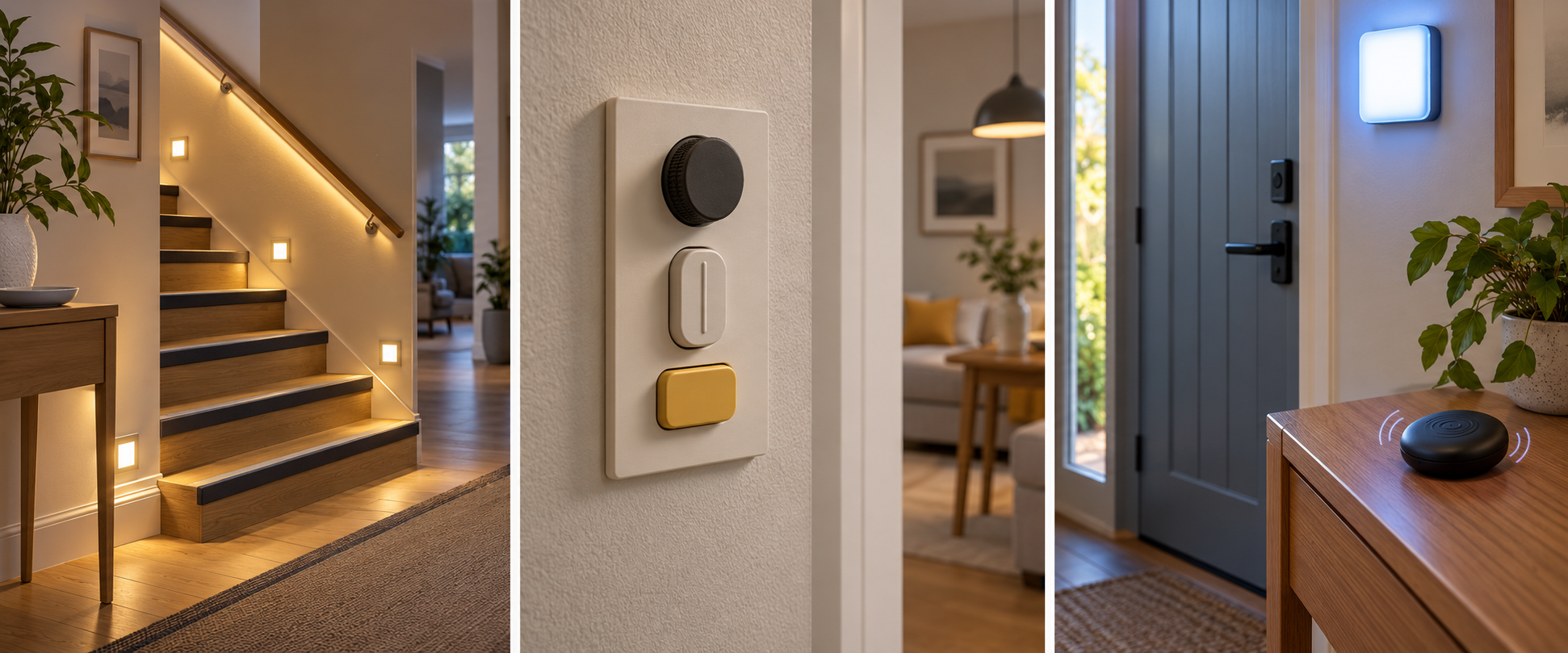
Accessibility remodeling is not limited to wheelchair routes. Low vision or hearing loss can make a home difficult to navigate, operate, or monitor even when every doorway is wide enough. Useful changes may involve lighting, glare, contrast, tactile controls, labels, visual or vibrating alerts, and clearer route organization. The appropriate solution depends on the person and the activities that matter.
Start with the activity
Identify what is being missed or made difficult: seeing a stair edge, finding a switch, distinguishing a countertop, reading a thermostat, hearing a doorbell, noticing a smoke alarm, or recognizing a visitor. Note the time of day, lighting, background noise, room layout, and whether another household member needs the same system.
Do not turn a sensory need into a diagnosis or assume one product solves every impairment. A specialist assessment may be helpful when the requirements are complex, changing, or connected to communication or safety.
Lighting and glare
Lighting work may include brighter or more even fixtures, task lighting, night lighting, switch relocation, contrast at controls, and window or shade changes. The objective is usable visibility, not maximum brightness. Glare, reflections, shadows, and abrupt changes between rooms can be as problematic as darkness.
Costs range from lamps and bulbs to new fixtures, wiring, patching, and controls. Electrical installation should be handled appropriately. Check that a motion or automatic control behaves predictably for the user.
Contrast and wayfinding
Contrast can make an edge, handle, switch, stair nosing, or route easier to identify. Changes may include contrasting trim, labels, surfaces, hardware, or better organization of furniture and storage. A busy pattern can make a floor or transition harder to interpret, so choose the treatment with the actual lighting and environment in mind.
The cost is often modest when it uses paint, labels, or hardware, but can rise when floors, cabinets, doors, or lighting must be replaced. Do not replace an entire room when a targeted change addresses the visibility problem.
Controls and labels
Large, tactile, contrasting, or easy-to-operate controls may help. Place frequently used switches, thermostats, faucets, and appliance controls where the user can identify and reach them. A label can be more useful than a new device if the challenge is recognition rather than force.
Moving a control can create electrical, plumbing, wall, or finish work. Automation and networking can assist some households but bring separate equipment and maintenance decisions; detailed platform selection belongs in the smart-home category.
Visual, audible, and vibrating alerts
Some households may need an alert that is visible, louder, repeated in another room, or paired with vibration. Door notification, telephone, appliance, and alarm interfaces should be considered together. Life-safety alarms require special care: use products appropriate to the application and follow manufacturer and applicable local requirements. Do not disable an audible alarm because another alert is being added.
This guide does not specify medical or life-safety product configurations. A qualified professional should verify the alarm, electrical, low-voltage, and installation requirements.
Cost by modification type
A small package may involve lighting, labels, contrast, and hardware. A moderate package may include new fixtures, switch locations, controls, alert devices, and patching. A larger project may combine room renovation, electrical work, low-voltage systems, and route changes.
Ask for product, installation, wiring, programming, subscriptions, maintenance, and replacement costs separately. Keep U.S. and Canadian estimates independent. Specific product performance and sensory suitability remain uncertain without an assessment and model-specific verification.
When a specialist assessment helps
Seek additional input when the user is missing alarms, cannot identify route edges, has difficulty communicating with caregivers, or needs multiple rooms coordinated. An accessibility-informed designer or relevant professional can connect lighting, contrast, construction, and equipment without assuming a checklist is enough.
The best modification is the one that makes a real activity more reliable while preserving the household’s ability to use the home. Price the construction and equipment layers, explain what the change does and does not solve, and reassess after the work is in use.
Test the system in context
Use the modification from the place where the person sleeps, cooks, bathes, enters, or waits. Test at night, in daylight, with ordinary household noise, and during the task that originally failed. Confirm that a caregiver or visitor can understand the signal and that a manual or backup method exists when power or connectivity fails.
Reassess when vision, hearing, cognition, mobility, devices, or household support changes. A good plan improves access to a specific routine, makes its limits explicit, and avoids turning a sensory difference into an unverified construction promise.
Coordinate occupants and technology
Discuss the change with the people who share the home. A doorbell alert, automated light, voice assistant, camera, or vibrating device can affect privacy, sleep, pets, visitors, and internet dependence. State who receives an alert, who maintains batteries or subscriptions, and how the household responds if a device fails. Avoid relying on a networked system when a simple local or manual fallback would be more dependable.
For building work, document fixture locations, switches, outlets, wiring, contrast finishes, and service access before walls close. Photograph or label concealed routes where a later adaptation is likely. This preserves future choice without claiming that early preparation solves an unknown sensory need.