
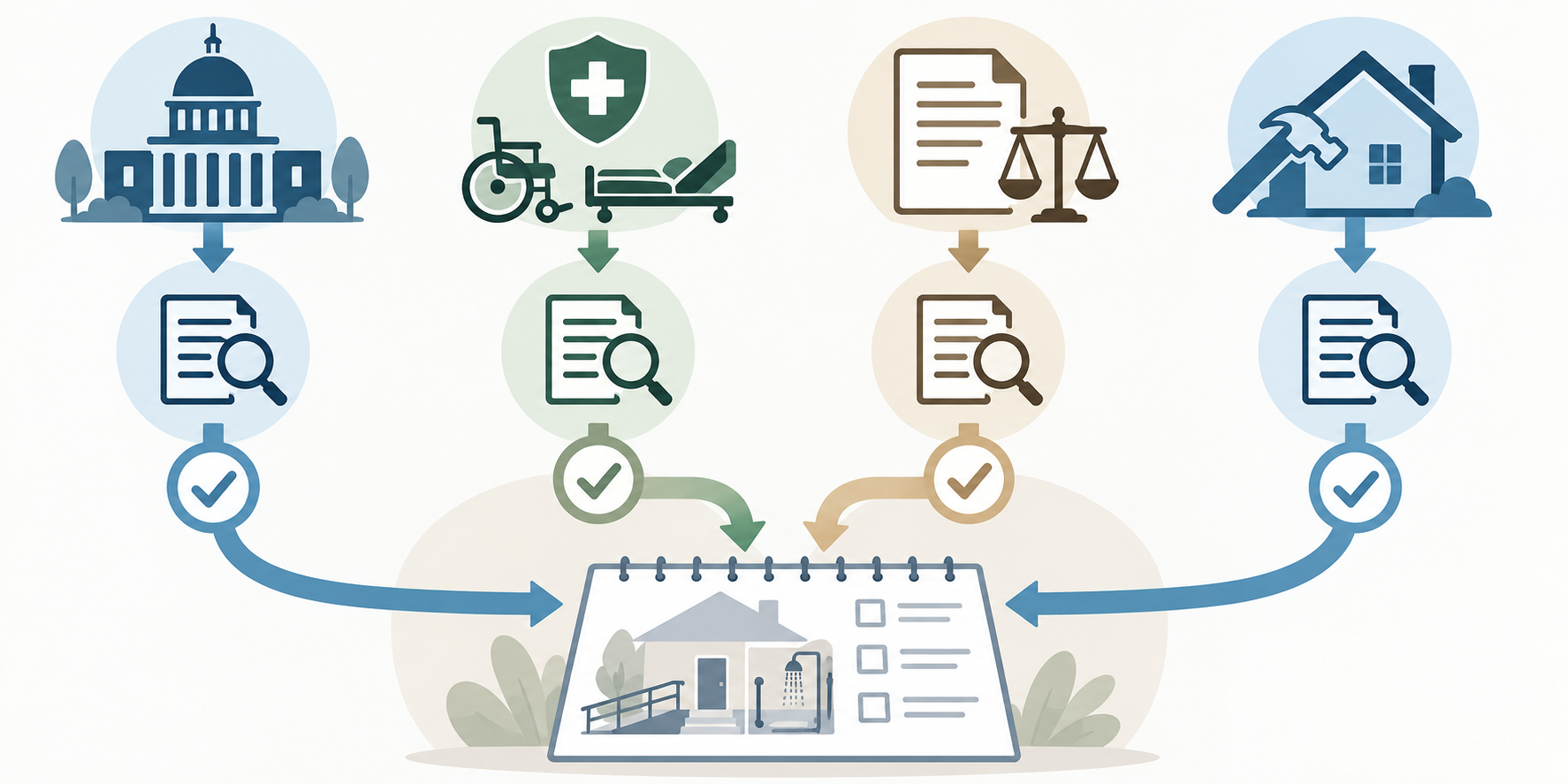
Funding for home modifications depends on the applicant, property, project, and program. Some assistance is limited to eligible Veterans, some health coverage is tied to a prescribed device, and some programs are state or location specific. A tax deduction or renovation loan also works differently from a grant. Treat every amount below as a program rule to verify, not a promised award.
Start with the applicant and project
Before searching, write down who owns or rents the home, who needs the modification, where the property is, what activity the project supports, and whether the work has already begun. Keep a short project description and a preliminary itemized quote. Programs may distinguish permanent construction from portable equipment, repair from adaptation, or the person receiving the benefit from the person who owns the property.
Ask each administrator whether approval is required before work, which contractors can be used, how other assistance affects eligibility, and whether the program pays the homeowner, provider, or lender. Do not start work based only on a general web page if the program requires prior authorization.
VA housing adaptation grants
The Department of Veterans Affairs has several disability housing pathways with different eligibility and project rules. For fiscal year 2026, VA lists maximum grant amounts of $126,526 for the Specially Adapted Housing (SAH) grant and $25,350 for the Special Home Adaptation (SHA) grant. The Temporary Residence Adaptation (TRA) maximums are $50,961 for an eligible SAH recipient and $9,100 for an eligible SHA recipient. These are statutory program ceilings; a household must meet the program criteria and the actual approved project determines use.
VA describes limits on how many times a person may use these grants over a lifetime. Confirm remaining eligibility, eligible work, application timing, and the current annual amount directly with VA before relying on a ceiling. A temporary residence adaptation is not a general payment for any rental or family home.
VA HISA is a separate pathway
The Home Improvements and Structural Alterations benefit (HISA) is distinct from SAH, SHA, and TRA. VA describes lifetime HISA amounts of up to $6,800 for qualifying service-connected needs and up to $2,000 for other qualifying needs. It requires a medical prescription and review of the proposed work for the Veteran’s primary residence.
The VA HISA page lists exclusions, including portable ramps, porch lifts, stair glides, and new construction. Do not assume that one VA pathway covers an item another excludes, or that a fixed ceiling-track system and the building work for it receive the same treatment. Confirm the exact proposed equipment, track, reinforcement, electrical work, and residence with VA. For installed overhead transfer systems, see ceiling-track patient lift installation costs.
State Medicaid and local programs
Some state Medicaid home- and community-based services authorities allow environmental modifications, but each state defines covered services, eligibility, authorization, provider requirements, and limits. Under 1915(i), for example, a state plan may include environmental accessibility adaptations for eligible participants. Other waiver authorities may operate differently.
Contact the state Medicaid agency or the specific waiver administrator and ask whether the participant is enrolled, the modification is in the approved service plan, and prior authorization is required. A general description of a federal authority is not proof that a particular state program is open or will cover a specific project.
Cities, counties, housing agencies, disability organizations, nonprofits, and insurers may also have assistance. These programs change and are not a complete national directory. Verify the administrator, current intake, eligible work, income or disability tests, contractor rules, and payment timing.
USDA Section 504 rural repair assistance
The USDA Section 504 Single Family Housing Repair program may offer loans to eligible very-low-income owner-occupants in qualifying rural areas to repair, improve, or modernize a home. Grants are limited to eligible homeowners age 62 or older and are intended to remove health and safety hazards. USDA currently lists maximums of $40,000 for loans and $10,000 for grants, with a combined loan and grant maximum of $50,000. Loan terms, location, income, credit availability, and the program’s hazard standards matter.
These are not unrestricted accessibility grants. Check current county eligibility and application rules with USDA Rural Development before including the funds in a project budget.
Separate equipment coverage from construction
Medicare’s durable medical equipment guidance includes patient lifts as a device category when medical-necessity and supplier rules are met. That does not establish coverage for every ceiling-track lift, the track itself, structural reinforcement, electrical work, or a bathroom or bedroom renovation. Original Medicare and Medicare Advantage plans have different rules; ask the plan and supplier to identify the exact item, prescription, supplier enrollment, prior authorization, and cost sharing.
Other health coverage may use its own equipment definitions. Request a written coverage decision for the specific model and installation configuration. A prescribed mobile patient lift and a fixed overhead system with building work are not automatically treated alike.
Tax treatment is not a grant
IRS Publication 502 (2025) discusses certain disability-related home improvements as possible medical expenses. In general, the deductible amount may be reduced by an increase in the home’s value, and eligible medical expenses must meet the applicable itemization and adjusted-gross-income threshold. Examples in the publication do not decide how a particular project affects a particular property or return. This is tax-year-specific information, not a cash payment or tax credit for every accessibility remodel. Keep invoices and consult current IRS guidance or a tax professional.
Financing is borrowing
FHA 203(k) and Fannie Mae HomeStyle Renovation are mortgage-financing pathways that may include eligible renovation work subject to current program and lender rules. They are not grants. Compare loan qualification, appraisal, contractor, draw, closing, and repayment requirements before choosing financing. Detailed loan comparison belongs in a lending decision, not in the project’s assumed assistance total.
Build a verified funding plan
For each potential source, record the program contact, eligibility decision, approved scope, application deadline, payment method, and whether work may start. Keep quotes separated into equipment, construction, professional fees, permits, and finish restoration so an administrator can review the actual work.
Compare the project with and without assistance. If approval is delayed or denied, know which phase can still proceed and which should wait. Do not reduce a safety-critical scope to fit an unconfirmed benefit; revise the project with qualified professionals and the funding administrator.
Verify sequence before signing a contract
Create a one-page funding checklist for each possible source. Record the contact, date checked, applicant, property, approved project description, maximum and calculation method, contractor requirements, start-work rule, payment recipient, and documents still needed. Ask the administrator to confirm any statement that is not clear on its website.
If more than one source might apply, ask each one how other assistance affects eligible costs and whether approvals can be used together. Do not submit the same equipment or invoice to multiple programs without checking their coordination rules. Keep correspondence and approval letters with the project file.
Build a fallback plan in case an award is smaller than expected or arrives after a quote expires. The household may choose to delay a discretionary phase, obtain a revised scope, or use another financing path. Do not begin work that a program says must be authorized first, and do not count a possible tax deduction as cash available to pay the installer.