
Canadian renovation assistance is a mix of federal tax measures and programs run by provinces, territories, municipalities, housing agencies, and Indigenous organizations. A tax credit is not an upfront grant, and a program’s maximum is not a guaranteed award. Start by defining the work, the dwelling, the person who may qualify, and the tax year or application window.
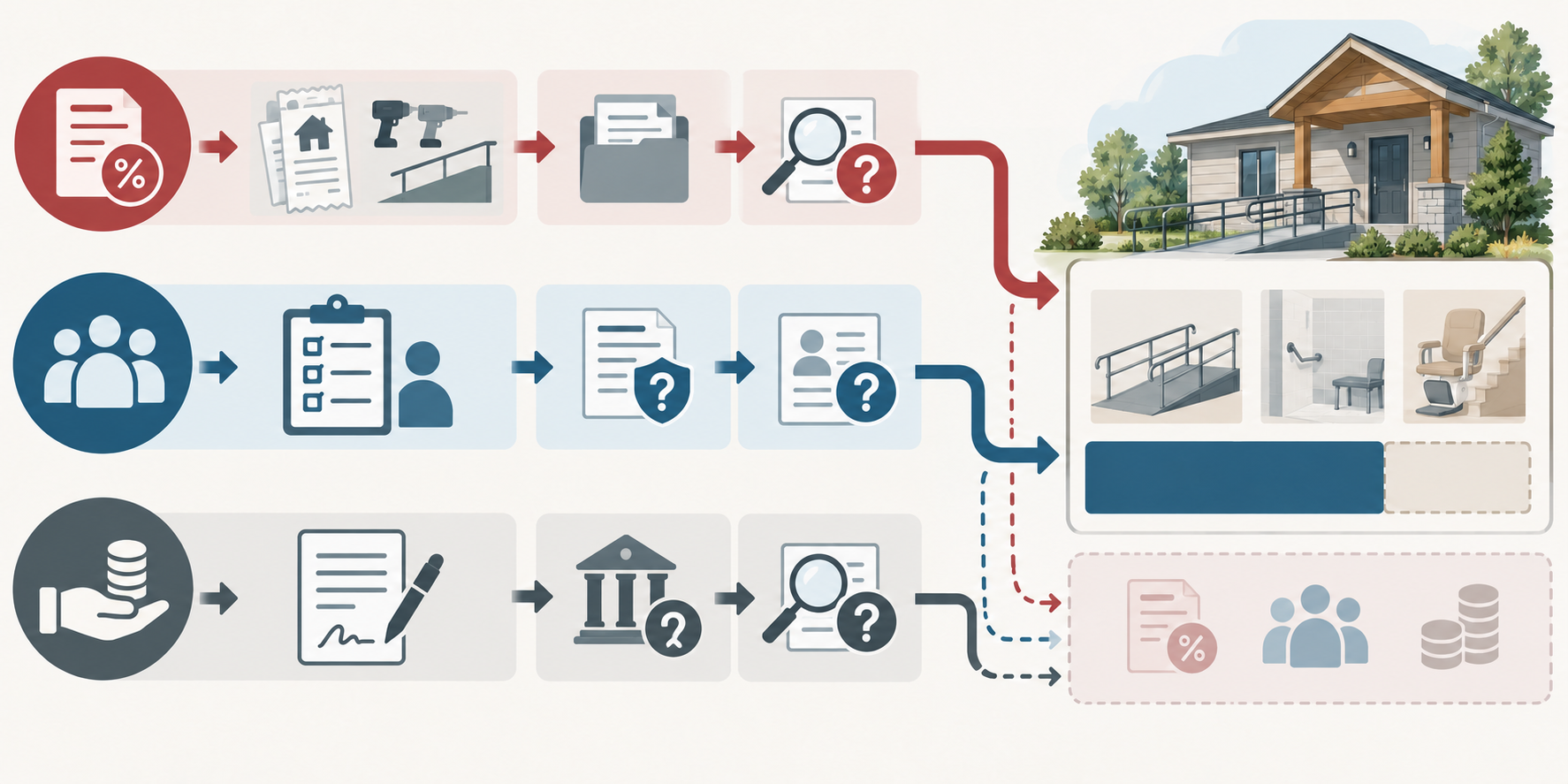
Federal Home Accessibility Tax Credit
The federal Home Accessibility Tax Credit (HATC) is a non-refundable credit for eligible expenses to make a qualifying dwelling more accessible or functional for an eligible person. CRA guidance for tax year 2025 describes a maximum $20,000 in eligible expenses. At the 2025 federal rate, the formula produced a maximum $3,000 credit before the non-refundable limit from tax payable; it is not $20,000 in cash. For 2026, the enacted federal rate change sets the lowest personal income-tax rate at 14%, implying a $2,800 maximum on $20,000 of eligible expenses if the expense cap and other claim conditions are met. CRA’s public claim page still gives tax-year 2025 guidance, so verify the current form and calculation before filing.
Eligibility depends on the person and the dwelling. CRA identifies qualifying seniors and people eligible for the Disability Tax Credit, as well as certain relatives who share or have a qualifying relationship to the dwelling. The work must meet the statutory conditions, such as being enduring and integral to the dwelling and enabling access, mobility, or reduced risk of injury. Ordinary maintenance, excluded goods or services, and work that fails the qualifying tests should not be included just because it appears on the same renovation invoice.
Use CRA’s current list of eligible and ineligible expenses for the year being filed. Ask the contractor to describe the work and separate construction, materials, equipment, and any excluded items. Keep the contract, invoices, receipts, proof of payment, property address, and records showing how the qualifying person and dwelling tests are met.
Medical Expense Tax Credit and the 2026 change
Some home modification expenses may also be considered under the Medical Expense Tax Credit (METC), subject to that credit’s separate rules. Do not assume an expense can be claimed twice. Bill C-15 received Royal Assent on March 26, 2026 and enacted a change preventing the same expense from being used for both the HATC and METC for taxation years beginning January 1, 2026.
At the time of this review, CRA’s public claim pages still presented tax year 2025 instructions. Confirm current forms, worksheets, and claim instructions before filing a 2026 return. The enacted rule and the practical filing guidance are separate questions; do not carry older proposal language or prior-year overlap examples forward without checking.
The Medical Expense Tax Credit is not the same measure as the Multigenerational Home Renovation Tax Credit. Their eligible people, work, dwellings, claimants, and limits differ.
The Multigenerational Home Renovation Tax Credit
The Multigenerational Home Renovation Tax Credit (MHRTC) concerns a qualifying renovation that creates a self-contained secondary unit for an eligible senior or adult with a disability, or a qualifying relative. It is not a general credit for any accessibility bathroom or aging-in-place remodel. 2025 CRA guidance describes a credit of 14.5% on up to $50,000 of qualifying expenses, for a maximum of $7,250. Applying Income Tax Act section 122.92, the section 248 definition of the appropriate percentage, and the amended rate in the 2026 Act gives a 14% rate and a $7,000 maximum on $50,000 for 2026. This is a statutory calculation; CRA’s published MHRTC amount page still covers tax year 2025. Verify current CRA instructions and the law for the year being filed.
Review the CRA rules for the qualifying person, relative, property, secondary unit, and eligible expenses. A project that improves access in an existing shared home may not create a qualifying self-contained unit. For caregiver or multigenerational planning, distinguish the housing layout from the separate accessibility work.
Examples of provincial and other assistance
Programs are jurisdiction-specific and can change during the year. These examples show different assistance models, not a Canada-wide entitlement or a complete directory.
- Ontario: The Home and Vehicle Modification Program has its own disability, residence, funding-sequence, and contribution requirements. The current Ontario page says other public and private funding must be accessed first and that some applicants above the stated income threshold may need to contribute. Confirm current intake and terms with the program administrator; older annual-report amounts should not be treated as today’s guaranteed maximum.
- Québec: The PAD Option 1 page currently describes professional support with an occupational therapist and accredited inspector, permanent accessibility work, and authorization before work. The program page lists up to $50,000 for the first eligible household member and $10,000 for each additional eligible member. Confirm that the current registration period is open and that the work is authorized before signing a construction contract.
- British Columbia: The provincial Home Renovation Tax Credit for Seniors and Persons with Disabilities is a refundable credit calculated on qualifying expenses. The current page describes 10% of up to $10,000 of expenses, for a maximum of $1,000 per tax year. Check the qualifying person, family relationship, expense rules, and tax year.
- Manitoba: The Safe and Healthy Home for Seniors program page describes assistance up to $5,000, or $6,500 in rural or remote areas, with household-income and age conditions. Verify current intake and detailed requirements with the program administrator before budgeting.
- Newfoundland and Labrador: The provincial Home Modification Program describes its expanded terms, effective October 1, 2026. It lists household-income limits of $51,500, or $65,000 in Labrador, and a forgivable loan of up to $15,000 with a five-year stay requirement for forgiveness. The current page says an occupational-therapy letter is no longer required for minor work such as grab bars or handrails, but remains required for major work such as bathroom or ramp projects. Apply through the current regional process and confirm funding availability, eligibility, and required approval before starting work.
- On-reserve housing: CMHC’s On-Reserve Residential Rehabilitation Assistance Program is administered through First Nations. The program fact sheet lists a maximum up to $60,000 per unit, with possible increases for northern or remote locations or adaptations for seniors and people with disabilities. The community applies and administers funds; this is not an individual Canada-wide grant. Confirm community eligibility, local priorities, and application timing.
Program amounts and availability can change. A province may have a tax credit, a grant, a forgivable loan, or a program with a separate funding administrator. Check the current provincial or territorial page, contact the administrator, and record whether approval must come before work.
Separate tax relief, grants, loans, and project cost
A credit usually reduces tax after expenses are paid and documented. A grant or forgivable loan may require an application, inspection, approved contractor, or authorization before work. A repayable loan creates debt. Do not combine headline maximums as if they were all available for the same person, expense, year, or project.
Before counting an amount in the budget, ask:
- Who applies and who receives payment?
- Does the person, home, and project qualify?
- Must the work be approved before construction?
- Are other funding sources required first or deducted?
- What documents, quotes, inspections, and deadlines apply?
- Can the same expense also be used for a federal or provincial tax claim?
Build a base budget without unconfirmed assistance, then show the verified award or tax effect as a separate scenario. If the project involves a caregiver suite or a fixed lift, price the construction and equipment separately. The U.S. assistance guide covers U.S. pathways; ceiling-track lift installation costs explains the building scope of an overhead system.
Keep records and verify the filing year
Keep contracts, invoices, receipts, proof of payment, permits, program approvals, and a description of the work completed. For shared or condominium work, preserve records showing the work and the eligible person’s share. Do not send documents with a return unless instructed, but retain what the CRA or program may request.
The safest sequence is to define the access need, obtain an itemized quote, verify the current program and tax-year rules, secure required approvals, complete the work, and then file or request payment using the proper documents. A tax professional can help when ownership, family relationships, more than one claimant, or overlapping measures complicate the decision.