
An assessment is useful when a household knows that an activity has become difficult but is not sure whether the answer is a product, a room change, or a larger construction project. It should start with the person’s daily tasks and the home’s actual routes. Buying a ramp, lift, or bathroom fixture before defining the barrier can create an expensive solution that does not fit or cannot be installed as expected.
Match the professional to the question
Different professionals answer different parts of the decision:
- An occupational therapist may assess how the person interacts with the home and which activities or environmental barriers matter. Occupational therapy is not a construction estimate.
- An accessibility-informed designer, architect, or remodeler can translate priorities into layout and construction options.
- A contractor can inspect existing conditions, price defined work, and identify likely construction dependencies.
- A structural engineer may be needed when a wall, floor, roof, foundation, or equipment load path is uncertain.
- A lift, bathroom, or other equipment specialist can address product fit, installation, service, and manufacturer requirements.
These roles can coordinate, but they are not interchangeable. Professional titles, licensing, insurance, credentials, and reimbursement vary across U.S. states, Canadian provinces and territories, and individual programs. Ask what the professional is qualified and insured to assess, what deliverable is included, and whether follow-up is part of the fee.
A simple lighting or hardware question may not need a multi-professional team. A project involving transfers, structural changes, multiple rooms, or a fixed lift may need more than one perspective. The right scope depends on the risk and complexity of the question, not the number of credentials in a brochure.
What to observe during the walkthrough
Describe activities in sequence rather than listing products. Follow the route from parking to the entrance, through the hall, to the kitchen, bathroom, bedroom, laundry, and the rooms used most often. Note thresholds, narrow points, turning areas, door swings, stairs, floor transitions, lighting, storage reach, and places where help is needed.
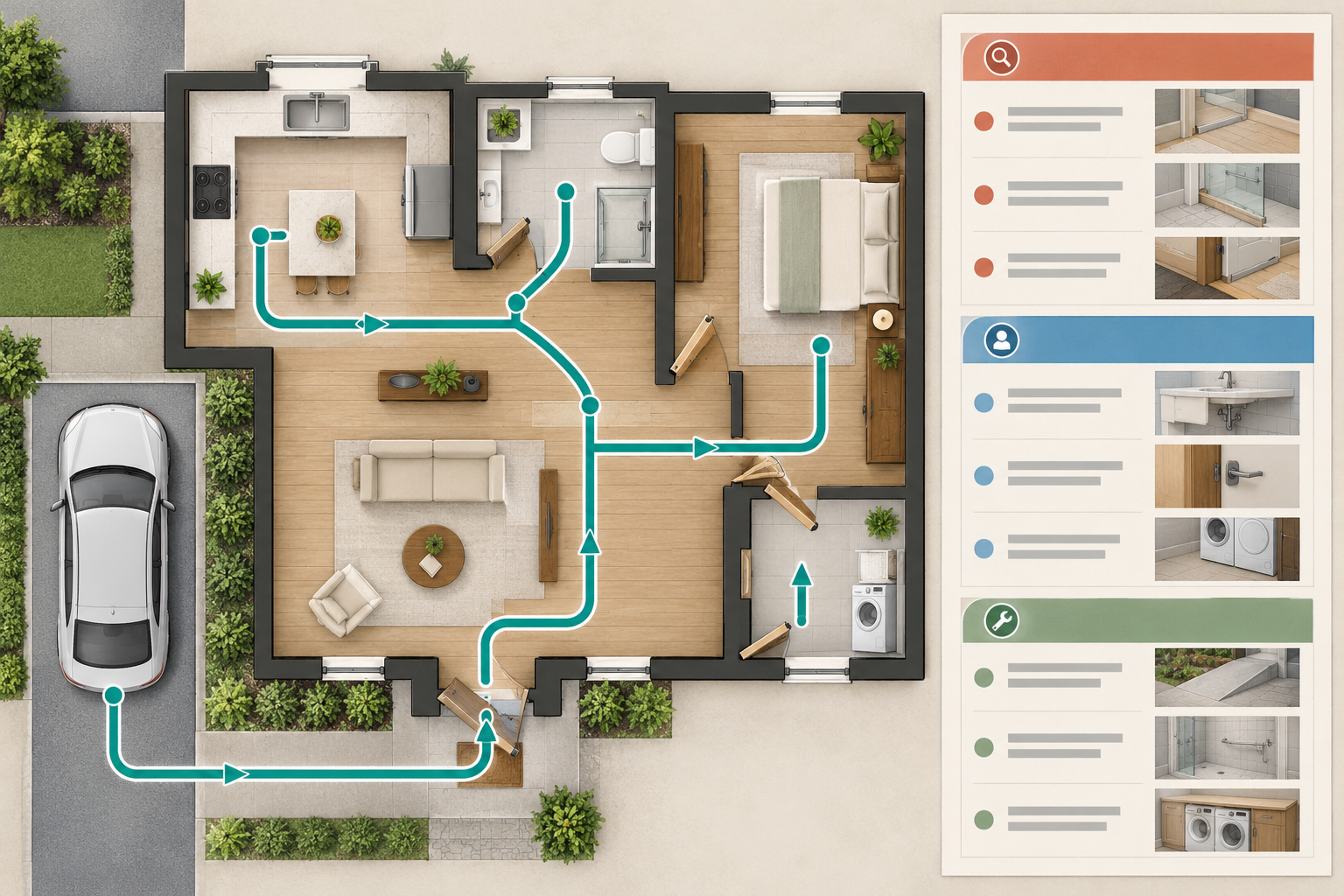
Ask the person and caregiver, if applicable, which movements are difficult and what is already working. The assessment should account for the person’s preferred mobility equipment and the space needed by anyone assisting. It should not assume a single standard layout works for every body or household.
The professional may need to distinguish an access problem from a building constraint. A bathroom difficulty might involve the entry door, toilet approach, bathing method, wet-floor risk, ventilation, floor framing, plumbing location, or all of these. A stair issue may be addressed through lighting and handrails, but a household that cannot use stairs may need a different first-floor routine or vertical-access system.
Ask for a usable written result
Before booking, agree on what the assessment will produce. A useful report records:
- the activity or route affected;
- observed barriers and relevant existing conditions;
- options considered, including lower-disruption alternatives;
- priorities and dependencies between tasks;
- items requiring a contractor, engineer, equipment specialist, or local authority;
- assumptions and limits of the assessment; and
- the next step for obtaining a comparable quote.
Ask the assessor to distinguish observations from recommendations and recommendations from construction specifications. An assessment is not necessarily a permit drawing, structural certification, equipment prescription, or fixed-price estimate. Confirm whether any such deliverable is included before relying on it.
Understand the fee and the handoff
Assessment fees may be hourly, flat-rate, bundled with design, or part of a program. Current local prices are not established by this guide. Ask whether travel, a written report, follow-up, measurements, and contractor coordination are included. A low consultation fee may cover only a brief visit; a detailed report may cost more but help bidders price the same scope.
For bidding, turn broad recommendations into measurable work: which room or route, what will be removed and installed, who supplies equipment, what finish repair is included, and what testing or inspection is expected. Request separate pricing for alternatives and optional work. A general consultation is not a promise that construction will fit a predetermined budget.
When more than one professional is involved, decide who will coordinate questions. A designer may organize the scope, while an engineer or installer confirms a specific technical requirement. The homeowner should receive the findings and know which assumptions remain unresolved.
Reassess when the decision changes
A walkthrough can become outdated when the household, building, equipment, or care arrangement changes. Revisit the assessment if a proposed product changes, a concealed condition is discovered, the household plans an addition, or the original modification does not make the activity workable. A follow-up is especially useful when the first report identified a dependency that was not yet priced.
Start with daily activities, not a catalog of products. Use the professional whose role matches the question, ask for a clear written handoff, then obtain local construction quotes against the same scope.
Turn findings into a construction handoff
A useful assessment ends with a next action for each recommendation. Mark whether it is ready for a contractor quote, needs a drawing or measurement, needs an engineer or equipment provider, or is only an option to revisit later. This prevents a broad suggestion such as “improve bathroom access” from being mistaken for a complete scope.
For a small project, a short written priority list may be enough. For a multi-room project, ask for a route plan and a room-by-room schedule of work. Identify any temporary arrangement required while the kitchen, bedroom, or bathroom is unavailable. If the assessor is also bidding on the construction, ask which parts of the report are independent findings and which are part of that contractor’s proposed scope.
A good handoff does not promise a price before a contractor inspects the property. It makes the quote more useful by describing the problem, the intended outcome, and the building questions that remain open. If bidders cannot price the same work, return to the assessor or designer and clarify the scope before comparing totals.