
There is no single price for making a home accessible. A project might change a handle, improve lighting, rebuild a bathroom, create a step-free entry, or connect two floors with equipment. Each solves a different problem and carries a different amount of design, installation, disruption, and future upkeep. Start by describing the activity or route that is difficult, then price a complete response to that need.
Think in project scales
| Project scale | Examples | What to include in a useful quote |
|---|---|---|
| Small usability changes | Better task or night lighting, lever hardware, clearer storage, selected threshold changes | Products, installation, electrical work if any, finish repair, and who will confirm the change works |
| Room-level renovation | Bathroom or kitchen changes, support blocking, reachable controls, improved circulation | Demolition, plumbing, electrical, waterproofing, cabinetry, structural work, finish restoration, and temporary room access |
| Entry and route work | Door widening, regrading, ramp, porch or landing reconstruction | Measured route, drainage, foundations, railings, weather exposure, utilities, approvals, and maintenance |
| Major adaptation or equipment | First-floor living, lift, elevator, addition, or connected rooms | Professional design, structure, power, equipment, inspection, service, lost room function, and schedule |
This scale is a way to define the project, not a national price list. A compact change can still need careful fitting; a large project may be avoided if a different room or route meets the household’s real routine.
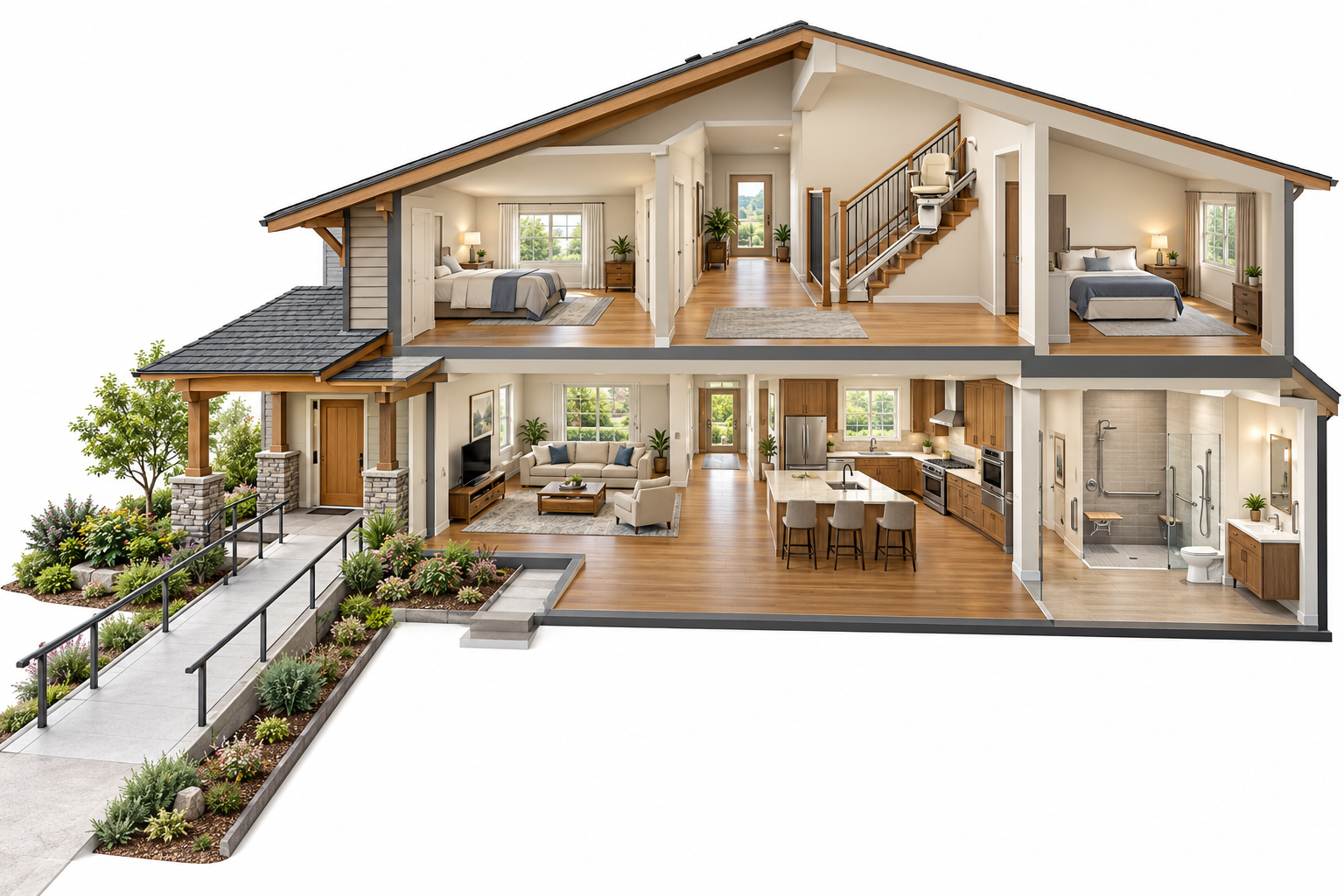
What drives the quote
The same label can hide very different work. A bathroom conversion over an accessible crawlspace differs from one over a framed floor that must be altered for a drain. A short ramp on a stable, gently sloping site differs from a long route with retaining, frost, runoff, and limited property width. Door hardware differs from widening a structural opening and moving a nearby switch.
Ask the contractor to separate:
- demolition and disposal;
- framing, foundation, and reinforcement;
- plumbing, electrical, and ventilation;
- equipment and installation;
- waterproofing, flooring, doors, and finish restoration;
- assessment, design, engineering, permits, and inspections;
- temporary accommodation or alternate bathing arrangements; and
- maintenance, service, removal, and future repair.
The goal is to see which cost comes from the access feature and which comes from existing building conditions. Ask for assumptions and exclusions in writing, especially concealed conditions, utility relocation, finish matching, and work outside the quoted room.
Prioritize the activity, not the product
Write down what the person wants to do, where the barrier occurs, how often it occurs, and who helps. A threshold may be the barrier at the entrance, or it may only be one of several breaks between the driveway, door, hall, bathroom, and bedroom. A grab bar may support one movement but will not correct an unusable route or unstable wall.
If the barrier or preferred solution is uncertain, a home accessibility assessment can help connect daily activities to the building. For several projects, phased remodeling can put current hazards and frequently used routes first while preserving choices for later.
Compare alternatives and disruption
For a vertical route, compare a stair lift, platform lift, elevator, first-floor living, and moving rooms only when each option serves the same needed destinations. For an entrance, compare a ramp with regrading or porch reconstruction. A technically possible option may consume yard or room space, require power or regular service, affect privacy, or leave another daily route unresolved.
Include household effects in the comparison: how long a bathroom or kitchen will be unavailable, who can use the temporary arrangement, whether a caregiver needs access, and whether the home can remain occupied safely during construction. Ask whether the contractor can phase work without duplicating demolition or making temporary access worse.
Keep U.S. and Canadian estimates separate
Collect quotes in the property’s own market and currency. Do not convert a U.S. estimate into Canadian dollars and present it as a Canadian installed price. The cost of labor, permitting, equipment supply, climate, and professional services differs by place and project. Current evidence does not establish a dependable national U.S. or Canada-wide total for a whole-home accessibility remodel.
A specialist marketplace estimate is not a substitute for a measured scope. Before using an online number, check its date, market, project definition, sample, and whether it includes installation, structural work, and finish repair. When the scope is not comparable, use the source only as a prompt for questions rather than as a budget target.
Make quotes comparable
Give each bidder the same room or route description, drawings where available, and written list of included work. Ask each to identify who is responsible for assessment, design, structural review, equipment selection, permits, inspections, and final testing. Request separate base and optional scopes so that a lower quote is not simply omitting work another bidder included.
After the quotes arrive, compare assumptions before comparing totals. Confirm whether an allowance is fixed or can change, how concealed damage is handled, and whether substitutions need approval. Keep a contingency for unknown conditions, but do not treat it as permission to leave safety-critical work undefined.
The most useful budget is tied to a specific activity, route, and scope. Local assessment and itemized bids can show whether a modest change is enough, whether several rooms must be coordinated, or whether a different housing plan deserves comparison.
Build comparable project scenarios
A household deciding between a handful of changes and a full renovation can ask the same bidders to price clearly separated scopes. For example, one option might address the entrance route, a second might address the entrance and bathroom, and a third might add a first-floor sleeping arrangement. State which activities each option makes possible and which barriers remain. That makes the tradeoff visible without pretending that every feature is necessary.
For each option, list the one-time construction, equipment, professional services, approvals, temporary arrangements, and recurring service separately. Include work that will be opened or disturbed, such as walls, floors, cabinetry, and exterior drainage. Ask the contractor to identify allowances and unknown conditions rather than rolling them into a single unexplained contingency.
If two bids differ substantially, compare scope before negotiating price. One may include a new electrical circuit or finish restoration while another excludes it. A cheaper bid can be useful if it is an intentionally smaller phase, but it is not an equivalent alternative until the omissions and consequences are understood.
A practical worksheet has one row per activity, one column per option, and a note for who verifies the design. Use it to identify the next decision: assessment, structural review, local permit question, or quote. Revisit the worksheet when an estimate or household need changes; do not treat a preliminary online number as a target the contractor must meet.