
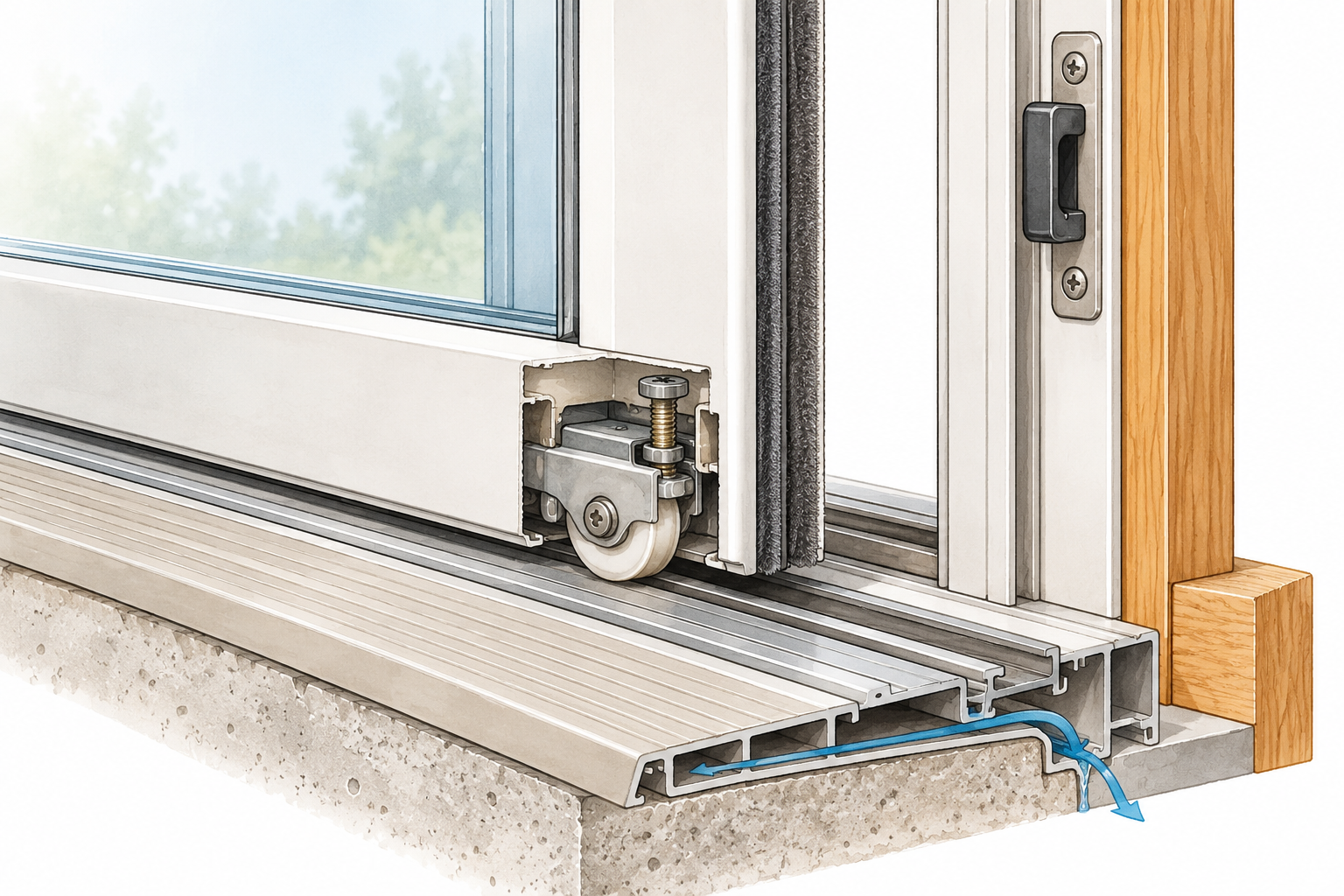
A sliding patio door that is hard to move, will not latch, leaks air, or has broken glass may need one component rather than a complete replacement. Rollers, tracks, handles, locks, weatherstripping, screens, panels, frames, and thresholds are separate scopes. Parts can be proprietary or discontinued.
Match the symptom to the likely scope
| Symptom | Possible repair | What to verify |
|---|---|---|
| Door drags or jumps | Roller adjustment or replacement; track cleaning or repair | Whether the track is worn, bent, corroded, or part of the frame |
| Door will not latch | Handle, lock, keeper, alignment, or frame adjustment | Whether the panel and jamb are square and the strike is secure |
| Broken or fogged glass | Panel or insulated-glass-unit replacement | Glass specification, safety requirements, panel weight, and manufacturer fit |
| Draft or water | Weatherstrip, threshold, sill, flashing, or wall-interface work | Whether water enters at the door or adjacent cladding |
| Screen damage | Screen panel, rollers, mesh, or track repair | Whether the replacement is compatible with the frame |
Do not assume a roller or glass panel is interchangeable across manufacturers. A replacement part should be identified by product, dimensions, configuration, and generation.
Use the symptom to narrow the repair
Start with operation and location. A door that drags may have worn rollers, a damaged track, a misaligned frame, or a threshold problem. A door that will not latch may have a handle, lock, keeper, strike, or alignment issue. A draft can come through weatherstripping, the meeting stile, the frame, or the wall perimeter. A water stain may originate at the sill, flashing, cladding, or an adjacent wall transition.
Ask what was observed and what was opened. A roller replacement is not a complete water repair, and a new lock does not prove that the frame is square or secure. The estimate should state the component, the expected result, the parts source, and the condition that would broaden the job.
Repair scenarios
| Scenario | Likely work | Main cost uncertainty |
|---|---|---|
| Poor movement | Roller adjustment or replacement, track cleaning or repair | Track damage and panel weight |
| Latching problem | Handle, lock, keeper, alignment, or strike work | Frame geometry and part availability |
| Broken or fogged panel | Glass or insulated panel replacement | Glass specification, safety, fit, and handling |
| Draft or water | Weatherstrip, threshold, flashing, or wall-interface repair | Where the path begins and finish access |
| Multiple failures | Consolidated repair or replacement comparison | Obsolete system and future parts |
Service minimums, measurement, return visits, access, interior protection, custom parts, disposal, and finish restoration can exceed the price of the visible component. Ask whether the diagnostic charge is credited and whether the repair is warranted for operation only or also for air and water performance.
When a repair is not enough
Repair is stronger when the frame, sill, threshold, and wall transition are sound, the failure is bounded, compatible parts exist, and the result restores movement, latching, sealing, or glass. Replacement becomes more plausible when the frame is distorted, the threshold or track is damaged, several components have failed, the system is obsolete, or the homeowner wants a different size or performance package.
Building America guidance treats the sill or pan, jamb and head flashing, weather seal, and wall drainage connection as an integrated opening. A new panel or roller cannot correct missing or failed flashing. If water enters at the wall, coordinate the repair with the cladding or enclosure scope.
Proprietary parts and repeat visits change the estimate
Sliding-door components are not interchangeable just because they have the same general name. Rollers, tracks, handles, mortise locks, keeper plates, screens, and glass panels can depend on the manufacturer, product series, panel size, and age. Ask how the service provider identified the replacement part—label, measurements, photographs, or a removed sample—and whether it is original, compatible, or fabricated.
A repair estimate may include an initial diagnostic visit, parts ordering, a return trip, panel removal, adjustment, and a final operating check. Request each step separately where the part is not yet confirmed. If a shop cannot identify the product before removing a heavy panel, the homeowner should understand the inspection charge and the possibility of a second visit. A quoted roller price is not equivalent to a complete repair that removes and rehanges the door.
A damaged or deeply worn track may sometimes be repaired or capped, but the proposed method should address alignment and rolling resistance without creating a water or drainage problem. A new roller cannot compensate for a bowed frame or a panel that is no longer square. If water enters at the threshold, ask whether the service is limited to the door hardware or includes evaluation of the sill and surrounding wall.
Glass and panel work can be a larger scope than ordinary hardware repair. Confirm the safety-glass construction, exact panel dimensions, tint or coating, and whether the replacement is available. Do not accept a substitute based only on visual similarity. If a component is discontinued, compare the cost and wait for a compatible panel with a full-door replacement proposal, including removal, installation, finish, and disposal.
A useful final test checks smooth travel, alignment, latch engagement, weather seals, and drainage behavior. Ask what remains out of tolerance after the repair and whether the labor is warranted. This makes the repair estimate comparable with replacement on the function the homeowner needs, not just the part that was changed.
Use the published repair figures as context, not a quote
The 2026 U.S.-oriented cost guide in the source list reports an average sliding-glass-door repair of about $400 and a typical range of $150–$800, with separate observations by repair type and configuration. Its displayed dollar sign does not establish an ISO currency, and some source-internal labor statements differ. Use the figure only as a broad publisher signal; do not convert it, treat it as a Canadian benchmark, or assume it includes a specific panel, access, or frame repair.
The source range is wide because a screen or handle visit is not the same as a glass panel, track, or threshold job. Ask the local provider to identify the symptom and part before using the average to judge the bid. A quote for a proprietary replacement panel may exceed the cost of ordinary roller work even when the door looks similar.
A repair quote should describe whether the panel will be removed and rehung, whether the opening will remain secure while work is underway, and whether the floor or track is protected. For a heavy glazed panel, include the handling method and number of technicians if that affects labor. These steps can explain why a professional repair costs more than the replacement part alone.
If a door is a major exit or connects to a deck, confirm that it will remain safely operable during the repair and that the final latch works. Where the glass is cracked, avoid using the door until a qualified professional assesses the hazard and arranges appropriate protection. The repair article is not a do-it-yourself glass procedure.
Before work begins, ask whether the repairer will preserve the original finish and whether replacement screws, rollers, or tracks will be visible. A functionally compatible part may differ in color or profile. If appearance matters, agree on an acceptable match before ordering; a special finish or obsolete component may affect price and timing.
If the issue is a screen, distinguish the screen frame and rollers from the main glazed panel. A screen repair may be a lower-cost scope, but it does not improve the door’s lock, glass, air seal, or threshold.
If a repair does not fully solve the symptom, ask what remains: rough travel, a small air gap, worn track, or damaged frame. A clear limitation is more useful than an open-ended promise of “smooth operation” and helps the homeowner decide whether to authorize further work.
If a repair affects the lock or security bar, test it from the inside and outside before final payment. Ask whether the homeowner receives a new key or code and whether the repair changed the door’s emergency operation.
Ask the repairer to state whether the panel will remain safe to use while a part is on order. Keep the door secured if the glass or lock is compromised.
If the repair involves removing the panel, ask whether the contractor will check the sill drain openings and track condition before reinstalling it. A clear track and correct drainage matter to the finished result, but cleaning does not replace repair of a damaged frame or flashing. The quote should say which of those items is included.
When a service provider recommends full replacement, ask whether the existing opening is sound and whether a smaller component repair is still available. The estimate should identify what failure makes repair unsuitable, such as an obsolete panel, damaged frame, or recurring water entry. A replacement recommendation is easier to evaluate when the remaining useful parts and repair limitations are stated.
Safety and older materials
Large glass panels need appropriate handling and product-specific safety or glazing requirements. Do not assume a replacement panel is interchangeable by dimensions alone. Confirm the exact manufacturer, series, panel weight, glass, edge, and hardware requirements.
Removing trim, paint, caulk, siding, plaster, or insulation can disturb older materials. U.S. EPA RRP guidance generally covers paid work disturbing paint in pre-1978 housing; Canadian guidance recommends assessment of older lead paint and asbestos-suspect materials. Ask who handles qualified assessment, containment, cleanup, and disposal.
The best proposal identifies the failure, inspection boundary, compatible part, labor, access, finish, warranty, and expected outcome. If repair will not correct water, air, security, or operation, say which limitation remains. That clarity makes a repair-versus-replacement decision possible.