
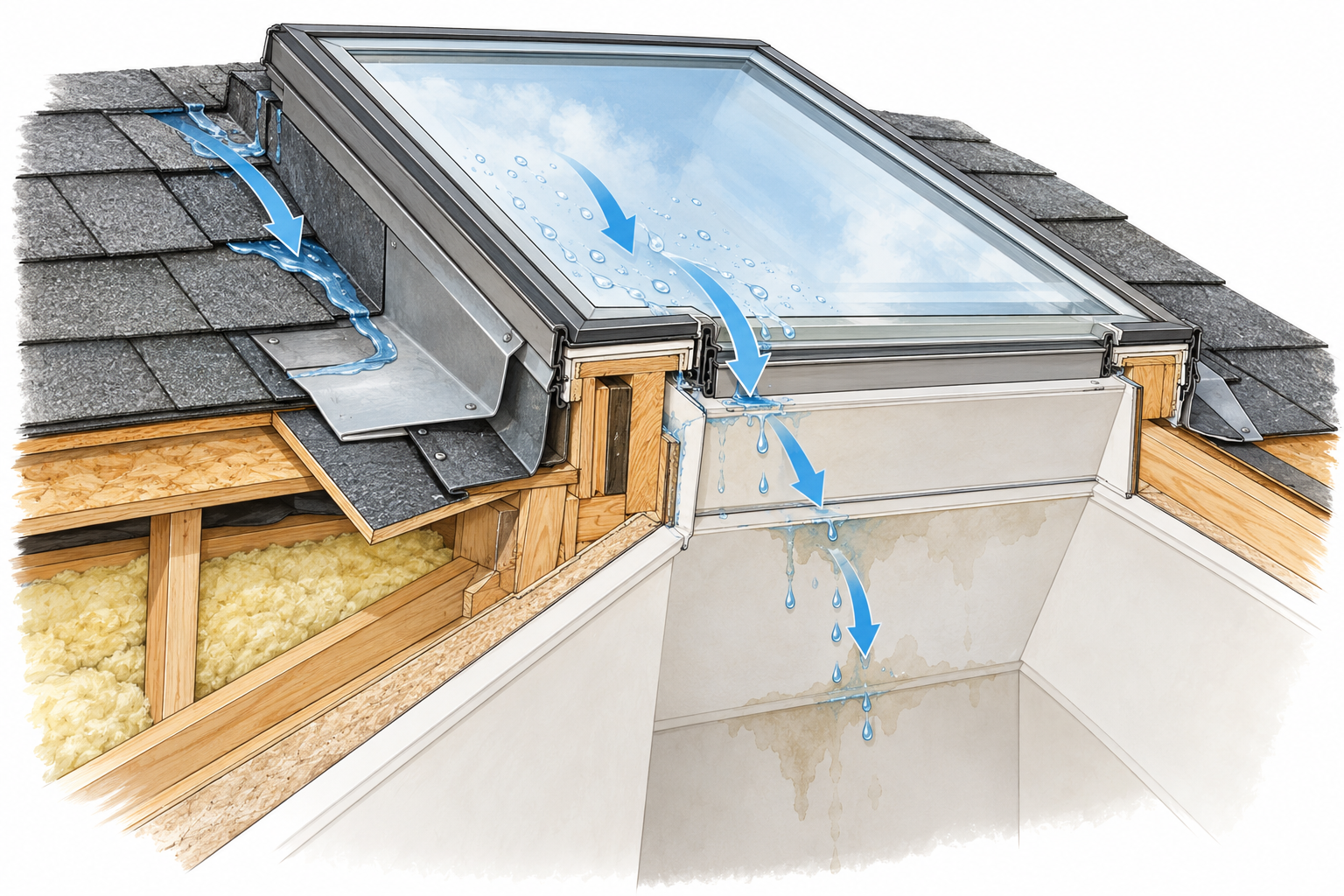
Moisture around a skylight does not prove that the skylight unit is leaking. Water can enter at roof covering, flashing, curb, frame, gasket, or an uphill transition and travel before appearing indoors. Condensation can also mimic rain leakage. Diagnosis should precede a sealant or replacement recommendation.
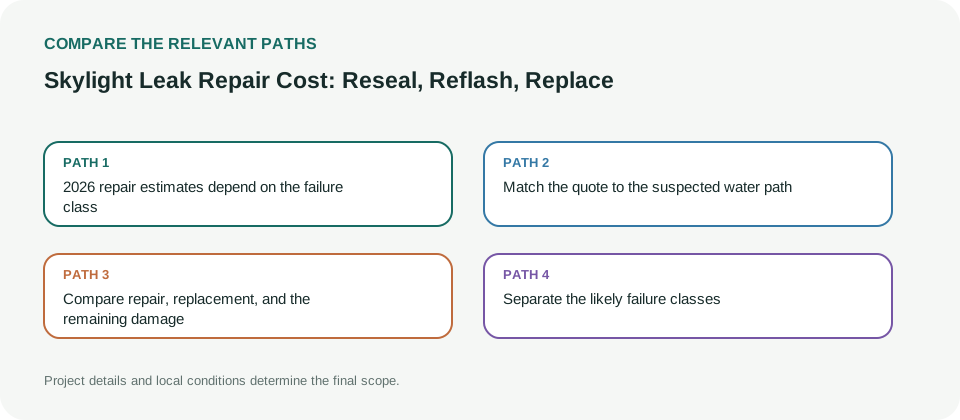
Separate the likely failure classes
- Condensation: Moisture on the room-side glass or shaft may relate to indoor humidity, cold surfaces, ventilation, or air leakage.
- Roof or flashing leak: Water may enter above the unit or at the roof-covering and flashing transition.
- Curb, frame, gasket, or glass failure: The unit itself may have a failed seal, damaged frame, cracked glass, or deteriorated gasket.
- Operator or drainage problem: A vented unit can have hardware or seal issues while the roof assembly remains sound.
- Interior consequence: Staining, damaged drywall, insulation, paint, or flooring can require a separate restoration scope.
VELUX guidance shows why product model, roof pitch, and flashing-kit compatibility matter. Its instructions are brand- and model-specific; do not apply them as universal roof rules.
Cost components
- diagnosis, roof access, moisture tracing, and limited opening;
- resealing or gasket work when the exact condition supports it;
- flashing or roof-cover repair, underlayment, and matching materials;
- curb, frame, glass, operator, or insulated-unit repair;
- complete skylight replacement and compatible flashing;
- interior drying, drywall, trim, paint, insulation, and disposal;
- access equipment, weather protection, permits, and conditional roof or framing work.
The available evidence does not establish a reliable universal repair price. Angi identifies roof or high-ceiling access as a reason skylight glass work can be unusually wide-ranging, but a glass price is not a full leak repair.
2026 repair estimates depend on the failure class
HomeGuide’s February 2026 guide gives several skylight repair observations: $225–$800 for a leak repair, $75–$250 to reseal, $75–$300 for weatherstripping, $150–$500 for flashing repair, and $150–$600 for frame repair. It reports $350–$700 for a motor replacement. The source’s main table lists glass replacement at $150–$600, while nearby narrative text gives $300–$650; the guide does not reconcile that conflict. Keep both glass observations visible rather than selecting one as definitive.
These are source-reported estimates, not a diagnosis or a guaranteed installed price. The page displays dollar signs without an ISO currency code and does not provide per-row sample sizes or clear geographic distribution. Its ZIP-code service context is U.S.-oriented, but the amounts should not be relabeled as confirmed USD or applied to Canada. Ask a local contractor what each line includes, especially roof access, call-out charges, interior repair, and water-damage restoration.
Match the quote to the suspected water path
A leak estimate should distinguish the roof covering, flashing, curb, frame, gasket, glazing, and interior finish. A flashing repair range does not prove that the flashing is the source. Water may enter upslope and travel under the roofing before appearing near the skylight. Condensation can also wet the shaft or glass without a rain leak. Ask what observations support the diagnosis and what work will confirm it.
A reseal or weatherstrip proposal is only comparable to another if both address the same joint and intended outcome. A surface patch may not correct the roof interface and can make later inspection harder. If the contractor recommends opening the roof or interior shaft, clarify access, weather protection, containment, and finish repair. Do not perform homeowner pressure or hose tests; a professional assessment should have a defined purpose, controlled method, and report if testing is proposed.
Compare repair, replacement, and the remaining damage
A motor or operator problem may be a limited service call if the frame and roof are sound and the part is available. A broken pane or failed insulated unit may require glass fabrication and a compatible sash. A recurring leak, damaged curb, obsolete unit, or broad frame failure can make replacement more practical. If the surrounding roof or shaft is damaged, restoration is a separate cost line even when the skylight itself is repaired.
Ask for the diagnostic fee, access and labor, proposed component, roof or flashing work, interior drying and finish, disposal, and warranty separately. If replacement is proposed, compare it with the quoted repair using the unit’s remaining serviceability, the roof condition, and the total work—not the glass price alone. Permanent removal is another distinct path when the homeowner no longer wants the opening; it requires closing and restoring both roof and ceiling.
Budget for access and restoration separately
A high roof, steep pitch, fragile covering, or difficult interior shaft can increase the cost even when the water defect is small. Ask whether the estimate includes roof access equipment, fall-protection setup, weather delay, interior protection, and cleanup. Do not compare a roof-repair minimum with a complete opening repair that includes access and room restoration.
The interior consequences may include drying, insulation removal, drywall, trim, paint, and damage to nearby flooring. These are not automatically part of the skylight repair. Ask who assesses moisture behind the visible stain and how the contractor will decide whether material can remain or needs replacement. If a separate restoration contractor is involved, coordinate the repair sequence so the roof is watertight before the ceiling is closed.
A written diagnosis is especially useful when the first visit cannot see the roof interface. Ask the contractor to distinguish a confirmed failure from a suspected source and provide a price to investigate further. Avoid a proposal that promises a “permanent leak fix” without naming the path, work, and limits of the warranty.
Use a staged estimate when the source is uncertain
A staged proposal can price the first inspection and the likely repair separately from work that depends on opening the roof or shaft. Ask the contractor to identify what evidence would confirm a flashing failure, a gasket issue, an uphill roof leak, or a condensation problem. If the source remains uncertain, the next stage should have an explicit purpose and approval amount rather than a broad instruction to “repair as needed.”
If the leak has damaged finished materials, distinguish emergency drying or containment from permanent restoration. The roof must be made weather-tight before interior surfaces are closed, and a restoration estimate should not conceal the repair of the source. Keep photographs and receipts for each stage, especially when a warranty, insurance, or contractor responsibility question may follow.
A recurring repair can be a warning that the first intervention addressed a symptom rather than the water path. Ask what changed after the last repair and whether the new proposal corrects the same interface. If the unit and roof remain serviceable, a targeted reflash may be appropriate; if the curb or frame is broadly damaged, compare replacement or removal. The remaining service horizon and the actual cause matter more than the number of prior sealant applications.
If the contractor proposes a new flashing kit or reflash, ask whether the existing skylight model is compatible and whether roof material must be removed beyond the immediate perimeter. A product-specific detail may not fit a different unit or roof pitch. The quote should identify the product and detail used and any limitation if the surrounding roof has deteriorated.
Keep the original leak photographs and the contractor’s proposed repair boundary. If moisture returns, those records can show whether it reappeared at the same location or moved, which helps the next professional avoid repeating an unrelated patch.
If a contractor charges a diagnostic or access fee, ask whether it is credited to approved work. Clarify whether the visit includes roof access and written findings. A separate service minimum can be a substantial part of a small repair, while a quoted repair range may not show that fee.
A quote for a roof repair should identify the material and area to be removed and replaced. Ask whether matching shingles, tiles, or membrane are available and what the contractor will do if the surrounding material is brittle or damaged during access. The estimate should include a clear repair boundary and finish warranty.
When more than one repair path is plausible, ask the contractor to rank the possibilities and state what would confirm each one. A written diagnostic path is more useful than a list of unrelated repairs.
For a professional assessment, request a short written record of the suspected source, inspection boundary, any test performed, and recommended next step. The report should distinguish a confirmed finding from a working hypothesis. This helps the homeowner compare a targeted repair with replacement without treating an uncertain diagnosis as a guaranteed cause.
If the repair involves roofing materials under warranty, ask who coordinates with the roofer and how the skylight work affects that coverage. Keep the manufacturer’s product warranty and the roofing contractor’s workmanship warranty separate. A written scope should identify the interface each party will restore and who to call if the same leak returns.
Do not use a surface patch as the diagnosis
Surface sealant can mask the entry point or make later inspection harder. Ask the contractor to identify the suspected source, what will be opened, how the roof and flashing are corrected, and what outcome is warranted. If the unit is sound but the roof is not, replacement may waste money. If the unit, curb, or flashing is obsolete or broadly damaged, repeated small repairs may be poor value.
If work disturbs older roofing, trim, paint, or suspect materials, confirm the applicable U.S. lead-safe and Canadian hazard requirements. Compare repair, replacement, and permanent removal only after the water path and remaining service horizon are clear.