
Replacing a skylight in an existing opening can be narrower than installing a new one, but “same opening” does not guarantee a direct-fit exchange. Curb or deck mounting, dimensions, roof pitch, flashing kit, roof covering, water damage, access, and interior finish all need to be checked.
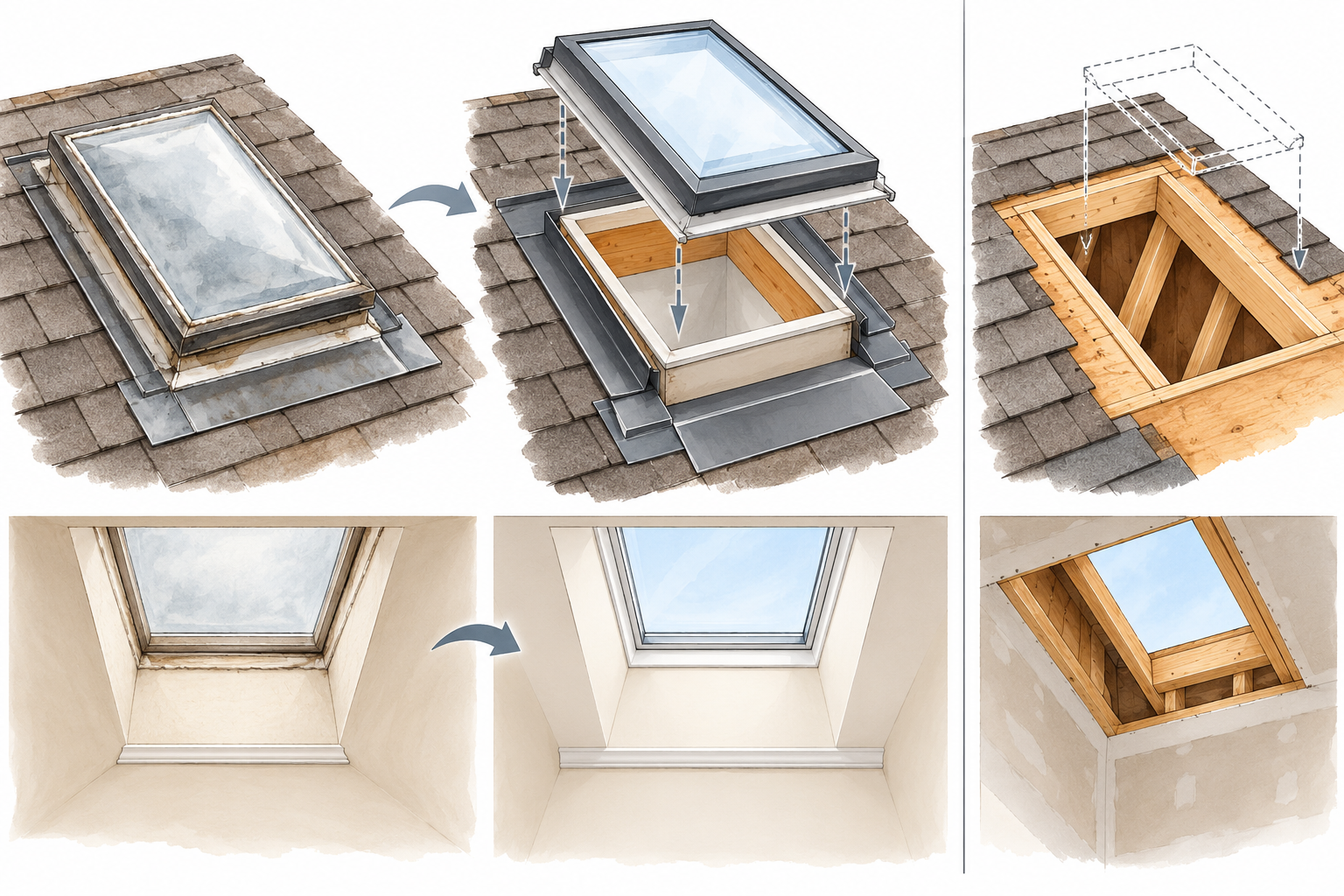
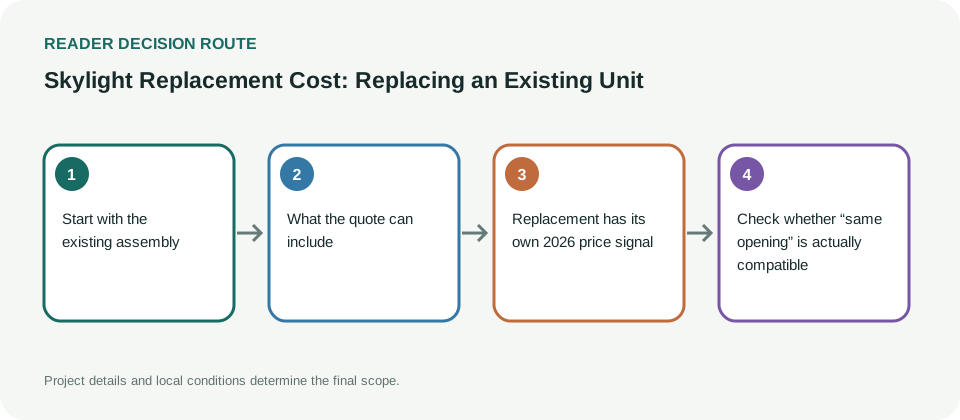
Start with the existing assembly
Record the manufacturer, model, dimensions, mounting method, roof pitch, roof covering, flashing, shaft, and visible interior staining. Legacy units may have discontinued dimensions or curbs. A current unit may require adaptation, a new flashing kit, roof-cover disturbance, trim work, or a different interior finish.
VELUX provides model-specific installation instructions and identifies roof pitch and flashing-kit compatibility as material selection constraints for its products. That is useful manufacturer guidance but does not establish a direct fit for every brand.
What the quote can include
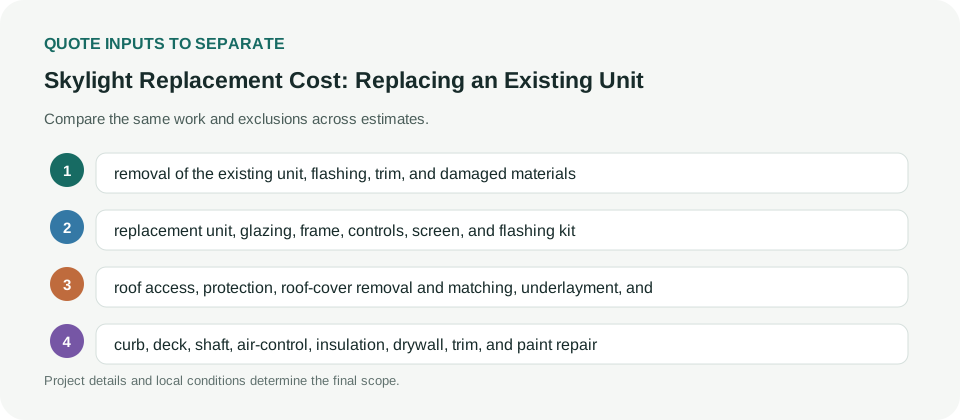
- removal of the existing unit, flashing, trim, and damaged materials;
- replacement unit, glazing, frame, controls, screen, and flashing kit;
- roof access, protection, roof-cover removal and matching, underlayment, and counterflashing;
- curb, deck, shaft, air-control, insulation, drywall, trim, and paint repair;
- diagnosis or repair of damaged roof deck, framing, insulation, or interior finishes;
- disposal, weather protection, taxes, permits, and warranty conditions.
Building America guidance treats openings as part of a surrounding water-management system. A new skylight can still leak if the roof and flashing interface is not resolved. Ask what is included below and above the roof covering.
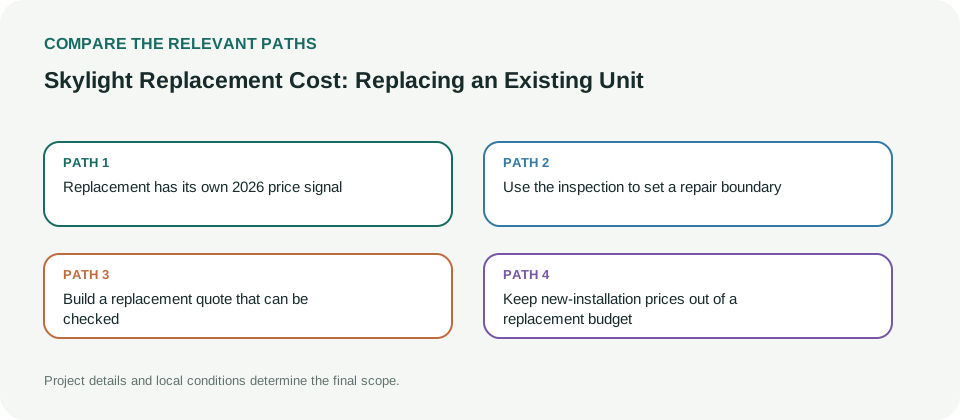
Replacement has its own 2026 price signal
HomeGuide’s February 2026 page lists $800–$2,400 for a full skylight replacement and separately lists $1,600–$4,200 for a new installation where no unit existed. The displayed dollar sign has no ISO currency code, and the guide does not give a per-row sample size or clear geography. Treat these as one publisher’s broad source estimates, not a verified U.S. or Canadian range. They are not interchangeable: replacement assumes an existing opening, while a new installation creates one.
The lower part of a replacement scope may involve a compatible unit and a straightforward flashing/roofing interface. A more complex job can need a new curb, altered opening, matching roof cover, difficult access, shaft repair, or interior finish restoration. A unit price does not show whether those items are included. Ask the bidder to separate the product, installation, roof covering, and interior work.
Check whether “same opening” is actually compatible
Record the existing manufacturer, model, outside frame dimensions, mounting style, curb height, roof pitch, roof covering, flashing system, and visible water or finish damage. Older openings may not match a current unit, even if the nominal size seems close. A deck-mounted and curb-mounted unit are different arrangements, and a current flashing kit may require changes to roofing or curb dimensions.
Ask for the manufacturer’s current installation instructions for the exact model and whether the proposed replacement keeps the existing curb, changes it, or rebuilds the opening. If the roofer and skylight installer are different, identify who removes the roof material, provides underlayment and flashing, and restores the roof covering. The interior shaft may also need adjustment if the new unit’s frame or dimensions differ.
Avoid paying twice for bundled work
A roof replacement may make access and matching easier, but the proposal should show whether skylight removal, replacement, flashing, roof repair, and interior finish are included in the reroof price or priced separately. If both documents include the same flashing or roof-covering work, there may be overlap; if neither includes it, the apparent package price is incomplete. Ask for one coordinated scope with responsibility assigned to each contractor.
Compare repair, compatible unit replacement, and new opening only if the homeowner wants a size or location change. Repair can be appropriate when the glass, frame, curb, and surrounding roof are sound and the failure is bounded. Replacement may be justified when the unit is obsolete, the glass or frame is failing, or a repeated leak cannot be corrected at the interface. A new opening is a broader project. The estimate should state which decision it prices and what condition would change that scope.
Use the inspection to set a repair boundary
A replacement proposal should distinguish visible damage from conditions that will only be known after the unit or flashing is removed. Ask for photographs of the curb, frame, roof deck, and shaft where accessible, and a written stop point for concealed rot or wet insulation. If the contractor discovers a damaged deck, the homeowner should know whether the repair is included, priced per area, or requires a separate approval.
Also ask whether the current unit is compatible with the old opening before ordering. If an adapter, new curb, or altered rough opening is needed, the project is not a simple exchange. That work may affect roof covering, interior trim, and product dimensions. A written measurement and model check reduces the risk of a replacement that cannot be installed without extra carpentry.
Build a replacement quote that can be checked
The contractor should record the existing product identity and dimensions before ordering. Ask for the new unit’s model, outside frame size, curb or deck mounting, required roof pitch, flashing kit, glazing, and operation. A product with a similar nominal size may still need an adapter or altered opening. The estimate should state whether those changes are included and whether they affect the roof or interior finish.
Separate removal, new unit, flashing, roofing, interior shaft, access, taxes, disposal, and any concealed deck or frame repair. If one line combines several trades, ask who owns each part and which warranty applies to the interface. Ask how the opening is protected between removal and installation and whether an interior patch and paint are included. These details are especially important if the homeowner is comparing a roofer’s package with a skylight specialist’s quote.
Before signing, compare the replacement with a repair quote only if both address the same diagnosed problem. A repair that includes a flashing correction is not comparable to replacing only the glass, and a new unit without interior restoration is not a complete comparison. Ask each contractor to name the condition that would make the proposed scope inadequate.
Keep new-installation prices out of a replacement budget
A replacement uses an existing roof opening, but may still need curb or deck changes. A new installation creates an opening and can include structural framing and a shaft; its total should not be mixed with the replacement figure. Similarly, a roof-over cost is not the cost of installing a new skylight. Separate these project types before using any published price context.
If the homeowner is replacing several skylights, request an opening-by-opening schedule. Different models, roof planes, curb heights, and shaft depths can make the work vary. Ask whether the contractor is using one mobilization and whether any pricing assumes the same product across all units. A group total can be misleading if one difficult unit creates most of the labor.
The new unit’s operation should be tested before the shaft and roof work are considered complete. Ask for the remote, screen, rain sensor, or control instructions if those features are included, and confirm who will adjust them.
A replacement quote should state how the old unit will be protected or disposed of and whether any interior furnishings are moved. If multiple trades work at the opening, assign responsibility for temporary cover, debris, and final cleanup. These details help compare the complete cost and disruption.
Ask what the price does not include
Confirm whether the estimate includes removal and disposal, temporary weather cover, replacement flashing, roof-cover repair, shaft work, painting, access, taxes, and permit or inspection fees. If a contractor uses an allowance, ask what observation will trigger it and who will approve the additional amount. A written list of exclusions is part of a usable cost comparison.
If an opening is difficult to reach from inside, ask whether furniture protection, scaffold setup, or ceiling access changes the labor. The contractor should also state how the room is kept secure and dry while the old unit is out. These details can be as important as the window price when planning the household schedule.
If the new unit changes the room’s daylight or ventilation goal, confirm that the selected product provides that function before comparing its price with a fixed replacement.
Repair, replace, or coordinate with reroofing
Repair may fit when the unit, curb, frame, and glass are sound and a bounded flashing, seal, operator, or roof repair can correct the problem. Replacement is more plausible when the unit is obsolete, the seal or glass is failing, the frame or curb is damaged, or the desired performance or operation has changed. Coordinating with reroofing can alter access and roof-covering costs, but it does not remove the need for compatible product and flashing details.
There is no reliable universal skylight replacement price. Ask for the unit, roof scope, flashing, access, finish, disposal, and concealed-condition allowances separately. The lowest product price is not the lowest completed project if the existing curb or roof covering cannot support it.