
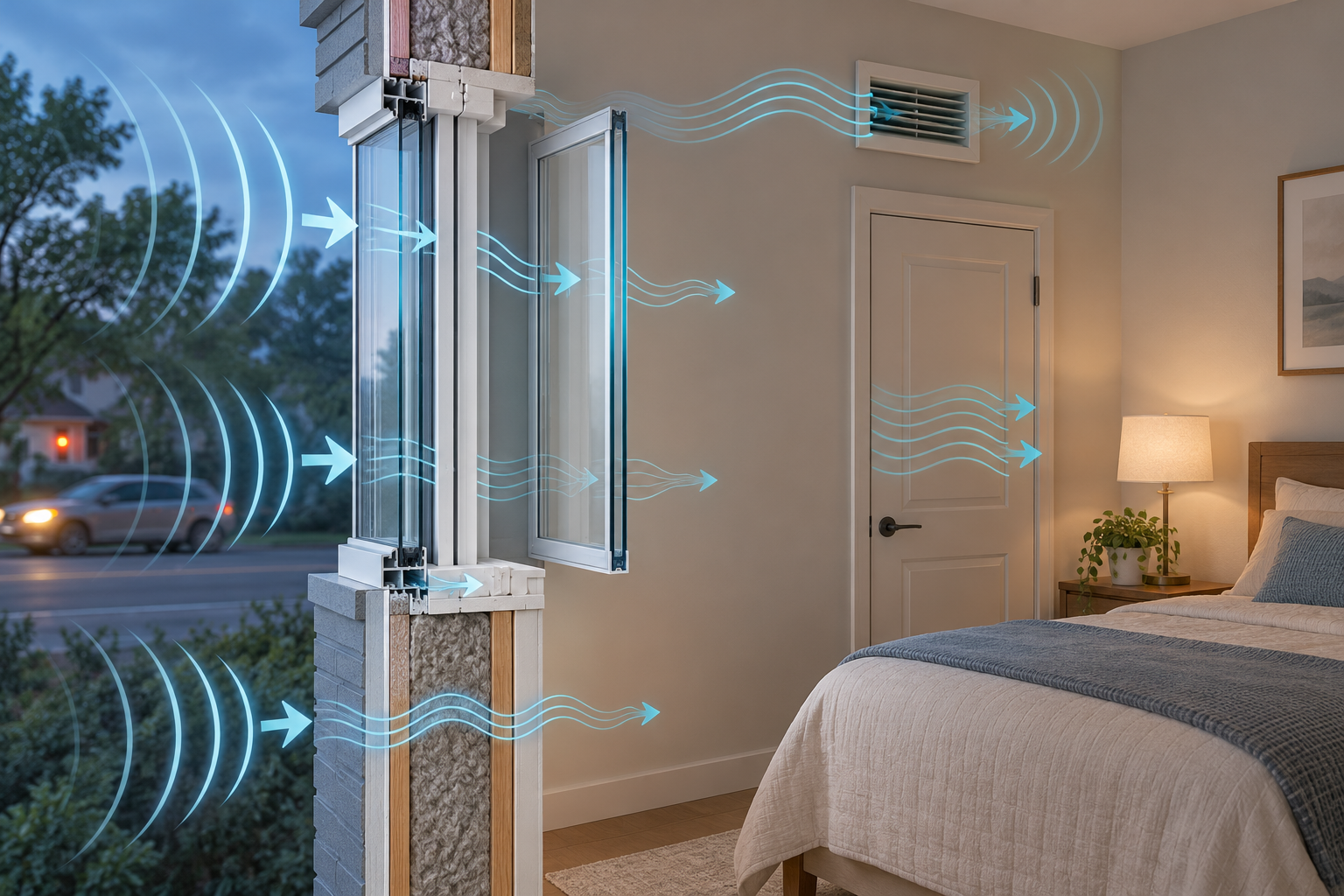
“Soundproof window” is usually a shorthand for reducing sound transmission through one opening. No window guarantees silence in every room. Noise can pass through the wall, roof, vents, doors, frame, or perimeter gaps, and the source’s frequency can determine whether a laboratory rating predicts the experience outdoors.
Describe the noise before buying an upgrade
Record the source, frequency, time, room, window position, and whether the complaint changes when the window is opened or closed. Road traffic, aircraft, voices, music, machinery, and impact sounds can travel through different paths. A window upgrade may help one path while leaving the wall, roof, door, vents, or another opening as the dominant route.
Air leakage is often a useful first question. A loose sash, failed weatherstrip, openable crack, or perimeter gap can reduce the benefit of a better glass package. If several windows and wall areas are noisy, an opening-only quote should say what it does not address. The goal is to avoid paying for glass when the sound is flanking around it.
Compare the upgrade paths
| Path | What it changes | Main limit |
|---|---|---|
| Perimeter or sash sealing | Reduces an identified air path | Does not add glass mass or isolate the wall |
| Interior secondary glazing | Adds a separated layer while retaining the window | Fit, operation, condensation, and appearance |
| Replacement glass or IGU | Changes glazing configuration within an existing frame | Frame, sash, and compatibility constraints |
| Complete replacement | Changes product, frame, hardware, and installation | Wall flanking and other openings remain |
The historical NRC digest explains that glass thickness, layer separation, frame transmission, and air leakage affect sound transmission. It reports that a well-weatherstripped openable window can perform below an equivalent sealed window and cautions that STC alone is not enough for strong low-frequency outdoor sources. Treat those findings as mechanism and question-setting context, not a current product guarantee.
Cost scenarios and evidence limits
A lower-complexity project may be a sound frame with a defined perimeter leak or a properly fitted secondary panel. A typical project may require custom glazing, access, interior trim work, and new seals. A complex project may include full-frame replacement, wall or cladding work, other openings, or acoustic design to address flanking.
The available evidence does not establish current universal product ratings, field results, or installed costs. Ask for data on the exact product and configuration, the test method, whether the rating covers a sealed or operable assembly, and what installation assumptions apply. Do not convert an STC value into a guaranteed decibel reduction in the room.
Triple glazing, laminated glass, thicker glass, or a larger air space may affect transmission, but none is automatically the best choice. The historical NRC evidence says that a third layer does not necessarily improve sound reduction substantially unless layer separation is large. Product-specific test data is more useful than a “soundproof” label.
Define the sound target before paying for new glass
“Soundproof” is not a single product result. Traffic, aircraft, voices, bass, and intermittent construction noise contain different frequencies and travel through different parts of a room. Before requesting a quote, record when the noise occurs, which rooms are affected, whether the window is openable, and whether sound is also noticeable through doors, vents, walls, or the ceiling. A window upgrade may reduce one path while leaving sound through the rest of the enclosure largely unchanged.
Ask what rating or test report applies to the proposed product and whether it covers the complete window assembly, the glass alone, or a tested laboratory configuration. The rating should match the actual size, frame, seals, and operating portions being installed. A thicker pane or laminated glass may change performance, but a glass specification by itself does not prove the result after installation. Do not rely on an unqualified decibel-reduction promise without the test condition and measurement boundary.
An interior insert or secondary glazing can add an air gap and preserve the existing exterior appearance, but fit, seals, operation, and condensation behavior matter. A replacement window can improve the frame and perimeter but may cost more and disturb trim or cladding. If sound enters mainly through an open vent, a wall, or an unsealed door, spending on a window may not produce the expected room change. Ask whether a site assessment or acoustic consultant can identify the dominant path before major work.
Compare the complete quote: window or insert, glazing, frame, sealing, removal, access, finish restoration, and any wall or ventilation work. Define a realistic success measure, such as a quieter bedroom at night or reduced audible traffic during a specific condition, rather than “silence.” Keep comfort and resale preferences separate from a guarantee that an entire room will meet a particular acoustic level.
If the proposal includes multiple openings, request the location and scope for each one. Treat the noisiest room and the easiest-to-treat window as separate decisions; the largest unit is not automatically the most important. A phased test or pilot on one opening may help when the contractor can describe how the result will be assessed, but only if the product and installation would be representative of the remaining work.
Review the result after installation
A written proposal should say how the contractor will verify that the window or insert was installed to the specified detail and what performance evidence can reasonably be provided. Field sound levels can vary with traffic, wind, open doors, and room setup, so one before-and-after reading may not match the laboratory rating. If measurement is offered, ask who takes it, where, under what conditions, and whether the method is repeatable.
A pilot installation is most useful when it represents the product, frame condition, and opening method planned for the remaining rooms. Agree in advance on what result would justify continuing and what alternative the contractor would recommend if the primary noise path remains elsewhere. That turns a large uncertain package into a smaller decision without implying that one sample proves whole-house sound reduction.
A sound upgrade may require more than changing the glass. Perimeter air sealing, sash adjustment, wall gaps, vents, and other openings can dominate what the homeowner hears. Ask whether the contractor will inspect these paths and what work is included. If the proposal adds wall or ventilation changes, separate them from the window price and involve the appropriate specialist.
If replacing multiple windows, rank the rooms by noise exposure and use. A bedroom that needs quiet at night may justify a different intervention from a living room where daytime traffic is acceptable. This gives the homeowner a basis for phasing instead of assuming every opening deserves the same acoustic product.
For a rental or condominium, check who may alter the exterior frame and whether the proposed insert changes the building façade. Approval can affect both product choice and schedule. Get written authorization before paying for custom fabrication, while recognizing that property approval does not establish acoustic performance.
If the home has mechanical ventilation or combustion equipment, do not seal vents or change airflow solely to reduce noise without an appropriate professional review. The quote should distinguish window work from any ventilation changes.
A final proposal should identify the exact unit and any tested rating documents supplied. Keep the claim tied to that product and assembly; a different size or field modification may not share the same test result.
If the household wants a quieter home for sleep, compare the expected benefit with room use and the time noise occurs. A bedroom may justify a targeted upgrade even if the rest of the house remains unchanged; a whole-house package may not be needed. Record that choice in the scope.
Compare the wider room decision
If the wall, ceiling, door, ventilation opening, or floor is weaker than the window, treating the window alone may produce disappointing value. Ask the contractor to identify the expected path and the remaining paths. An interior panel may offer lower disturbance, while a full replacement may make sense when the existing frame, seal, or operation is already failing. Repairing an air leak may improve comfort without solving low-frequency traffic noise.
Noise upgrades can also interact with ventilation, daylight, egress, and condensation. An opening that must provide escape or ventilation cannot be sealed or restricted without checking the applicable requirement. A secondary layer should not trap moisture or make the primary opening unusable.
Older materials can be disturbed during trim, glazing, or frame work. Confirm the applicable U.S. lead-safe and Canadian older-material assessment requirements. Before signing, request the source diagnosis, tested data, scope, access, finish, warranty, target outcome, and limitations. The honest goal is a quieter room under defined conditions, not universal silence.
Describe the source and desired outcome. Ask what rating is provided, under which test, whether it covers the complete installed assembly, how openable portions perform, what other paths were considered, and what the quote includes for seals, trim, access, and finish. If the wall or other openings dominate, coordinate broader enclosure or acoustic design work. Treat the historical NRC evidence as useful mechanism and question-setting context, not a current product guarantee.