
A home battery quote should be understood as an energy-and-control system, not a battery box. The total can include one or more battery units, an inverter or charger, gateway and transfer equipment, backup circuits, wiring, mounting, commissioning, permits, utility work, and monitoring. The right budget depends on whether the goal is bill management, solar self-consumption, outage backup, or some combination.
Start with the service the battery must provide
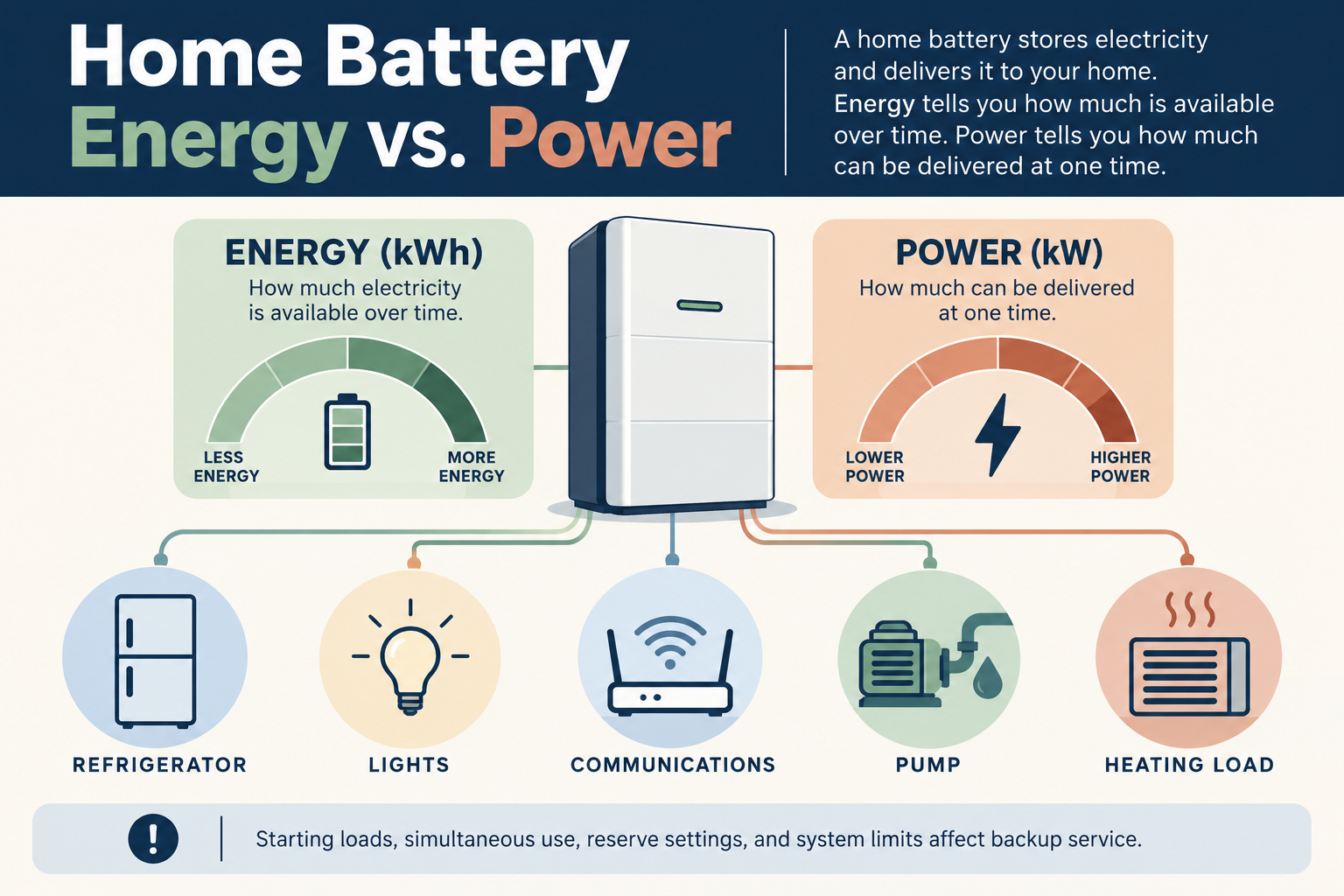
Usable energy, measured in kWh, describes how much energy can be delivered over time. Power, measured in kW, describes how much can be delivered at once. Surge capability matters for motors and other starting loads. A large energy rating does not guarantee that the battery can start a pump, carry electric heat, or run several loads simultaneously.
Define the circuits, continuous loads, starting loads, desired outage duration, recharge source, and whether the battery operates with or without solar. A battery for evening load shifting is a different project from a system that isolates a home during an outage.
What the installed price includes
The equipment scope may include battery modules, an inverter, controls, gateway, disconnects, enclosure, communications, and mounting. Labor includes site assessment, installation, wiring, configuration, commissioning, and sometimes inspection or utility approval. The electrical panel may need a critical-load subpanel, transfer equipment, relays, or load-management controls.
Location affects work. Distance from the service, wall or pad conditions, access, weather protection, code-required clearances, and routing can change installation. Battery location and certification requirements are product- and jurisdiction-specific; do not infer them from a generic internet diagram.
Cost drivers
Capacity and power are separate drivers. Multiple units may be needed for runtime, power, or both. Whole-home backup generally requires more output, transfer capability, and load management than selected critical circuits. Existing solar adds compatibility questions involving the inverter, controls, monitoring, and utility approval.
For a dated U.S. marketplace reference, EnergySage’s H1 2026 quote-platform report gives an average of $1,159 per kWh and $15,647 before incentives for a representative 13.5 kWh system. These are platform/editorial observations, not a transaction census or a local quote; the article does not fully define configuration and price inclusions for every observation. Use them as broad context only, and compare the same storage, inverter, transfer, backup-load, and installation scope.
The economic objective also matters. A battery used for tariff shifting may cycle under a different pattern from one reserved for outages. A resilience system may carry value even when its bill savings alone do not justify the capital cost. Keep those benefits separate in the model.
Three scenarios
Energy-shifting system: The battery serves defined household loads and does not promise whole-home outage operation. The quote centers on storage, controls, installation, and program eligibility.
Critical-load backup: The system isolates selected refrigeration, lighting, communications, pumps, or receptacle circuits. Panel and transfer work become visible and runtime depends on the load list.
Broad backup: The system supports more of the home, requiring greater power, controls, wiring, and perhaps load shedding. Large electric heating, air conditioning, cooking, and vehicle charging can change the design substantially.
Incentives and ownership
Programs are local and time-sensitive. A current BC Hydro program is an example of utility-specific approval and verification conditions, not a North American rule. Confirm eligibility, equipment requirements, application timing, interconnection, and whether the program values storage used with solar or without it. Do not create Canadian costs by converting U.S. market data.
Compare the quote
Require usable kWh, continuous and surge kW, included circuits, backup mode, inverter topology, recharge source, installation location, controls, approvals, warranty, capacity-retention terms, monitoring, and expansion path. Ask which work is conditional and what happens if the service or existing solar is incompatible.
Reliable comparable current installed-price evidence was not established for this category. Use local quotes in the relevant currency and compare the service delivered. A battery is economically defensible when its bill, resilience, or operational value is explicit and the system is sized to the loads that matter—not when a nominal capacity is treated as a complete answer.
Nameplate capacity is not the service you buy
Ask for usable energy at the operating conditions, continuous output, surge output, reserve setting, and expected degradation treatment. Ask which loads are excluded when the system reaches its power limit and how the controls behave at low state of charge. A battery that can store enough energy for a night may still be unable to run a pump and heating load together.
Location and approvals
Battery placement, enclosure, spacing, certification, fire-resistance conditions, and utility treatment depend on the product and jurisdiction. The installer should identify the exact equipment and authority review rather than borrowing a generic diagram. Include site preparation, weather protection, conduit, panel work, inspection, and commissioning in the quote.
California’s 2025 battery-ready rule is a separate, narrow new-construction example: it applies to qualifying one- or two-dwelling single-family buildings with electric service above 125 A. It specifies electrical readiness, not a battery purchase or a general retrofit requirement. See the critical-load panel guide for the limited requirements and boundary.
Decide with a service ledger
List the value of bill shifting, solar self-consumption, outage circuits, automatic operation, noise reduction, and avoided fuel handling separately. Then list capacity retention, eventual replacement, controls, service, and approval costs. This shows whether the battery is being purchased for financial savings, resilience, convenience, or a combination.
Ask for the operating envelope
The proposal should state the minimum and maximum state of charge, reserve for outages, expected usable capacity at commissioning, continuous and surge output, and which loads are limited. It should also identify whether the system is grid-charging, solar-charging, or both, and what happens when the grid is down. These details turn a nominal battery size into a service promise.
Include the house around the battery
The panel, service, wiring path, mounting surface, disconnects, communication path, and approval process can be a meaningful share of installed cost. A physically easy location may be electrically difficult, and a nearby location may not meet the exact product or authority requirements. Require those assumptions in writing before comparing capacity prices.
Compare the battery with the service it replaces
If the goal is short outage protection, compare the battery with a generator, critical-load arrangement, or demand reduction using the same loads and event duration. If the goal is bill management, model the tariff, load timing, cycling, reserve, and replacement rather than assuming every stored kilowatt has the same value. If the goal is both, keep the two ledgers separate. A battery can be worthwhile for resilience even when its bill savings are modest, but the owner should know which value is carrying the decision.
Ask for a low case with a small priority load list, an expected case with the intended service, and a difficult case with added circuit work, approval conditions, or a longer outage. Include future replacement, service access, monitoring, and what happens if the platform is discontinued. The complete cost is the cost of keeping the desired service available over the ownership horizon, not just the equipment invoice.
Make the operating promise testable
The proposal should state how the system responds to grid loss, which loads remain energized, how reserve is protected, and how the battery recharges. Ask what happens when the source reaches its continuous or surge limit and whether a later electrician can identify the backed-up boundary. These details are especially important when a pump, heating control, refrigeration load, or communications system is part of the reason for buying storage.
Also keep the financial and resilience cases separate. A battery can be a reasonable resilience purchase even if tariff savings are uncertain, but it should not be sold as a payback solution without a load, rate, cycling, and replacement model. A documented operating promise lets the homeowner compare a larger battery with load management, a generator, or a smaller critical-load design on the service actually delivered.
Price the service in layers
Start with the service ledger: daily bill management, short outage coverage, critical-load support, or longer resilience. For each service, record usable energy, continuous output, surge capability, reserve setting, recharge source, control behavior, and the loads that are intentionally excluded. A battery sized for bill shifting may not carry a pump or heating load, while a battery sized for rare long outages may spend much of its life reserved and underused.
Then separate equipment from the work around it. The quote may include a battery, inverter or gateway, mounting, disconnects, panel or circuit changes, wiring, communications, permits, inspection, commissioning, and monitoring. It should also state whether service upgrades, fire or enclosure work, structural preparation, trenching, and utility changes are base scope or conditional. This allows the homeowner to compare a smaller critical-load system with a larger whole-home design without treating capacity as the whole price.
Test the ownership case
Include expected replacement, warranty limits, software or platform support, maintenance, outage testing, and the cost of a future change in load. A battery can provide valuable resilience even when bill payback is weak, but that value should be stated separately from energy savings. If the household mainly wants to avoid brief interruptions, a smaller battery, generator, or load-management approach may be more economical. If long events matter, recharge and fuel alternatives deserve comparison before adding more stored capacity.