
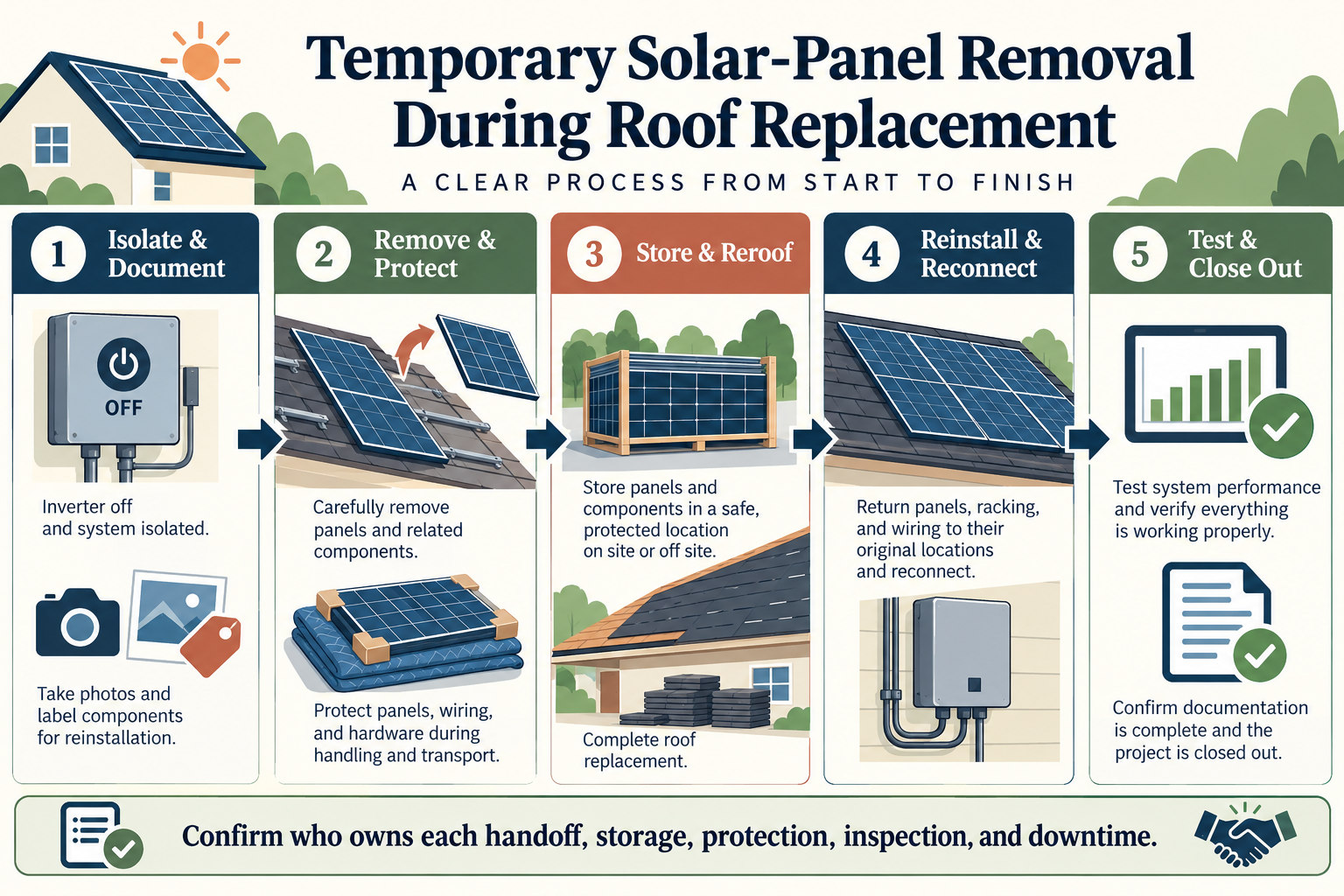
Solar removal for roofing is a separate project from the roof replacement itself. The solar contractor may need to isolate the system, remove modules, detach or protect racking, transport and store equipment, return after roofing, reinstall attachments and modules, reconnect electrical equipment, test the system, and complete any required inspection or utility steps. A simple array can become a partial replacement when hardware is damaged, obsolete, or incompatible.
What the removal quote should show
Ask for an itemized scope rather than a single “remove and replace” allowance. It should say whether shutdown, module removal, racking removal, conduit handling, labels, storage, protection, return transport, reinstallation, electrical reconnection, monitoring, commissioning, and documentation are included. The roof contractor’s work should identify what must be left accessible and who protects exposed wiring or equipment.
The roof replacement price belongs in the roofing project. The removal quote should not quietly include roof repair, deck replacement, or unrelated electrical upgrades. Conversely, a roofing quote that assumes modules disappear at no cost is incomplete.
Why system size is not the only driver
Module count affects handling, but access can matter more. A steep or high roof, fragile material, limited staging, long carry path, or difficult parking can increase labor. Multiple roof planes and unusual mounting hardware slow both removal and reinstallation. Tile, slate, standing-seam metal, and other specialty systems require exact attachment and walking practices that should not be inferred from an asphalt-roof quote.
System age creates a second branch. Older modules, clamps, rails, optimizers, rapid-shutdown devices, connectors, inverters, and monitoring equipment may not be available or accepted after the roof work. A contractor should identify what will be reused, what is conditionally reusable, and what would trigger a change order.
Three project scenarios
Orderly reuse: The array is documented, accessible, and supported by available equipment. Removal and reinstallation remain distinct mobilizations, but the scope is predictable.
Mixed condition: Roofing reveals damaged attachments, corroded hardware, compromised conduit, or components that cannot be reinstalled as-is. The project now includes replacement and recommissioning decisions.
Lifecycle reset: The array is old, underperforming, or incompatible with current equipment. Compare removal and reinstall with replacement or a revised array before paying to reinstall hardware that may soon require another mobilization.
Warranty and responsibility
Ask who warrants roof penetrations after reinstallation, who warrants electrical reconnection, and whether either warranty excludes work performed by the other contractor. Confirm who handles failed monitoring, damaged modules, broken tiles, or a leak discovered after closeout. Do not assume the solar installer, roofer, manufacturer, and insurer have the same responsibility.
Keep the array layout, photographs, equipment models, commissioning records, and roof closeout documentation. Those records reduce the risk of re-discovering system details during the next service call.
Price the decision in advance
Before signing the roof contract, obtain a local solar removal/reinstall quote and a conditional replacement quote if the system is old. Model the low case as complete reuse, the expected case as minor hardware or reconnection work, and the difficult case as equipment replacement plus additional approval or inspection. Future prices are not guaranteed, so treat the quote as planning information rather than a fixed future tariff.
The economic question is not whether removal has one standard fee. It is whether reroofing now, removing and reinstalling later, or replacing the system while access is available produces the best complete outcome. Make the solar scope visible before the roof is opened.
This quote assumes the array will return to service. If the decision is to end solar use and not reinstall the equipment, compare the separate permanent retirement and removal scope, including component handling and final roof restoration.
Plan the handoffs
The roof contractor needs a clear work area and a date when the solar system is safely out of the way. The solar contractor needs the roof plan, attachment details, material specifications, and a condition in which reinstallation is possible. Document who disconnects equipment, who protects stored modules and exposed wiring, who releases the area, and who returns for commissioning. A delay between trades can create storage, temporary protection, and lost-production costs.
Reinstallation is not always the reverse of removal
The new roof may change attachment locations, flashing details, conduit routes, or the accessible service area. A roof repair can reveal deck damage or a condition that makes a particular attachment unsuitable. Ask whether new clamps, rails, seals, labels, shutdown devices, or monitoring setup are included. The contract should state how a changed roof scope affects the solar price.
Decide before paying twice
Compare removal and reuse with replacement when the system has low production, repeated faults, unavailable parts, or a roof project that already requires design review. The relevant comparison includes removal, disposal, new equipment, approvals, downtime, and future service—not just the cost of a new array. A small removal quote can be poor value if it resets an old warranty with no credible remaining service horizon.
Protect the roof and equipment record
Photograph module positions, clamps, conduit, labels, flashing, and equipment before removal. Record any pre-existing damage and the condition of stored components. The purpose is not to create a guarantee; it is to distinguish prior condition from damage during handling and to give the reinstallation team an as-built reference.
Lost generation and project timing
The array may be offline during removal, roofing, weather delays, reinstallation, inspection, and utility permission. Ask for the expected sequence and what happens if roofing takes longer. If the home relies on the array for a financial or resilience objective, include temporary utility cost or unavailable backup value in the timeline.
Compare one mobilization with repeated access
If a roof has more than one near-term intervention, coordinating removal with the larger project may avoid repeated roof access. If the roof is stable and only a minor repair is needed, full removal may be disproportionate. The contractor should show why its proposed access scope matches the actual roof work rather than using a standard removal package.
Assign responsibility for the second installation
Removal and reinstallation are two different quality events. The return visit may require new attachments, replacement flashing, changed conduit, repaired labels, monitoring checks, inspection, or utility permission. The quote should state who is responsible if a module, connector, roof surface, inverter, or production baseline is damaged during the work. It should also identify what condition the system must meet before the solar contractor declares it complete.
A low removal price can be misleading if it excludes safe storage, weather protection, equipment transport, access, or a return visit after another trade finishes. Ask whether the crew records module locations and existing faults before disconnecting anything. Those records help distinguish pre-existing underperformance from a problem introduced during the project.
When reinstallation is not the best use of the budget
Reinstallation is strongest when the array is productive, supported, compatible with the new roof or electrical condition, and likely to remain useful for the next ownership period. Compare replacement or redesign when the inverter is obsolete, several modules or connections are failing, the roof geometry changes, or the same access will soon be needed for another project. Paying to reinstall a system that requires a second major mobilization can cost more than deciding on the lifecycle path first.
The comparison should include lost production, temporary backup limitations, disposal, new approvals, and future service—not just the removal invoice. This is how a homeowner distinguishes a necessary access cost from a repeat-work cost that can still be avoided.