
Battery replacement is a lifecycle project, not automatically a battery-only swap. The quote may include a replacement unit, inverter or gateway compatibility, controls, labor, mounting, commissioning, monitoring, permits or utility work, disposal, and any redesign needed because the original platform is no longer available. Warranty duration should not be treated as a guaranteed service-life or replacement date.
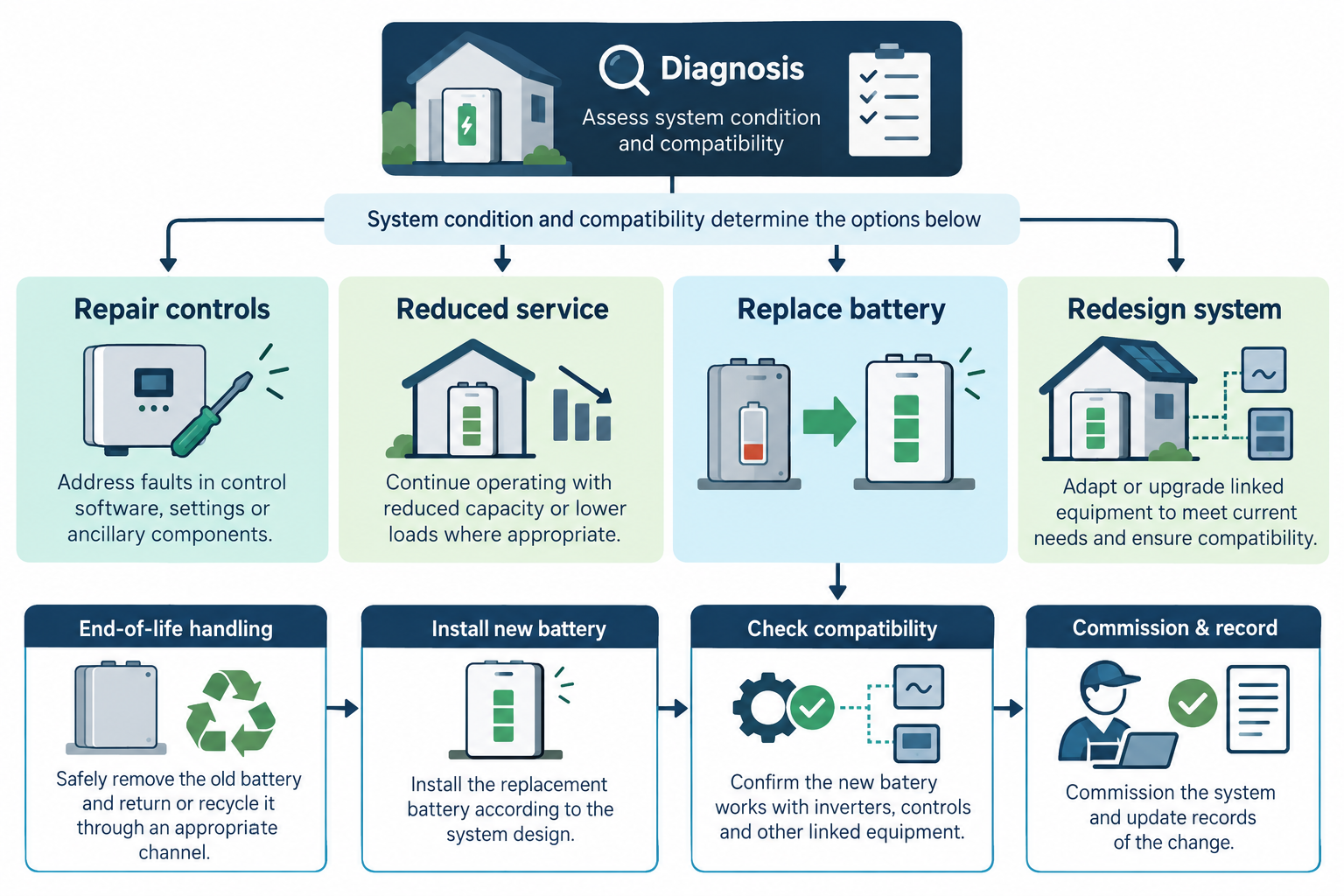
Decide whether replacement is due
Review usable capacity, output, alerts, warranty, cycle history where available, outage performance, and the reason for replacement. A battery that has lost some capacity may still serve a reduced load. A battery with a control fault, gateway failure, or inverter issue may not need a full storage replacement. Obtain a diagnosis before approving a complete system.
Calendar age and cycle use are different. Capacity retention, operating conditions, reserve settings, product warranty, and support availability affect the economic decision. The exact product documentation controls; do not infer a universal life from another battery’s warranty.
What drives replacement cost
The equipment may be physically compatible but electrically or digitally incompatible with the inverter, gateway, monitoring platform, solar array, or transfer equipment. If the original product is discontinued, the installer may need to replace related controls or redesign the system. Access, mounting, wiring, code-required protection, and commissioning add labor.
An average for a newly installed battery is not a replacement quote. EnergySage’s H1 2026 platform estimate does not isolate replacement work, compatibility changes, labor, removal, or recycling. Use it only as broad equipment-market context; request a quote that separates the new battery from controls, transition labor, and end-of-life handling.
Disposal or recycling should be identified. Ask who handles transport and end-of-life equipment, whether warranty return requirements apply, and whether the old battery can remain on site during the transition. Do not improvise handling of damaged or suspect batteries.
For medium and large stationary lithium-ion storage, the U.S. Department of Energy’s consumer guide says the battery may not be removable by the consumer and directs owners to the manufacturer or installer for disposal options. It says not to put these batteries in household trash or municipal recycling. This 2022 U.S. guidance gives no removal or disposal price and does not establish a Canadian route; verify current manufacturer instructions and local requirements.
Replace, expand, or redesign
Like-for-like replacement: Appropriate when supported hardware remains available, the inverter and controls are compatible, and the existing load objective still fits.
Replacement plus expansion: May be sensible when the household has added loads or the original capacity no longer meets its backup objective. Price added power as well as added kWh.
System modernization: Consider when the inverter, gateway, monitoring, solar, or transfer equipment is also aging. It can cost more but avoid repeated compatibility mobilizations.
Three ownership cases
A simple replacement may be mostly equipment, labor, commissioning, and disposal. A legacy-platform replacement may require diagnosis, new controls, approval, and revised backup circuits. A battery that has degraded because the home’s outage needs changed may be better replaced with a smaller or differently configured system rather than the same nominal capacity.
The current evidence does not establish a reliable universal installed price or service-life threshold. Obtain a product-specific local quote and compare the replacement with continued operation, repair, expansion, and redesign over the ownership horizon. Keep the battery’s energy and resilience value separate from any incentive claim.
Check capacity before buying the same size
Measure the service the old battery still provides and compare it with the current outage load. A household may need more power but less energy, or more energy but not more simultaneous output. Replacing the same nominal capacity can preserve an obsolete mismatch. Ask for usable capacity, continuous and surge output, reserve settings, and expected performance under the intended load.
Replacement timing can coordinate other work
If the inverter, gateway, solar array, or roof is also approaching a decision, compare a battery-only replacement with a coordinated redesign. Shared access or commissioning may reduce duplication, but do not assume a package is cheaper without seeing which costs are actually avoided. Confirm utility, warranty, monitoring, and program consequences before changing the architecture.
End-of-life responsibility
Ask how the old unit is isolated, transported, returned, recycled, or disposed of, especially if it is damaged. Request written manufacturer or contractor handling responsibility. End-of-life work is part of lifecycle cost, not an afterthought that disappears from the replacement quote.
Recommissioning is part of replacement
The contractor should test normal operation, outage transfer, charging, discharge, monitoring, and backed-up circuits within the agreed scope. Ask for records of settings and the new capacity or power limits. A battery installed without a clear commissioning result leaves the most important part of the replacement decision unverified.
Check ownership and platform support
Ask whether the new unit remains supported by the monitoring account, inverter, gateway, utility arrangement, and installer. A physically compatible battery can still create a service gap if software, controls, or warranty ownership changes. Record the new models, settings, capacity, and service contact at closeout.
Use an end-of-life comparison
Compare repair, reduced-load operation, like-for-like replacement, expansion, and redesign. Include the cost of access, downtime, disposal, approval, and future replacement in each path. Replace when the old system cannot reliably provide the intended service or its support path is disappearing; do not replace solely because a newer product is available.
Ask what remains under warranty
Confirm whether the replacement affects the original solar, inverter, gateway, controls, and installation warranties. A new battery may be covered while older adjacent equipment is not. Request a written boundary for labor, access, commissioning, monitoring, disposal, and future service. This prevents a “like-for-like” replacement from silently changing responsibility for the whole backup system.
Compare replacement capacity with the actual next use
The old battery’s nominal size is not a reason to buy the same nominal size again. Review the loads that mattered, the outage duration that was actually experienced, reserve settings, production or recharge limits, and any electrification or occupancy change. A smaller replacement may be adequate if the original system was consistently underused; a larger or differently controlled system may be justified if the homeowner’s objective has changed. The decision should be based on usable energy and output at the intended operating conditions.
Ask for a like-for-like case, a right-sized case, and a broader redesign case. Each should state usable kWh, continuous and surge output, backed-up circuits, transfer behavior, recharge source, warranty, monitoring, and future replacement responsibility. This avoids turning a replacement into an automatic upgrade without showing what service the upgrade buys.
Coordinate replacement with other access work
If the battery is near a roof inverter, service panel, gateway, or constrained equipment area, combine compatible work only when it genuinely avoids a second mobilization. Coordinate roof work, electrical upgrades, utility approval, and monitoring changes with clear ownership. The cheapest sequence is not always the fastest; a delay may leave the home without backup during a season when the service matters. Price downtime and temporary protection when the replacement cannot be completed in one visit.
Make the handoff part of the replacement
At completion, record the installed model and serial number, usable capacity, output limits, reserve setting, backed-up circuits, monitoring access, warranty contact, and the conditions under which the system will not provide backup. Confirm that the old unit has been handled according to the responsible contractor or manufacturer’s process and that any damaged equipment has a documented disposition. These details reduce the cost of the next service call and prevent a future owner from treating a replacement as an undocumented equipment swap.
The final comparison should include the value of that continuity. A slightly cheaper replacement with unclear ownership, unsupported controls, or missing commissioning records can create another diagnostic cost later. A complete handoff is especially important when the new battery is expected to interact with older solar or transfer equipment.
Decide what happens if the replacement is delayed
Ask whether the old unit can remain safely in service, whether temporary backup is available, and how a roof, electrical, utility, or product delay changes the sequence. The answer affects the real cost of replacement when the household depends on backup during a particular season. It also identifies which contractor owns protection, storage, and recommissioning between visits.
The best replacement quote therefore describes the complete handoff from diagnosis through removal, installation, testing, monitoring, and future service. That sequence is more useful than a like-for-like label because it shows whether the homeowner is buying restored capacity, a changed operating service, or a broader system reset.