
Adding storage to existing solar is a compatibility project. The battery, inverter, gateway, transfer equipment, controls, wiring, backup circuits, monitoring, approvals, and commissioning must work with the existing array. A battery price alone cannot establish retrofit cost, and an existing grid-tied inverter may not provide outage operation.
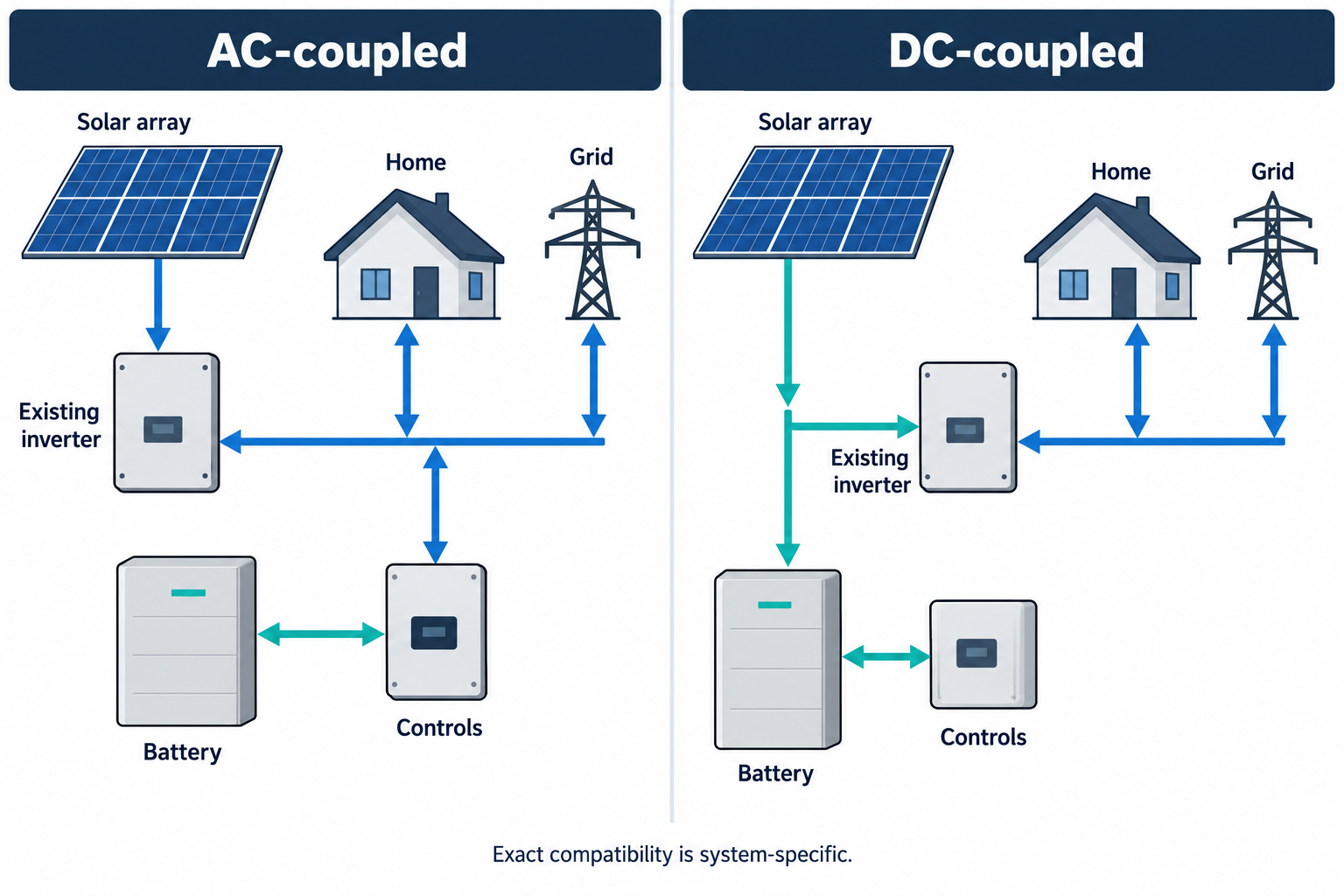
Identify the existing architecture
Document module and inverter models, string or microinverter design, optimizers, shutdown equipment, monitoring, service configuration, array production, and warranties. Determine whether the battery can be AC-coupled, DC-coupled, or requires a new hybrid inverter or broader redesign. These are equipment- and design-specific questions; do not assume brands or generations interoperate.
What the retrofit quote includes
Ask for battery units, inverter or charger, gateway, transfer/islanding controls, disconnects, wiring, mounting, circuit changes, panel work, software or monitoring setup, permits, utility application, inspection, and commissioning. Identify whether the existing solar continues operating during an outage and which circuits receive power.
EnergySage’s H1 2026 marketplace battery report notes that adding storage to existing solar may require extra labor, wiring, and sometimes equipment, but it does not quantify a retrofit amount. Its broad battery average is not an add-on price; use a compatibility-specific quote for the existing inverter, gateway, transfer, and circuit scope.
Distance, wall condition, service capacity, panel space, and access affect installation. A critical-load panel or load-management system may be needed even when the battery itself fits physically. An installer should identify conditional work before the contract treats the retrofit as turnkey.
Three retrofit paths
Compatible add-on: Existing equipment supports the proposed battery and controls. The project may focus on storage, wiring, protection, commissioning, and approvals.
Control or inverter replacement: The array remains, but the original inverter or gateway must be changed. This adds equipment, downtime, disposal, and compatibility risk.
System redesign: The array, inverter, service, and battery are reconsidered together. This can cost more initially but may be more coherent than stacking incompatible devices onto an aging system.
Is the retrofit worthwhile?
Separate energy and resilience value. Storage can reduce exports or provide outage support, but the utility’s export treatment and the home’s load profile determine financial value. If the existing system is already near a major inverter, roof, or monitoring decision, compare the retrofit with a planned replacement. Include future battery replacement and the possibility that the original solar components cannot be supported through that lifecycle.
Use local system-specific quotes. The current evidence does not establish a general installed retrofit range, and no Canadian price should be created by currency conversion. Ask what is known, assumed, and conditional, and require a documented operating mode for normal grid service and outage service.
Check the retrofit before choosing capacity
A large battery attached to an incompatible inverter is not a larger solution. First determine whether the present system is AC- or DC-coupling compatible, whether the controls recognize the array, and whether the backup output can isolate the intended circuits. Then compare usable energy, power, surge, and runtime. If the installer cannot identify the existing architecture, pay for documentation or diagnosis before selecting equipment.
Roof and warranty timing
If the roof is nearing replacement, adding storage may be sensible while the solar system is already being assessed—or may be premature if the array must soon be removed. Ask whether a battery retrofit affects the solar warranty, utility agreement, monitoring account, or future roof work. Record who owns each warranty and who coordinates a later service call.
A retrofit decision threshold
Proceed when the existing array is productive, the retrofit preserves a supported control path, the outage load is defined, and the value of storage is clear. Consider redesign when the inverter or gateway is obsolete, the roof is uncertain, or the household’s objective now requires more power than the original system can provide.
Ask what “backup” means
Some retrofit proposals store energy but continue to depend on the grid during an outage. Others isolate selected circuits or a broader service. Ask when the existing solar shuts down, what restarts it, whether the battery can form the needed local system, and which circuits remain energized. A storage retrofit should not be priced as outage backup until that operating mode is documented.
Include approval and warranty consequences
Adding a battery can change the utility application, export treatment, monitoring, and program eligibility. It can also divide responsibility between the original solar installer and a new storage contractor. Obtain written confirmation of who supports the combined system and who handles a failure at the boundary.
Existing production records are essential
Collect the array layout, inverter and module models, monitoring history, utility bills, and previous service. Without a baseline, an installer cannot reliably tell whether a battery is solving low self-consumption, low production, or a control problem. The cost of reconstructing records should be identified before the equipment quote.
Compare retrofit with a planned reset
If a new battery requires a new inverter, gateway, panel, or approval, ask for a full-system alternative. Include removal, disposal, downtime, roof access, and future expansion in both paths. A retrofit is strongest when it preserves productive equipment and a supported control platform; a redesign is stronger when several old components are already constraining the household.
Start with the existing system’s usable value
Collect the array layout, equipment models, monitoring history, production data, utility records, service configuration, and warranty documents before selecting capacity. A battery cannot correct an underproducing array, unsupported inverter, or deficient service connection. If those conditions are uncertain, the first paid step may be diagnosis or design reconstruction rather than equipment purchase. That cost should be visible because it reduces the risk of sizing a new battery around a false baseline.
The retrofit should also state whether solar can recharge the battery during an outage, whether the battery can island the array, which circuits are backed up, and what happens when the battery reserve is reached. Those behaviors depend on the exact architecture and approval path. A quote that promises “solar backup” without describing the transfer and recharge sequence has not yet defined the service being bought.
Compare mobilizations and future choices
Use a low case with supported equipment, nearby installation, and spare panel capacity; an expected case with controls, approvals, and circuit work; and a difficult case involving inverter replacement, service changes, or a full redesign. Include the cost of a later roof project and battery replacement in both retrofit and reset paths. A retrofit may save capital now while narrowing future choices, whereas a planned reset may cost more initially but create a clearer service and warranty boundary.
The decision is strongest when the existing solar still has a credible production and support horizon. If the array, inverter, roof, and monitoring platform are all approaching major work, adding a battery can simply attach a new lifecycle obligation to an old system.
Do not buy capacity before defining the architecture
Usable kWh answers how much energy is available; it does not answer whether the system can form the required backup condition, supply a motor’s starting demand, recharge from the existing array, or transfer the selected circuits safely. Ask for the exact operating modes and the loads that can run together. A larger battery cannot correct an incompatible inverter, unsuitable service, or missing control path.
Also ask what the retrofit changes for future roof or electrical work. If a battery shares access, monitoring, or controls with the existing solar, record who owns each part of a later repair. A slightly more expensive design may be preferable when it leaves a supported platform and a clear service boundary; a cheap add-on may be false economy if the original array becomes the next failure point.