
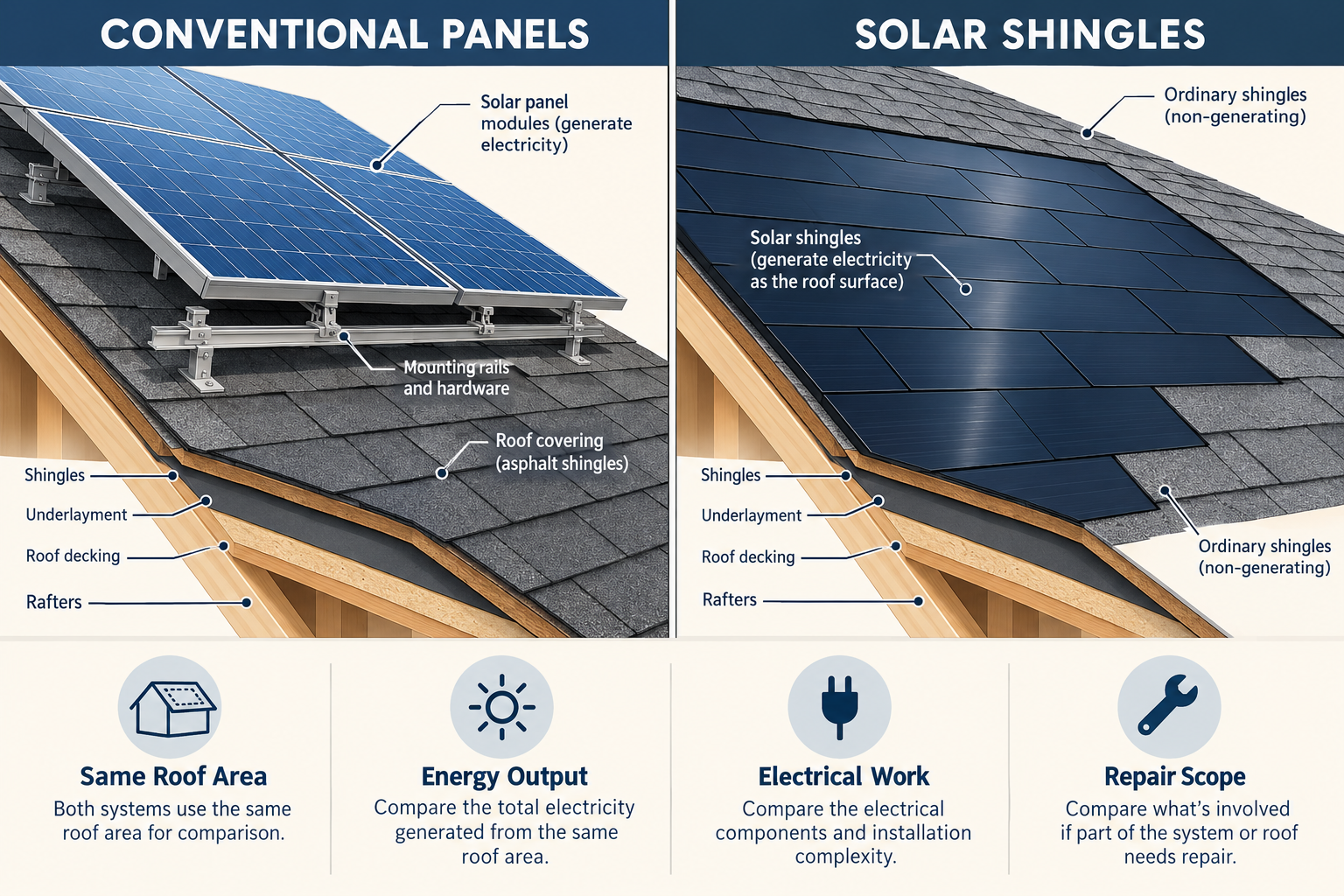
Solar shingles and conventional panels are not simply two finishes for the same roof. Solar shingles combine a roof covering with generation; conventional panels are a separate array mounted above a roof that still needs its own covering. The cheaper choice depends on whether you need a new roof, how much usable roof area exists, the product available locally, and how you value repair and replacement flexibility.
Compare the same scope
The first pricing mistake is comparing a solar-shingle quote with a panel-only quote. A fair comparison includes the roof work each option actually replaces, non-generating roofing around the array, underlayment and flashing, electrical equipment, design, permits, inspection, interconnection, labor, and commissioning. Conventional roof replacement remains a separate roofing scope, even if it is coordinated with solar.
Ask each bidder to identify the area that receives generating shingles, the area that receives ordinary roofing, and the work needed at edges, valleys, penetrations, and transitions. If a solar-shingle quote includes a new roof but the panel quote does not, the totals answer different questions.
Where solar shingles may fit
Solar shingles can appeal when a homeowner already needs a roof replacement and wants an integrated appearance. They may also fit a roof design where separate racks would be visually intrusive. Those advantages are product- and installer-specific. Availability, trained installers, repair arrangements, and replacement paths may be less uniform than for conventional PV.
The roof still needs to shed water, and the generating product still needs electrical design, approved equipment, inspection, and interconnection. Integration does not remove the need to evaluate roof geometry, shading, household loads, production, and utility treatment.
Where conventional panels may fit
Panels often preserve more choice. A homeowner can select the roof covering separately, replace a failed inverter without replacing the roof, expand or alter the array subject to compatibility and approvals, and have a roofing contractor address the roof independently. Racks and attachments still create flashing, access, warranty, and future removal considerations.
Panels may be economically stronger when the roof is serviceable, when the array needs to be limited to the sunniest planes, or when the household wants a generation system without replacing the entire roof. They may be less attractive if the roof is near a major project and future removal would be likely.
Cost drivers beyond the product
Roof geometry affects both choices. Dormers, valleys, chimneys, skylights, multiple orientations, shading, and small fragmented areas can reduce useful generating area and increase detailing. Access and local labor affect installation. Electrical service, inverter architecture, monitoring, design, permit, inspection, and utility interconnection remain part of either system.
Repair economics differ. A conventional panel can often be removed from the affected roof area while a roofer repairs the covering. An integrated product may require a specialist or a coordinated roof-and-electrical repair. Do not assume either system is easier to repair without a local service plan.
Lifetime comparison
Compare the cost of the roof and generation functions over the period you expect to own the home. Include likely inverter or control replacement, roof maintenance, failed generating units, access, downtime, warranty limits, and the possibility that the original installer is unavailable. A long warranty is not a guarantee that labor, adjacent roofing, or future compatibility will be free.
For a new roof, integrated solar may avoid some conventional roofing material and mounting work, but it may also narrow the installer pool and replacement options. For an existing sound roof, conventional panels may avoid premature roof spending. Neither conclusion is universal because product coverage and local labor are decisive.
Three decision cases
Roof replacement already due: Obtain a solar-shingle roof quote and a conventional roof-plus-panel quote with the same roof area and production target. Separate the roof-only value from the generation value.
Roof is sound: Price conventional panels first, then compare the cost of postponing roof replacement with the future removal or coordination requirement. Solar shingles may represent unnecessary roof work if the roof has useful service remaining.
Complex or highly visible roof: Ask both bidders to show layout, detailing, repair responsibility, and replacement path. A visually appealing system can still be a poor economic choice if a small failure requires a specialist mobilization.
Incentives and claims
Incentives depend on the exact product, tax year, property, and jurisdiction. Do not rely on an old federal credit statement or assume roof-covered generating material has the same treatment everywhere. Request the program name, eligibility basis, timing, and exclusions in writing, and confirm it independently before using it in payback math.
The lower-cost choice is the one that delivers the needed roof and energy functions with a credible local installation, repair, and replacement path. Compare complete scopes, not the most attractive product line or a panel-only equipment price.
Account for partial-roof economics
Neither option necessarily covers the whole roof with generating material. A solar-shingle design may use ordinary roofing at ridges, edges, valleys, shaded planes, and around penetrations. A panel design may use only the most productive roof planes while the rest receives conventional roofing. Request an area-by-area scope so the “roof included” value is real rather than an assumption based on the product name.
Repairability is a cost question
Ask what happens when one generating unit, flashing detail, inverter, or roof section fails. Find out whether the repair requires an electrical specialist, a roofer, both trades, a product-specific part, or temporary removal of nearby material. Ask how long replacement parts are expected to remain available and whether labor is covered. These are inputs to ownership cost, not reasons to prefer one technology automatically.
Match the system to the ownership horizon
For a long ownership period, model roof maintenance, generation-component replacement, monitoring, and the chance of an installer change. For a short period, consider documentation, warranty transfer, buyer familiarity, and whether the roof project is already due. A product that looks cheaper because it combines two functions may still be expensive if its repair path is narrow.
The evidence supports comparing these branches but does not establish a current universal price or output ranking. Let complete local scopes resolve the question.
Separate the roof decision from the generation decision
Solar shingles can combine a roof surface and generation function, while conventional panels are installed over a separate roof covering. That difference can matter when a roof replacement is already due, but it does not make every solar-shingle project a cheaper roof. Compare the roof area actually being replaced, the portion that produces energy, unused roof areas, flashings, edges, penetrations, and future access. A proposal that covers more roof than the energy plan requires may be buying a different roofing product rather than simply replacing panels.
The comparison also changes if the roof is sound. Removing a serviceable covering to install an integrated product can create a larger capital decision and may shorten the expected payback. If the roof is marginal, installing conventional panels first can create future removal and reinstallation work. The right sequence depends on the roof’s remaining service horizon and the generation objective, not on the product label alone.
What a premium must buy
If one option costs more, identify the service that premium purchases: a roof finish, a particular appearance, more usable roof area, fewer visible attachments, simpler future roof coordination, or a different repair path. Then ask how that service is protected by the warranty and supported when a generating unit or roof section fails. A premium with no clear benefit to the property or ownership horizon is difficult to justify.
For each option, request the same production assumptions, warranty responsibilities, monitoring, replacement process, access method, and roof-restoration boundary. This exposes whether a lower price comes from a genuinely different design or from omitted work. It also prevents a narrow comparison of product prices from hiding the cost of a future repair that requires two trades.