
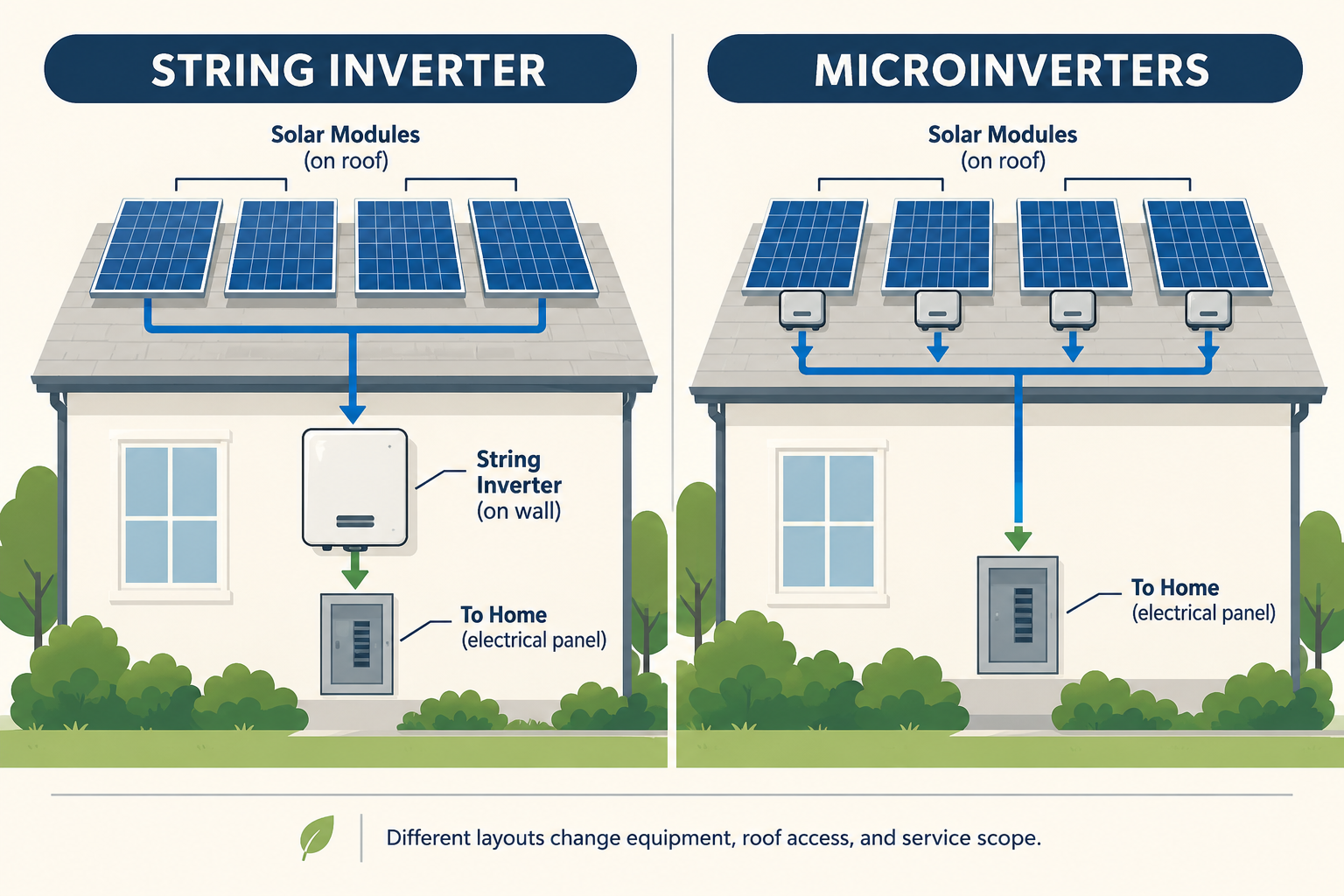
String and microinverter systems move power through different architectures. A string design usually concentrates conversion in one or more accessible units, while microinverters place conversion at the module level. Neither has one universal installed-price advantage. Roof geometry, shading, equipment selection, access, warranty, service strategy, battery plans, and future expansion determine the economic result.
Upfront cost is only the first comparison
Compare the complete design: modules, inverters, optimizers if used, racking, wiring, shutdown and monitoring equipment, labor, roof access, permits, interconnection, and commissioning. A string system may concentrate equipment and simplify roof access, but a split or shaded roof may require additional design or module-level equipment. Microinverters may add equipment at the roof and change installation labor.
The lowest equipment line is not necessarily the lowest project. Ask for the same production target and the same treatment of difficult roof planes. A proposal that excludes the shaded plane or uses different assumptions cannot establish a fair architecture comparison.
Layout and shading
String output is influenced by how modules are grouped and by the behavior of a string when conditions differ across the array. Microinverters allow each module to convert independently. That distinction can be useful on roofs with several orientations or partial shading, but the amount of additional value depends on the actual shade pattern and design. Do not accept a universal production premium without a site-specific model.
Roof access also has an economic effect. Central equipment may be easier to inspect or replace from a wall or service area. Module-level equipment can require roof access for diagnosis or replacement. On a low, accessible roof that difference may be modest; on a steep, fragile, snow-covered, or difficult roof it can change service cost materially.
Replacement and warranty
String failure may interrupt a larger portion of production while a replacement is arranged. A microinverter failure may affect a smaller portion but require a roof visit. Compare the likely mobilization, diagnostic time, warranty labor, and equipment availability rather than treating one failure pattern as automatically cheaper.
Read warranty terms by component. Equipment coverage may not include labor, access, shipping, or compatibility with later hardware. Monitoring platforms and shutdown devices can also outlive or become incompatible with an inverter. Record the exact models and installation layout for future service.
Batteries and expansion
Future battery addition or panel expansion can make architecture more important. A battery may require a compatible hybrid inverter, gateway, control equipment, service capacity, and utility approval. Adding modules may require inverter capacity, matching electrical characteristics, available roof space, new racking, and an amended interconnection. A battery-ready label does not guarantee that a future product will be suitable or available.
Ask bidders to price the present system and explain what a future change would replace. Do not pay a premium for theoretical flexibility without a credible platform and documented compatibility path.
Decision scenarios
Simple, unshaded roof: A string architecture may be economically compelling if the design, access, monitoring, and future service are straightforward.
Multiple orientations or localized shading: Compare both architectures using site-specific production and service assumptions. Module-level conversion may solve a design problem, but its extra equipment and roof labor need to be priced.
Long ownership or difficult service access: Give greater weight to warranty labor, component availability, monitoring, and the cost of a roof visit. The upfront difference may be less important than one repeated repair mobilization.
The available evidence supports the architecture distinction but not a universal current price gap or production advantage. Use comparable local quotes in the relevant currency, ask what each bid includes, and choose the system whose total ownership risk fits the property rather than the one with the simplest slogan.
Compare the failure paths
For a central inverter, diagnosis and replacement may be concentrated at one accessible location, but a failure can interrupt much of the array. For module-level equipment, one fault may affect less generation while requiring roof access, module handling, and a device compatible with the existing platform. Neither pattern is automatically cheaper. Ask each installer to price warranty labor, access, monitoring restoration, and a second visit if the first diagnosis is inconclusive.
Roof and climate change the answer
A low, accessible roof with a simple array may reduce the practical cost of module-level service. A steep, fragile, snowy, or difficult roof increases the value of accessible central equipment. Shade and multiple orientations may make module-level design useful, but the production benefit must be modeled for the actual roof. Do not pay for a theoretical advantage that the site cannot use.
Make expansion a real option
If future panels or storage matter, ask what would be replaced under each architecture. Record inverter loading, module electrical characteristics, monitoring, shutdown, battery interface, and utility approval assumptions. A future option has economic value only if the current equipment and likely service path make it credible.
Compare monitoring value without overstating it
Module-level monitoring may make it easier to identify a weak part of an array, but it does not eliminate diagnosis, access, or replacement cost. Central monitoring may show less detail but can be adequate for a simple design. Ask what data the homeowner receives, who supports the platform, and whether it remains usable if the original installer disappears.
Installation and service tradeoffs
A string design can concentrate conversion equipment and simplify roof-level service, while a microinverter design distributes electronics across the roof. Distributed equipment can change weather, access, and replacement considerations. Product and installation requirements control the result. Do not translate a general architecture description into a guarantee about reliability or production.
Quote the future explicitly
Request a comparison that includes one plausible inverter failure, access or labor, monitoring support, expansion, battery integration, and roof timing. This is not a prediction of failure; it is a way to see whether the architecture’s future cost changes the initial choice.
Make downtime part of the comparison
The two architectures can fail differently. A central conversion problem may affect a larger portion of a string design, while a microinverter issue may affect one module but require roof access and a compatible replacement. Neither statement predicts which system will be cheaper in a particular home. Ask how the contractor will identify the failed component, reach it, preserve the rest of the system, and restore monitoring.
The quote should state whether troubleshooting, lift or roof access, replacement labor, commissioning, and return travel are included. It should also say whether a failure can wait for planned roof work or needs an immediate visit. This turns a general reliability discussion into an ownership-cost assumption that can be compared.
The best architecture depends on the next project
A simple roof with one orientation and no near-term change may favor a design with a straightforward installation and service path. Multiple roof planes, partial shading, planned expansion, battery integration, or difficult access may shift the economics. If a roof replacement is likely, distributed roof equipment can change the removal and protection scope. If service capacity is limited, adding more modules may require a different conversion or control design.
Ask bidders to price the same current production objective and identify one credible future change. The preferred architecture is the one that keeps that future change feasible at a known cost, not the one that wins a comparison based only on today’s equipment line.