
Heating and cooling responsibility follows the system design and the governing documents. A thermostat inside a unit does not prove that the unit owns the equipment, and a shared boiler does not mean every repair is paid through the same account. Start by identifying what serves the unit, where it is located, and who controls the operating schedule and replacement decision.
Identify the system
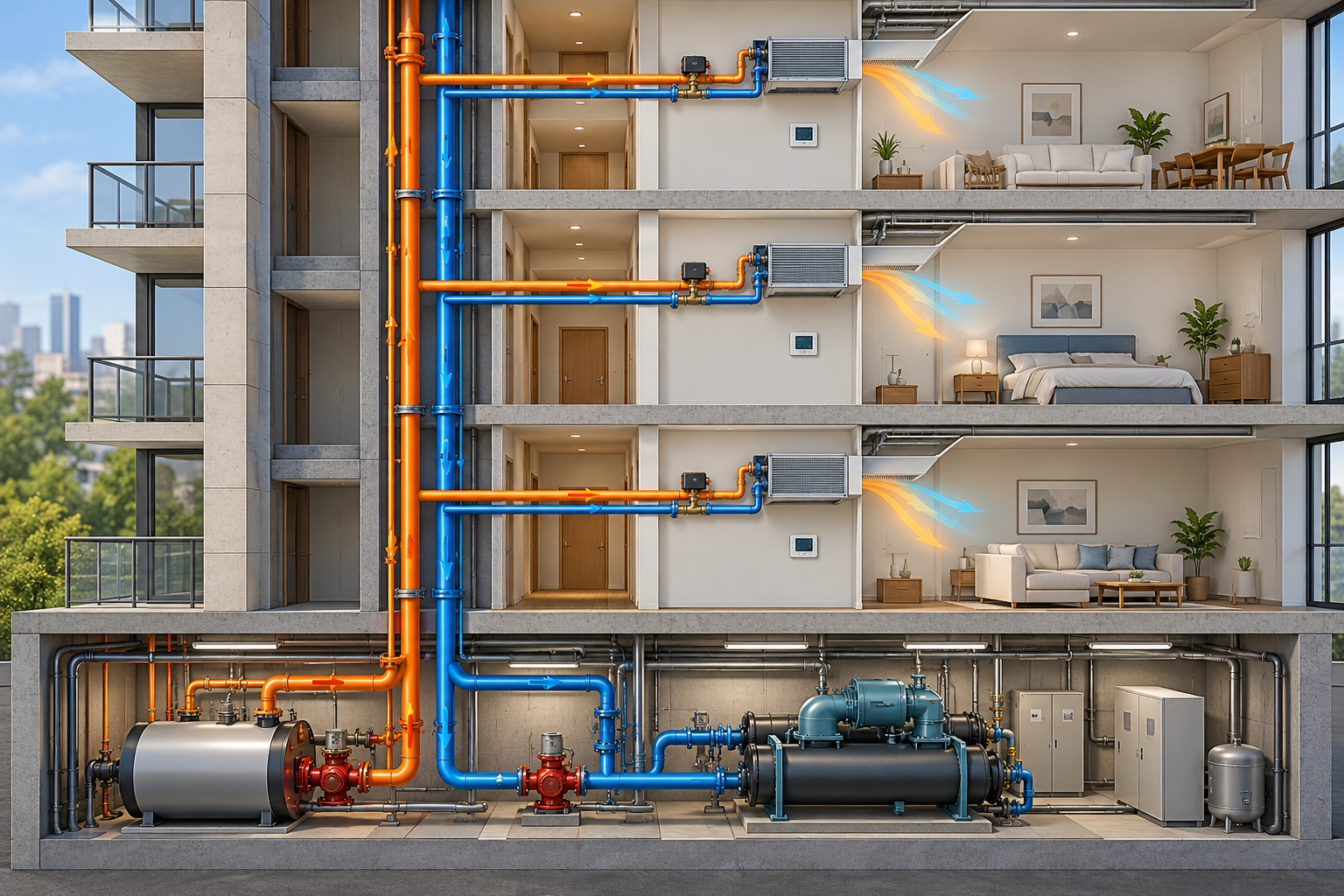
Ask the manager or HVAC contractor to map the system from the energy source to the unit:
- central boiler, chiller, heat pump, or cooling tower;
- pumps, controls, valves, and distribution risers;
- building ductwork or hydronic piping;
- fan-coil, air-handler, terminal, or unit-level heat pump;
- thermostat, filters, condensate drain, and local shutoffs;
- electrical disconnects and refrigerant lines;
- vents, grilles, and wall or ceiling access.
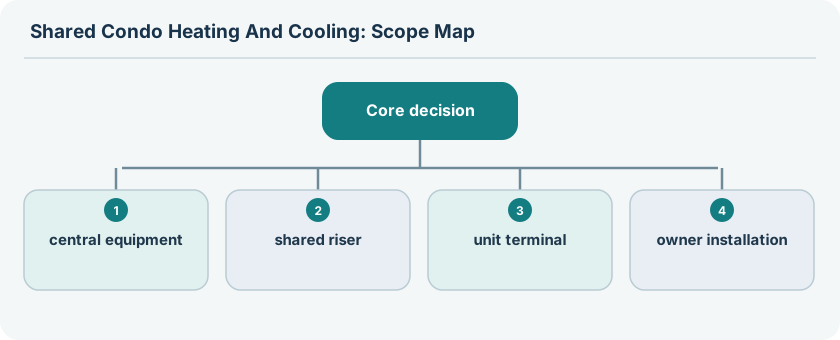
The declaration may classify central equipment as common elements and assign filters or in-unit terminal maintenance to the owner. A system may also be common until a service valve or branch, with a separate rule for damage caused by an owner-installed unit.
Symptom is not diagnosis
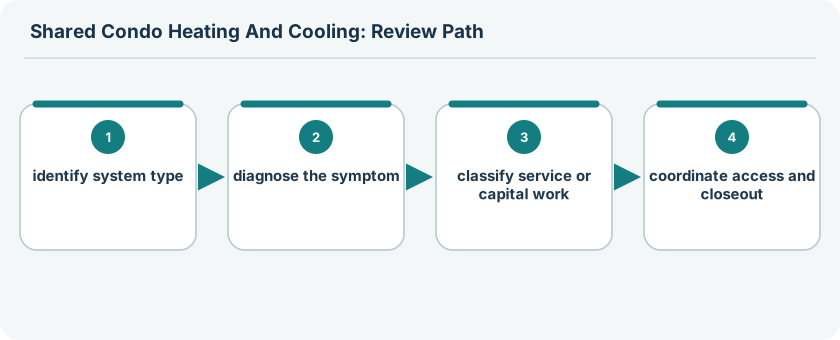
“No heat” or “no cooling” can result from a central failure, a local control, an air lock, a clogged filter, a condensate problem, a closed valve, a failed electrical component, or a building-wide capacity issue. Ask for a written diagnosis and note whether other units are affected.
Do not replace a thermostat or fan coil before checking the distribution system. A unit-level repair may mask a central problem, while a central contractor may need access through several homes. Record dates, temperatures where relevant, alarms, service calls, and temporary measures.
Routine service versus capital replacement
Routine work can include filter changes, cleaning, belt replacement, seasonal commissioning, and minor controls. Capital work can include a boiler, chiller, cooling tower, heat pump bank, riser, duct, or distribution-pipe replacement. The documents may allocate routine service to the unit and capital replacement to the association, or use a different arrangement.
Ask whether the work is part of a reserve or depreciation plan. Review the expected service life, inspection findings, energy or code upgrades, access costs, commissioning, and future maintenance. A lower operating cost does not necessarily mean a lower project cost.
In-unit equipment and owner installations
An owner may install a ductless unit, portable system, humidifier, smart control, enclosure, or replacement terminal. Approval may be required for penetrations, electrical capacity, condensate disposal, refrigerant lines, roof access, noise, or exterior appearance. The approval should state who maintains the installation, who removes it for common work, and who pays for resulting damage.
An approved alteration is not automatically an association asset. Keep the approval, specifications, invoices, warranty, and service history. Future owners and contractors need to know whether the equipment is standard or owner-specific.
Damage, water, and access
HVAC failures can create water damage through a condensate line, coil, drain pan, or frozen pipe. Notify the manager and insurer promptly, limit damage safely, and photograph the source before demolition. Responsibility for the equipment, the line, the ceiling, flooring, contents, and deductible may be divided.
The association may have authority to enter a unit for inspection or common-system repair. Ask for reasonable notice, emergency access documentation, protection of belongings, and a plan for patching openings. A contractor’s need to work in a unit does not by itself decide which party pays for restoration.
How major HVAC work is funded
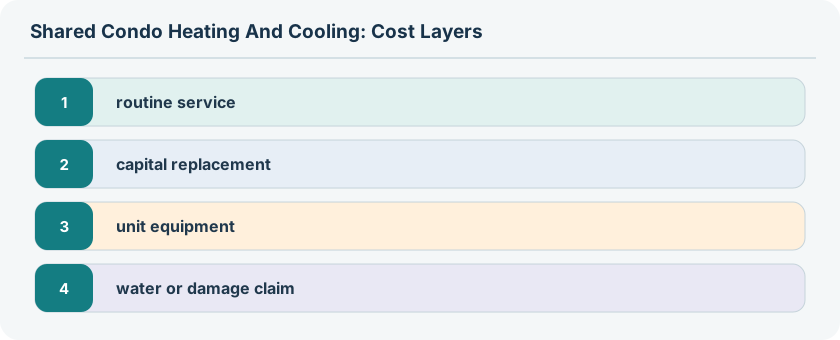
A shared-system project may use reserves, a special assessment, a loan, insurance or warranty proceeds, or a blend. Review the engineer’s or contractor’s scope, equipment assumptions, contingency, access plan, phasing, and commissioning requirements. Confirm whether only a failed component is being replaced or whether the project changes the system for the whole property.
Owners should ask how their share is calculated and whether the project includes owner-requested upgrades. Buyers should review meeting minutes, capital plans, recent service failures, fee changes, and pending assessments before relying on the current monthly fee.
HVAC responsibility checklist
Before accepting a charge or authorizing work, record:
- system type and service map;
- affected units and written diagnosis;
- unit, common, or exclusive-use classification;
- routine maintenance versus capital replacement;
- alteration approvals and non-standard equipment;
- emergency response and access authority;
- insurance, warranty, and deductible position;
- funding source and allocation formula;
- commissioning, warranty, and future service plan.
HVAC responsibility is usually a chain, not a single label. Identify the system layer, the controlling document, the party with repair authority, and the separate treatment of consequential damage before deciding who pays.
Service records and project decisions
Request the last several service reports, recurring complaint log, equipment inventory, inspection findings, reserve or depreciation recommendations, and recent meeting minutes. Compare the age and condition of central equipment with the association’s current fees and reserve contributions. A series of emergency repairs may indicate that replacement planning is more appropriate than another temporary fix.
For a replacement, ask whether the design preserves capacity for peak conditions, whether units will receive balanced service, and whether the work changes controls, metering, ventilation, noise, or access. Confirm who accepts the commissioning report and who receives the operating manuals. If equipment is phased by building, document which units are included in each phase and how later phases will be funded.
Allocation examples to test
A central boiler may be association-controlled while a unit fan coil, filter, thermostat, or condensate line has an owner duty. A shared riser can be common even when a valve or terminal serving one unit is allocated differently. A unit-installed mini-split can remain an owner obligation while facade penetrations and waterproofing are subject to association approval.
Ask the contractor to identify the component in the quote and the documents to identify the payer. Do not allocate a full system replacement from the location of a thermostat or from which unit first reported a failure.
Owner and buyer closeout
Owners should retain approval letters for alterations, model and serial numbers, service records, warranties, and access instructions. Buyers should request central equipment records, maintenance plans, meeting minutes, assessments, and any notices about recurring outages or planned replacement.
At closeout, confirm testing under normal operating conditions, balancing or commissioning where appropriate, condensate drainage, protection of penetrations, and the future maintenance schedule. A complete HVAC decision accounts for comfort, safety, authority, cost, access, and service life.
What the final record should show
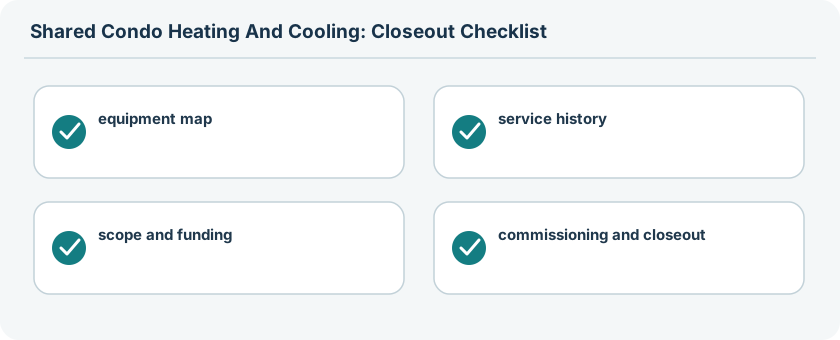
The closeout file should identify the equipment, service area, diagnosis, approval, funding, access, testing, warranty, and future maintenance. If the system is common until a branch or terminal, mark that boundary on the service map. If an owner alteration remains, attach its agreement and model information. This gives the manager and future owners a reliable starting point for the next failure.
For a central system, ask whether the association tracks energy use, recurring failures, refrigerant or water leaks, and replacement forecasts. For a unit terminal, ask whether a filter, valve, drain, or control has a separate duty. The service inventory should show each layer and its maintenance interval.
When a central project is complete, update the equipment inventory and reserve plan. When a unit alteration is complete, attach the approval and service agreement to the unit record. Both records should identify emergency access and who pays for future replacement.
For a central system, the board should identify the equipment inventory, service history, project scope, funding, commissioning, warranty, and next inspection. For a unit terminal, the approval or maintenance matrix should identify filters, controls, drains, valves, and access. A complete record lets an owner distinguish a local service call from a common capital failure and budget accordingly.
Example: a failed unit fan coil
A fan-coil failure may be a unit obligation, but the diagnosis should still check the shared valve, hydronic riser, controls, condensate drain, and electrical disconnect. The manager should coordinate access if common equipment is involved. The owner should retain the service report, model information, repair invoice, warranty, and any water-damage record. If several units experience the same failure, the association should investigate whether the issue belongs in a capital plan.
When a unit is sold, pass along equipment details, approval, service records, warranties, and any owner maintenance obligation. When a central system is replaced, update the association’s inventory and reserve plan. Both records should state emergency access and restoration responsibility.
If the system remains under observation, record the next service date, performance measure, and person responsible for follow-up. A temporary repair should not disappear from the capital record.
For a shared HVAC project, note the affected buildings, replacement phase, funding source, equipment warranty, commissioning result, and future service interval. For an owner unit, note the terminal, controls, condensate, electrical connection, and approval conditions. This makes the next service call traceable.
A current record should connect the system diagnosis with the funding, access, restoration, warranty, and future inspection. It should distinguish central equipment from unit equipment and shared distribution.
Keep the resulting records with the unit or association file.