
Deferred maintenance is more than a list of old components. It is a gap between work a shared property needs and work the association has inspected, approved, funded, and completed. The gap can create safety, water-intrusion, insurance, budget, financing, and resale questions.
“Critical repair” also needs a defined scope. A lender, engineer, insurer, board, or local rule may use the term differently. Ask what component is affected, what evidence supports the classification, and what decision is required now.

Separate ordinary aging from an active critical issue
A component can be near the end of its expected life without an emergency. Conversely, a relatively new component can require urgent work because of a defect, leak, structural movement, or failed installation. Sort the condition into stages:
- observed deterioration requiring monitoring;
- recommended maintenance with a target date;
- planned capital work with a budget;
- approved work awaiting construction;
- active failure requiring temporary protection;
- emergency or safety-related repair.
This staging matters because the financial exposure is different. A planned roof replacement may be funded over years. An active water-intrusion problem may require immediate stabilization before the permanent scope is known.
Follow the chain from condition to owner cost
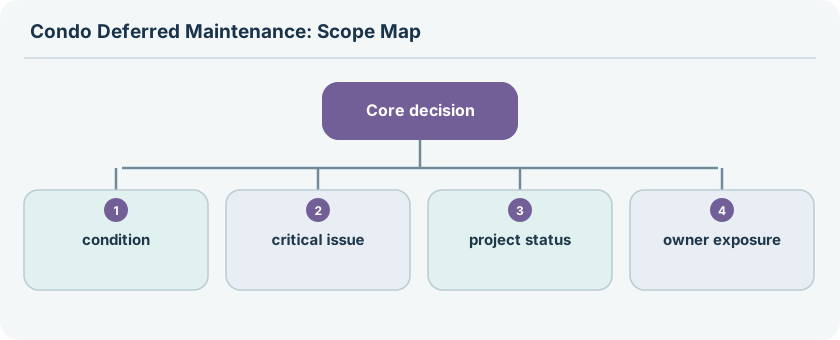
Read the report and minutes together. The report may describe the problem, but the board resolution or association budget may explain the chosen response. Look for:
- the component and location;
- the inspection date and qualifications;
- the recommended scope and alternatives;
- temporary measures already taken;
- bid, contingency, and schedule;
- reserve funding, assessment, loan, or insurance plan;
- allocation of the cost among owners;
- completion, warranty, and follow-up testing.
Do not infer the amount an individual owner owes from a headline project figure. The allocation may use unit interest, a statutory formula, a separate chargeback rule, or a combination of common and owner-specific costs.
Why deferred work can affect refinancing or resale
Unresolved major work can affect buyer confidence and project review even when the unit itself is in good condition. A purchaser may ask for reports, minutes, assessments, insurance information, and evidence that the association can complete the work. An appraiser or lender may also request project-level information.
Fannie Mae’s published project guidance illustrates why critical repairs, special assessments, insurance, and project condition may be reviewed in some conventional transactions. It does not establish a rule for every lender or jurisdiction. A buyer should ask the actual lender for its current requirements before relying on a project being financeable.
For an owner considering refinancing, request the association’s current project packet early. A pending report, unapproved scope, or unresolved insurance question may slow underwriting even if it ultimately can be resolved.
Freddie Mac also ties parts of its reserve review to the mortgage application date: its highest-recommended-allocation rule applies to applications received on or after August 3, 2026, and its 15% minimum reserve allocation for capital expenditures and deferred maintenance applies on or after January 4, 2027. These seller/servicer requirements do not replace the project’s engineering findings or establish a rule for every lender. Ask the lender to identify the current program test and the documents it needs.
Florida has a separate statutory milestone-inspection process for qualifying condominium and cooperative buildings. The usual age trigger is the year a building reaches 30 years, with inspections every 10 years; local enforcement may set the first trigger at 25 years. The inspection is not a diagnosis of a particular symptom or a universal determination of who pays for all resulting repairs. See the Florida milestone-inspection guide for eligibility, report stages, owner notice, and cost-allocation questions.
Financial warning signs
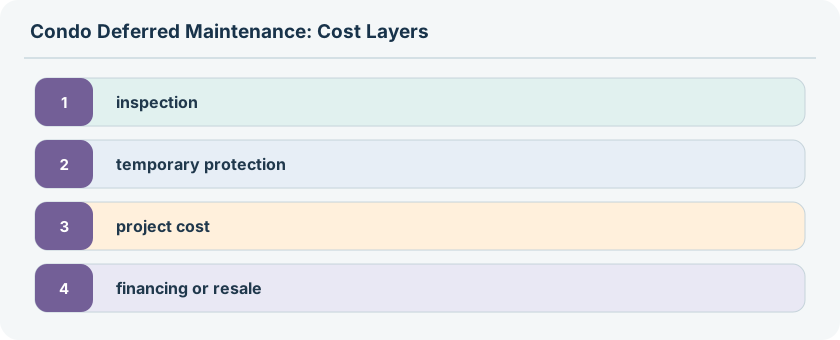
Look for:
- repeated postponement of the same repair;
- reserve contributions below the adopted plan;
- assessments used without a complete project budget;
- emergency work paid from funds intended for other components;
- insurance that excludes or limits the relevant condition;
- open litigation or construction-defect claims;
- minutes that identify a problem but contain no owner communication or schedule;
- bids that omit access, testing, permits, temporary protection, or restoration.
None of these proves that a project is unmanageable. They identify questions that need documented answers. Also look for positive signals: a current engineering report, a realistic reserve plan, a board resolution, transparent owner notices, and completed work that has been independently verified.
Questions for owners and buyers
Ask:
- What does “critical” mean in this project?
- Is there an immediate safety or habitability measure?
- What work is included and excluded?
- What is the estimated range, contingency, and funding source?
- Who approves changes to scope?
- How is each unit’s share calculated?
- Are payment dates, installments, interest, or late charges specified?
- What happens if the project costs more?
- Are insurance proceeds, warranties, or recovery claims assumed?
- What records will prove completion?
An owner should preserve notices, reports, photos, invoices, and communications. A buyer should make the purchase decision contingent on obtaining the documents and lender review appropriate to the transaction.
A cautious response
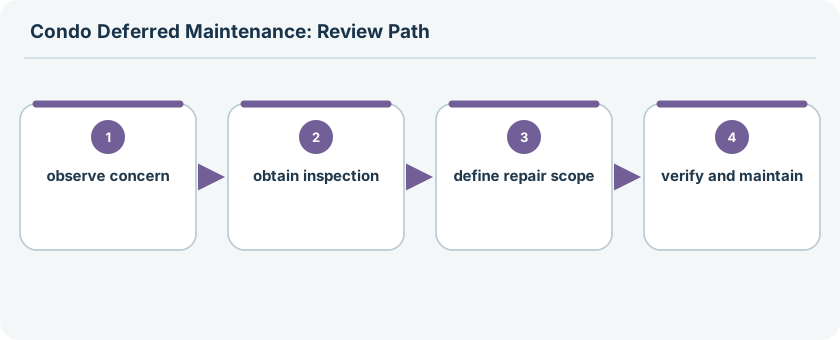
If urgent work is identified, do not wait for a perfect long-term budget before addressing immediate hazards. Coordinate emergency protection with the association and insurer, then separate that stabilization from permanent replacement and interior restoration. Ask the board to communicate what is known, what is still being investigated, and when the next decision will be made.
Deferred maintenance is best evaluated as a process: condition, scope, authority, funding, allocation, construction, and verification. A clear process may reduce uncertainty even when the eventual bill is substantial.
Read the financial records with the condition report
A reserve study or depreciation report is a planning tool, not a guarantee that every recommendation is funded. Compare the recommended contribution with the budget and actual reserve transfers. Check whether projects were moved to later years, whether inflation or new bids changed the estimate, and whether emergency work used money intended for another component.
Meeting minutes can show a project’s history more clearly than a single report. Look for recurring leaks, engineer appointments, failed tenders, owner complaints, temporary repairs, insurance renewals, and decisions to defer. Record the date of each decision and whether the board gave owners a scope, schedule, and funding explanation.
What owners should request
For an active issue, request the current condition report, emergency restrictions, project manager or engineer contact, scope alternatives, bid summary, contingency, funding resolution, allocation formula, and expected completion evidence. Ask whether access, permits, testing, temporary relocation, and interior restoration are included.
If a report is incomplete, ask what additional testing is scheduled and what information would change the estimate. An honest list of unknowns is more useful than a single precise number unsupported by a scope.
What buyers should test
A buyer should compare the building’s known project exposure with the planned holding period and available cash. Ask the lender about project review, the insurer about coverage and deductibles, and the seller about notices and payment obligations. One mortgage program’s “critical repair” approach should not be treated as a universal legal or financing rule.
A current assessment can be manageable if the project is defined and funded. A low fee can be risky if the reserve plan omits visible components or minutes show repeated postponement. Treat uncertainty as a question to resolve, not automatically as proof of failure.
Completion and prevention
At closeout, obtain evidence that the repair was completed, tested, and accepted. Ask for warranty terms, maintenance intervals, future reserve contributions, and a responsible contact. Update the component inventory and capital plan if the project changed the expected life or maintenance method.
Deferred maintenance is reduced when the association moves each issue through a visible sequence: inspection, priority, scope, authority, funding, construction, verification, and future care. Owners can evaluate that sequence even when they cannot predict the exact next invoice.
Build a status register
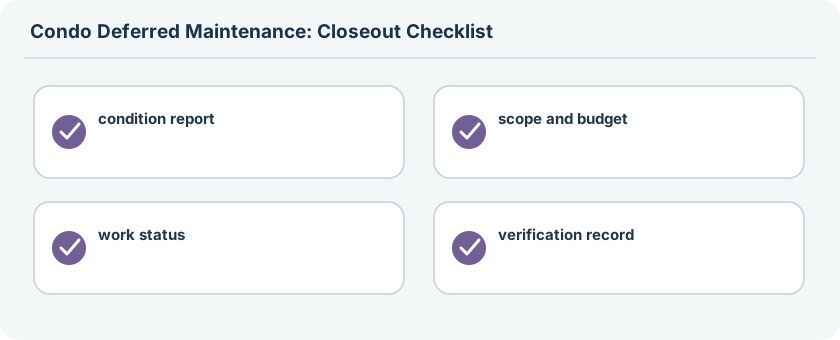
For each deferred item, record the component, condition, priority, report date, responsible decision-maker, proposed scope, funding source, owner allocation, next milestone, and evidence of completion. Update the register after an inspection, board meeting, bid, assessment, or construction phase. This prevents a serious item from disappearing into a general phrase such as “future maintenance.”
Ask whether the association has temporary controls while the permanent project is pending. Examples include leak monitoring, restricted access, shoring, water diversion, inspections after storms, or a limit on use. Temporary controls reduce immediate risk but are not a substitute for permanent repair.
When discussing refinancing or resale, describe the actual status rather than using a label alone. “Report ordered,” “scope approved,” “assessment collected,” and “work completed and tested” are different states. Provide the lender or buyer with the current documents and note any unresolved uncertainty.
The best sign is not the absence of a major project. It is a traceable process that identifies the condition, acts on urgency, funds the scope, communicates the allocation, verifies the repair, and updates the future plan.
A status register should be shared with owners in a way that distinguishes confirmed facts from estimates. That distinction helps buyers and lenders evaluate the project without turning an early observation into a definitive conclusion about safety, cost, or financeability.
When an item is described as urgent, ask what action is required today and what evidence will show that the risk has been controlled. Record the interim measure and the permanent milestone separately. This prevents “temporary” protection from being mistaken for completed repair.
Example: a recurring facade leak
A recurring leak may be classified as a maintenance item, a capital repair, or a critical issue depending on the evidence and risk. Compare the engineer’s report with meeting minutes, temporary protection, bids, insurance, and funding. Ask whether the association has addressed the entry point or only repainted the interior.
Record the status as observed, investigated, scoped, approved, funded, under construction, or completed and tested. If the association has restricted access or placed temporary protection, record the date for review. For a purchase or refinance, provide the current status and source documents rather than a bare “no assessment” answer.
The example shows how condition and financeability interact without making a universal lender conclusion. The project status must be described accurately and checked with the actual lender or insurer.