
A septic inspection is usually priced as a professional evaluation, not as a guarantee that every buried condition has been discovered. U.S. specialist market estimates report a broad inspection range, with price affected by inspection type, access, size and depth, pumping, and add-ons. Canadian pricing is not established as a dependable national range, so compare local CAD quotes by scope.
Directional U.S. cost anchors
The current U.S. specialist guides display ranges of $3,593–$12,463 for septic-system installation, $100–$1,300 for inspection, $627–$3,041 for septic-tank repair, and $5,000–$12,000 for tank-and-drainfield replacement. These are broad market observations, not quotes or universal rates; they are not Canadian prices and must not be converted into CAD.
Not every article in this category has the same scope as those anchors. Use the closest comparison only to set an order of magnitude, then ask the contractor, designer, pumper, or authority to separate the work specific to this decision from access, excavation, design, permits, restoration, pumping, disposal, equipment, service, or future operating costs.
Three different inspection decisions
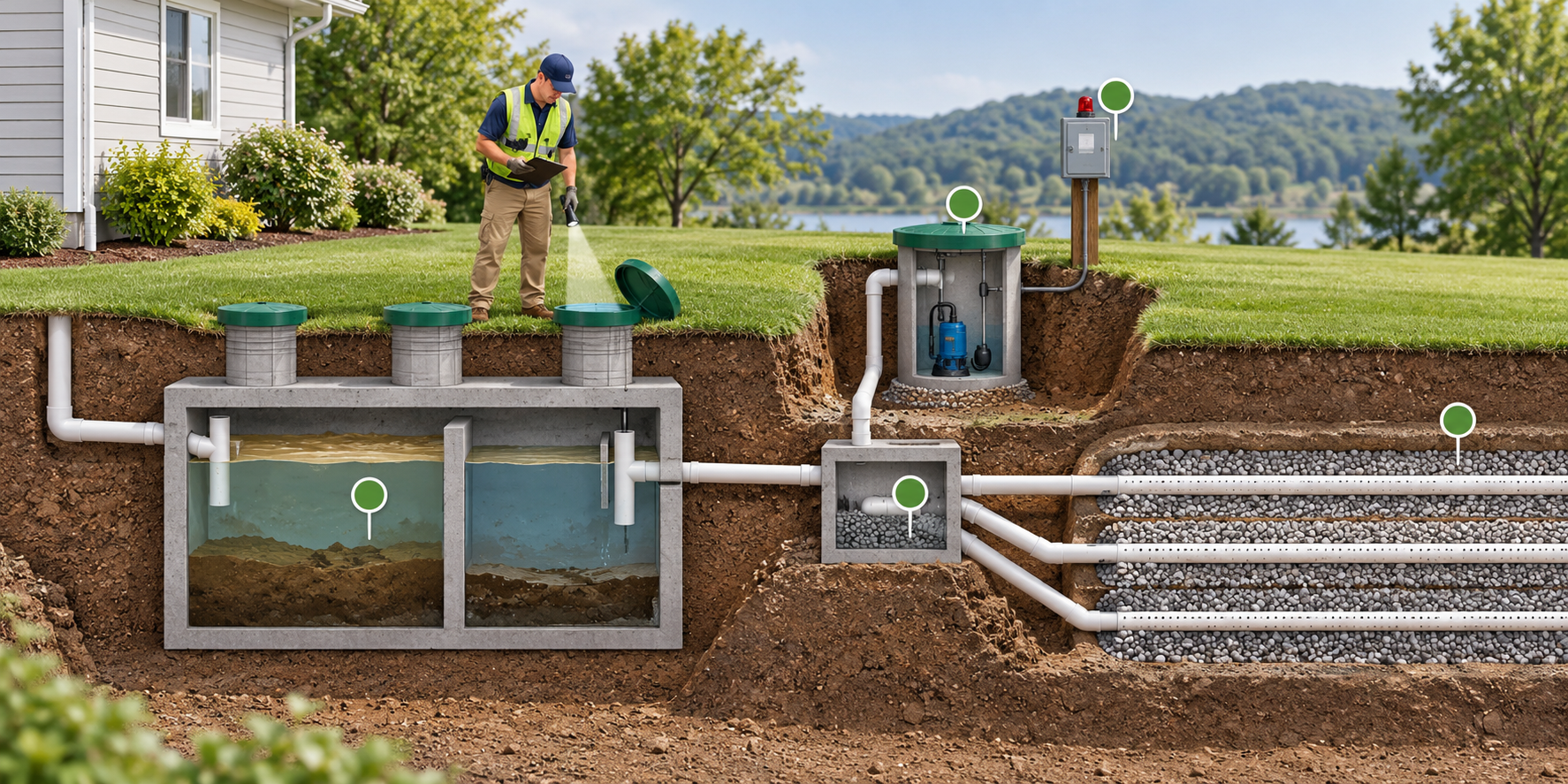
Routine ownership inspection checks condition and maintenance needs before a failure. It may review records, locate access points, open tanks, examine sludge and scum, inspect baffles and filters, look at pumps and controls, and observe the field and distribution components.
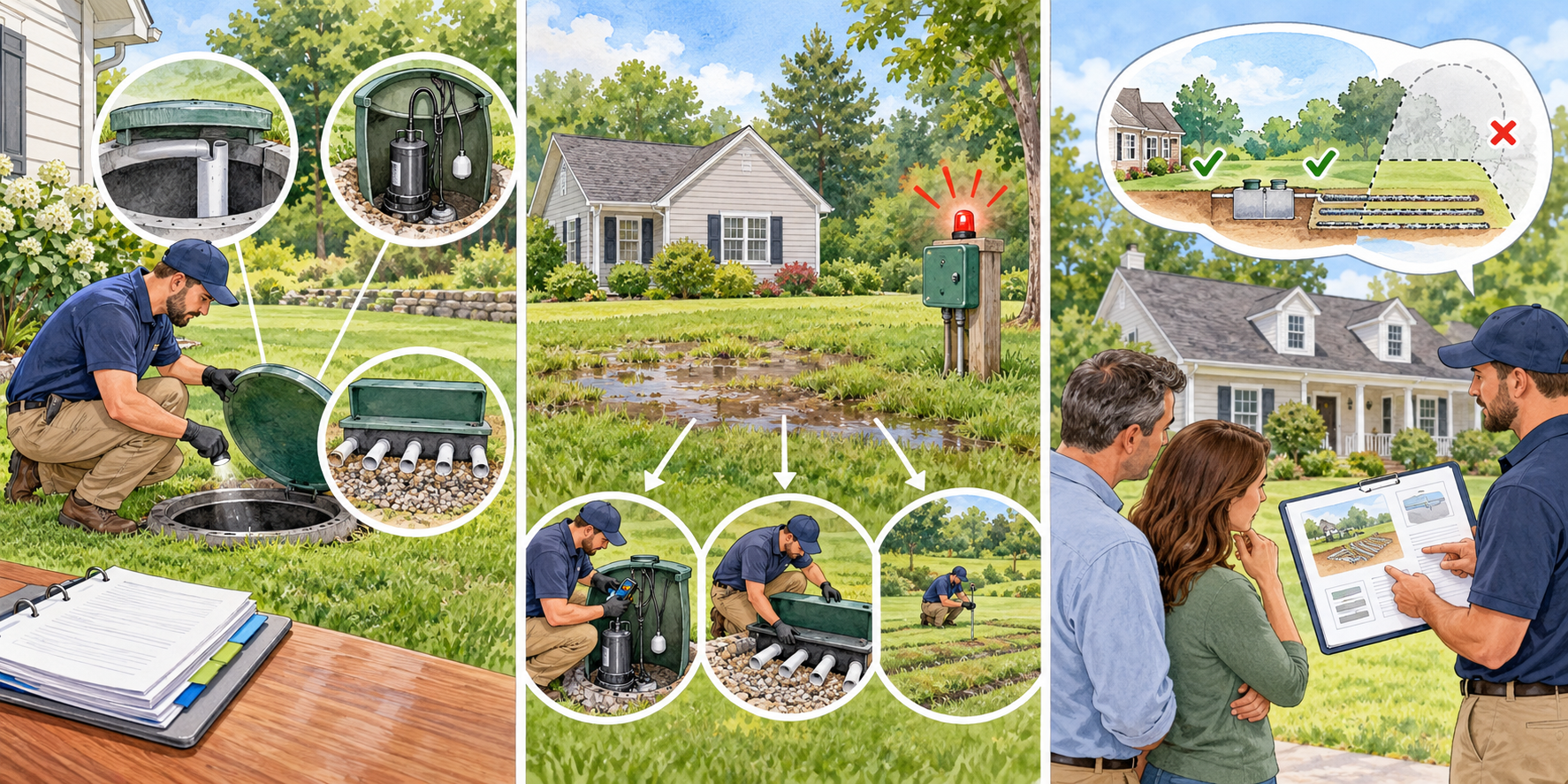
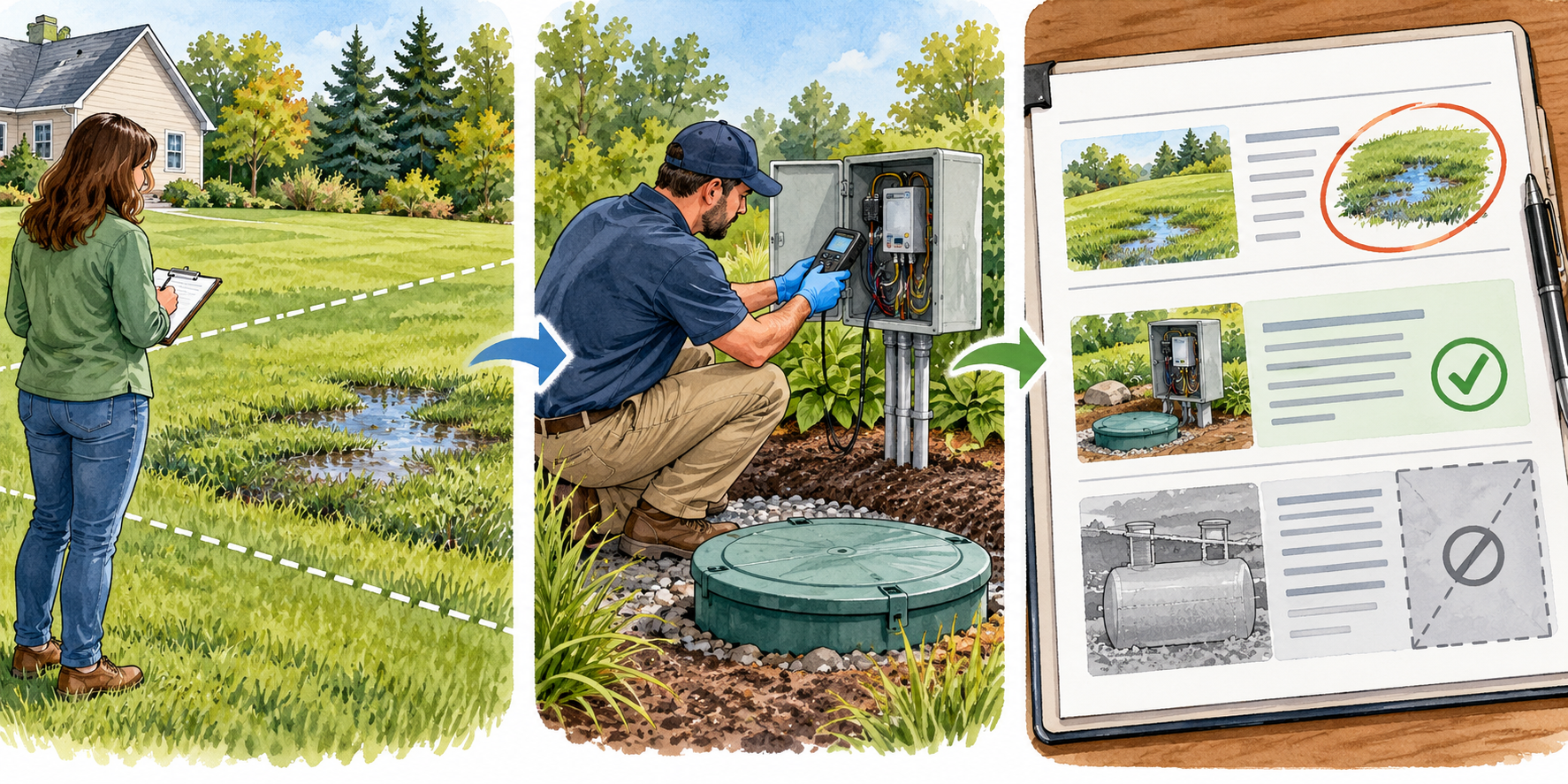
Diagnostic inspection starts with a symptom such as backup, odor, an alarm, ponding, or unusually wet vegetation. It may add pumping, flow or loading checks, camera work, excavation, electrical testing, or a focused field assessment. The objective is to narrow the cause, not merely document that the system exists.
Property-transfer inspection is governed by the transaction and local authority. Massachusetts, for example, provides a Title 5 inspection framework with listed exceptions. That is a Massachusetts example, not a rule for every U.S. state or Canadian province. Ask the local authority, lender, insurer, and transaction professionals which report is accepted.
A lender’s property review is not a septic inspection
Some U.S. mortgage programs add property-eligibility and documentation steps, but they do not create a universal septic-inspection mandate. Fannie Mae treats private or community septic service as part of utility eligibility for eligible loans. For some value-acceptance transactions that use property-data collection, a lender may need a qualified-professional report when the collected information shows a possible eligibility problem; if repairs are needed, the lender must document their completion before selling the loan to Fannie Mae. Those steps depend on the loan and lender review.
VA-guaranteed loans have separate minimum property requirements. The individual-sewage rule calls for sanitary disposal without creating a nuisance or public-health danger, and identifies circumstances that require health-authority approval. The handbook also says a connection is required when public sewer is available and the local authority mandates it. Availability alone does not trigger that VA condition. Topic 17 displays a March 28, 2019 change date, so confirm current handbook wording and local requirements for a specific transaction.
An appraisal or property-data review does not establish the inspection scope a septic professional performed. Ask the lender which report and repair documentation it will accept, and ask the local authority what approval or inspection applies to the property.

What a useful inspection may include
The provider should identify the system location and records available, then state which components were actually examined. A useful scope can include:
- permit, design, maintenance, and pumping-record review;
- all accessible tanks, liquid levels, sludge and scum, leaks, baffles, filters, risers, and lids;
- pump chamber, floats, controls, alarms, wiring, and dosing equipment where present;
- distribution box, outlets, visible line conditions, and evidence of unequal flow;
- drainfield surface condition, ponding, lush or spongy growth, erosion, and nearby drainage;
- camera inspection, excavation, or hydraulic testing only when the question justifies it.
“Inspected” should not mean “looked at the grass.” Ask what was inaccessible and what conclusions the inspection cannot establish.
Inspection is not pumping
Pumping removes accumulated solids from a tank. It can be part of an inspection or a response to a full tank, but it does not by itself prove that the tank is watertight, distribution is balanced, the pump works, or the soil can absorb wastewater. Conversely, an inspection without opening or accessing the relevant components may leave major uncertainty.
Ask for separate prices for the base inspection, pumping, locating buried lids, filter service, camera or excavation, and any written transfer report. Bundling can be economical when the tank is already being accessed, but the deliverables should remain clear.
Low, typical, and complex inspection cases
Simple maintenance review: Records and accessible risers are available, the system is conventional, the property is dry, and the inspection is not tied to a legal transfer. The main value is confirming condition and updating the maintenance plan.
Home-sale review: The provider must inspect a defined scope, document limitations, and produce a report that the parties can interpret. The buyer should budget separately for repairs or pumping identified by the report; the inspection is not a repair allowance.
Complex diagnostic review: Access is buried, the system has a pump or advanced treatment, the field is wet, or symptoms are active. Additional time and tests may cost more, but they can prevent the larger mistake of approving excavation or a replacement field before the failed layer is known.
How to read the report economically
Separate observations from conclusions. “Standing water at the field edge” is an observation; “the entire field must be replaced” is a much larger conclusion that may require design or authority confirmation. Check whether the report identifies the tank, field, distribution box, pump chamber, and reserve area, and whether it states what was not visible.
If buying a home, use the report to request a defined follow-up: a component repair quote, a pump test, a site evaluation, or a replacement design. Do not turn a general caution into a precise repair budget without confirming access, extent, and local requirements.
Questions before booking
- What exact components and area will be inspected?
- Does the price include locating, opening, pumping, and filter service?
- Will I receive photographs, measurements, a written report, and a list of limitations?
- Is the inspection designed for maintenance, diagnosis, or property transfer?
- What additional work requires approval before it is performed?
- Which findings require local-authority confirmation?
Pay for the inspection that answers your decision. A low-priced visual visit may be appropriate for a narrow maintenance question, but it is not an equivalent substitute for a documented transfer or diagnostic inspection.
Match inspection depth to the decision
For routine ownership, the useful output may be a maintenance date, a list of accessible defects, and a recommendation for the next pump or service. For a sale, the important output is a documented scope that a buyer and seller can interpret, including the system location, components reached, observations, limitations, and any required local form. For a large repair quote, the value is evidence that distinguishes a localized component from a tank, distribution, or field problem.
Ask whether the inspector will open all tanks or only the easiest access point. A system with a separate pump chamber or advanced treatment cannot be evaluated from the primary tank alone. Likewise, a clean tank does not show that the field is accepting wastewater. If the provider recommends excavation or a loading test, ask what uncertainty that additional cost resolves and what decision it will change.
Avoid false reassurance
An inspection can find no visible defect while still being limited by wet conditions, buried components, missing records, inaccessible areas, or a lack of long-term performance data. That is not a failure of the service if the limitations are stated. It becomes a problem when “passed” is used to imply a warranty or a guaranteed remaining life that the inspection did not establish.
When comparing reports, look for the system boundary and the words that describe uncertainty. “Not observed,” “not accessible,” and “not tested” are materially different from “sound.” If a transfer depends on a local inspection rule, confirm the authority’s current requirement rather than relying on a generic home-inspection label.