
A distribution box divides effluent among drainfield laterals in systems that use that arrangement. Replacement cost is usually driven by locating and exposing the box, the number and condition of outlets, leveling and reconnection, excavation, and restoration. U.S. market signals are directional; Canadian pricing requires a local CAD quote.
Directional U.S. D-box estimate
Angi’s August 2026 guide estimates septic distribution-box replacement at $500–$1,500, with a typical estimate around $1,000. Box size, material, access, grading, and any line or field work can change the project scope. Treat this as a specialist market estimate, not a local quote or Canadian price, and confirm whether digging and restoration are included.
What the box does
The box should send flow to the intended field lines. Settlement, deterioration, damaged outlets, or an out-of-level box can create unequal loading. That may produce a localized wet area or contribute to stress on one part of the field. A distribution-box problem and a soil-absorption failure can exist at the same time.
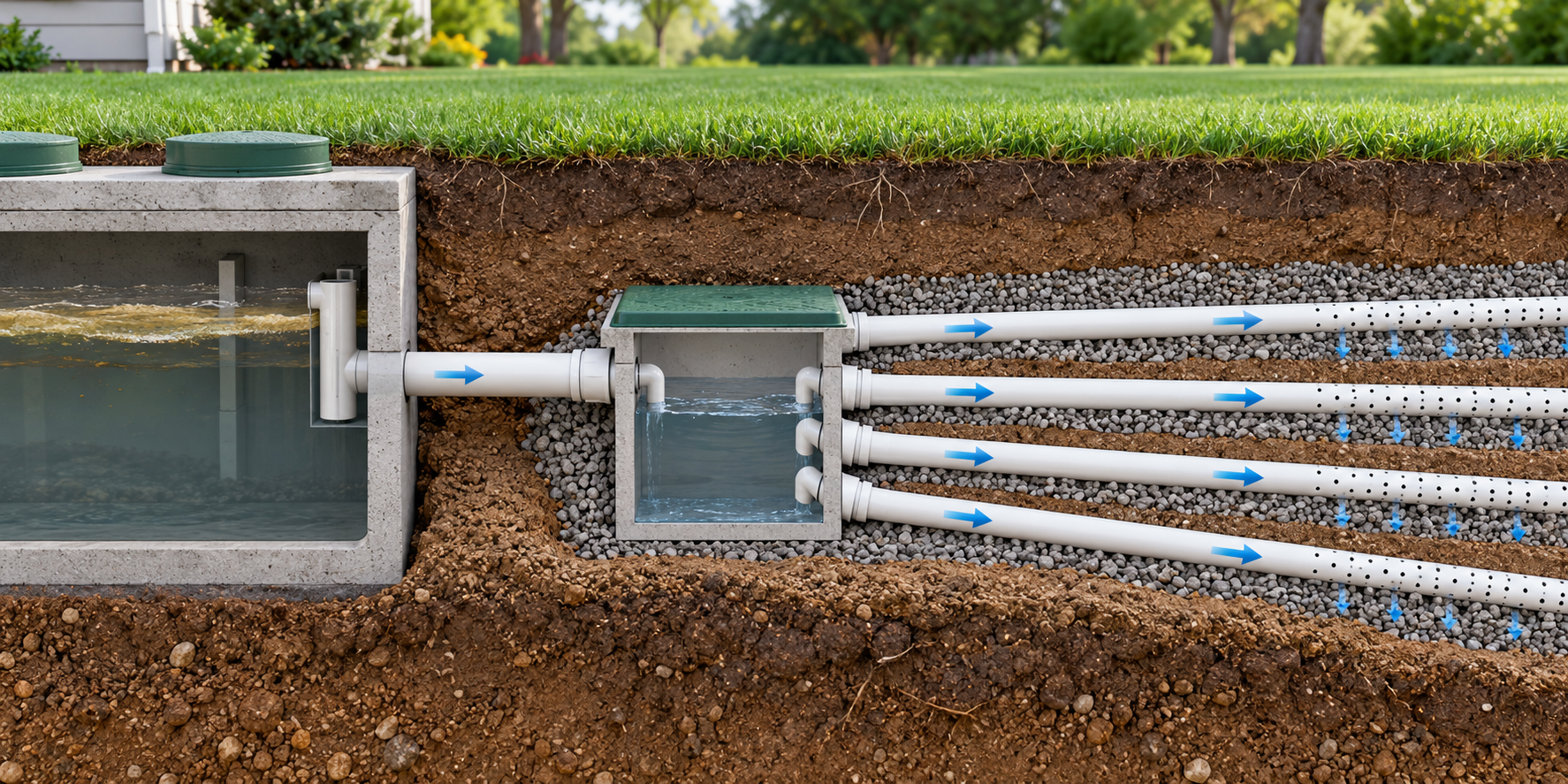
Cost layers
- locating the box from records or field investigation;
- exposing buried access and protecting nearby landscaping;
- pumping or controlling flow where necessary;
- replacement box, outlet fittings, seals, and line reconnection;
- leveling and confirming the approved configuration;
- excavation, backfill, grading, and restoration;
- inspection or permit work where the local authority requires it.
The box price is only one line. A quote should state whether the lateral lines were accessible and whether any damaged or settled line is included.
When box replacement may be enough
A component-focused project is more plausible when the box is visibly deteriorated or misaligned, the lines are intact, the field has no evidence of hydraulic or soil-treatment failure, and the authority accepts the repair. The provider should explain what evidence supports that narrow boundary.
If the field remains ponded, spongy, surfacing, or overloaded after distribution is corrected, replacing the box has not solved the main problem. Do not accept a guarantee that equal distribution restores a field whose soil capacity has been lost.
Simple, typical, and difficult cases
Simple: The box is located, exposed, and accessible; outlet lines are intact; the lawn is easy to restore.
Typical: The box is buried, settled, or surrounded by roots and the contractor must excavate, level, reconnect, and restore the area. The field needs at least a defined visual or functional assessment.
Difficult: The box is deep, beneath a driveway, in saturated or rocky soil, or tied to multiple damaged laterals. The economical scope may become line repair, field repair, or a replacement design rather than a box-only job.
Questions for the quote
- How was the box located and what condition was observed?
- How many outlets and laterals are included?
- Is leveling, reconnection, flow verification, and any line repair included?
- Was the drainfield assessed separately?
- Are excavation, rock, groundwater, disposal, backfill, permits, and restoration included?
- What result would require a larger field decision?
Septic tank and drainfield professionals should perform this work. A new distribution box is a useful repair only when the quote makes the downstream assumptions visible.
Leveling is a function question, not a cosmetic one
The box matters because its position and outlet arrangement affect where effluent flows. Ask the professional to explain how equal or intended distribution will be checked and whether the lines can be observed. A level box with a compromised field can still leave ponding or surfacing wastewater; a box replacement should not be sold as a complete field restoration without supporting evidence.
Compare restoration and repeat-work risk
If the box is beneath a lawn, the restoration may be modest. Beneath a driveway, patio, mature planting, or saturated soil, access and surface repair can dominate. Ask whether the contractor will protect the remaining laterals and whether heavy equipment can enter without compacting the field.
If flow imbalance has existed for a long time, ask whether the affected lateral needs separate evaluation. The economically sound scope may be box-only, box plus line repair, or field redesign. Request the alternatives in writing before excavation makes the decision more expensive.
Existing-system records matter
Keep the original layout, number of laterals, box location, and prior service records with the quote. If the property has been regraded or landscaped, ask whether current drainage and access still match the approved layout. A component replacement is easier to defend when the provider states what downstream condition was examined and what remains outside the scope.
If the box is part of a larger gravity field, ask whether the replacement preserves the approved outlet configuration. If a pump or pressure system is involved, confirm that a distribution-box quote is addressing the right subsystem; the components and economics may instead belong to the pump, control, or engineered-system scope.