
Routine septic pumping is a service visit to remove accumulated sludge and scum from the tank. U.S. specialist market research provides a directional pumping signal, but no dependable national Canadian price is available. Local CAD quotes vary with tank size, access, hauling distance, disposal, and whether inspection or component work is added.
Directional U.S. pumping estimate
Angi’s July 2026 U.S. cost guide lists routine septic pumping at $292–$564, with a reported average of $428. Tank size and access affect the price. This specialist estimate is not a quote, a Canadian price, or an inspection price; confirm whether a local quote includes locating, opening, disposal, filter service, or additional work.
What pump-out service usually includes
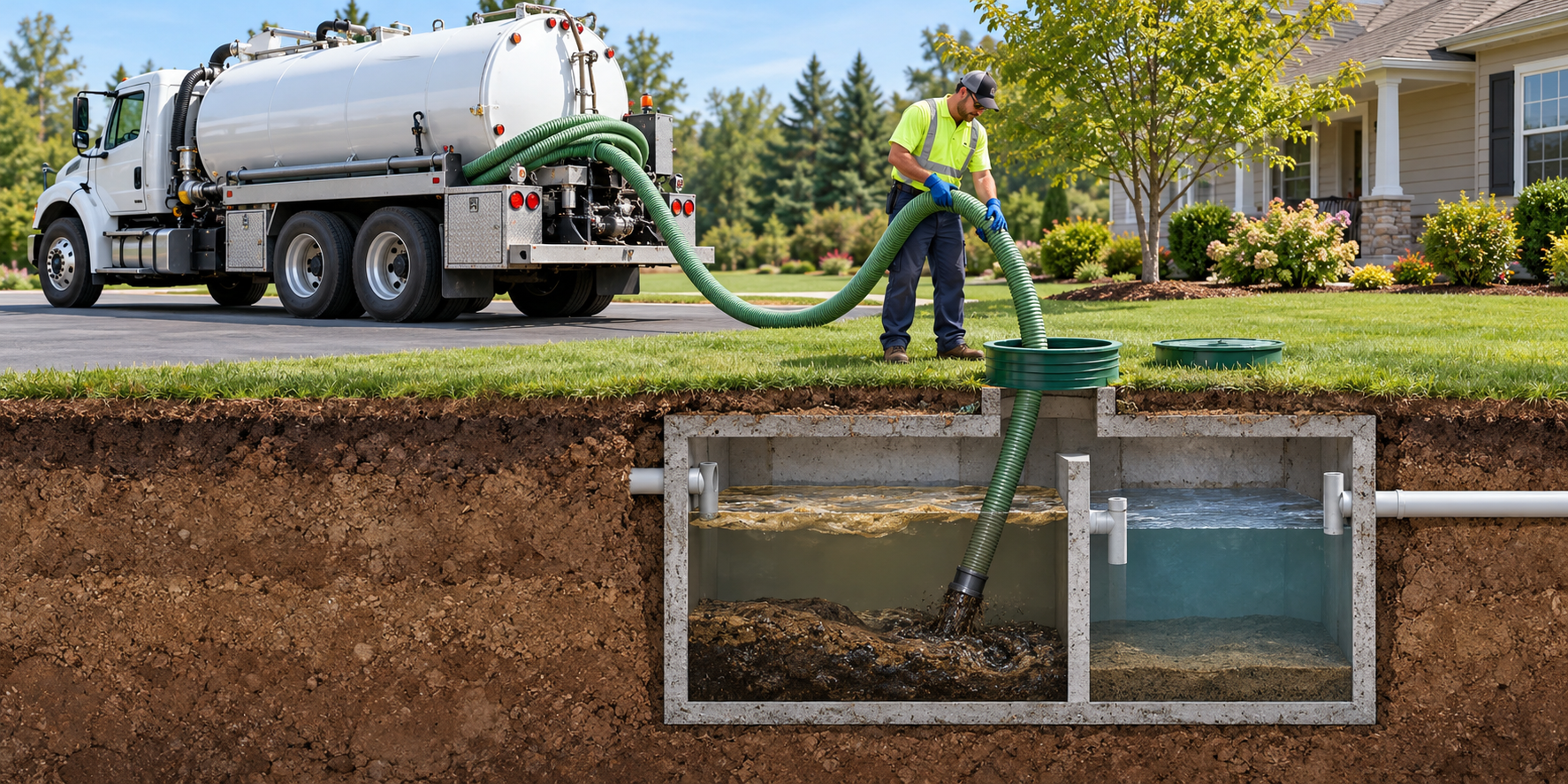
The pumper locates or accesses the tank, removes accumulated contents, transports them for disposal, and records the service. The quote may also include opening multiple access points, cleaning an effluent filter, checking a pump tank, or reporting visible conditions. Those additions are not automatic.
Ask whether the quoted price includes the travel or service minimum, tank capacity, all compartments, pumping of a separate lift or pump station, disposal, taxes, and a written record. If the lids are buried or damaged, locating and excavation can become a separate line.
Why the bill changes
| Price driver | What it changes |
|---|---|
| Tank capacity and number | More volume, compartments, or tanks can require more time and truck capacity. |
| Access | Long hose runs may be manageable; buried, unsafe, blocked, or damaged access may require locating and excavation. |
| Haul and disposal | Distance, road access, and local disposal arrangements affect travel and handling. |
| System type | Pump tanks, advanced systems, or holding tanks can require additional service beyond a conventional tank. |
| Timing | Emergency, weekend, or weather-constrained service can carry a premium. |
| Add-on work | Inspection, filter cleaning, riser repair, lid replacement, or pump service changes the scope. |
The tank itself is not the whole system. Pumping does not establish that the outlet, distribution box, pump, or drainfield works.
How often should it be pumped?
EPA general guidance describes pumping about every three to five years or as needed, while also identifying tank size, household size, water use, garbage-disposal use, and solids accumulation as variables. That is a planning interval, not a universal legal schedule. A local rule, an advanced-system service agreement, or actual measured solids may change it.
The useful record is not just the date. Keep the tank size, measured solids if provided, system type, filter service, observed issues, and the next recommended action. That information lets the next provider distinguish a routine interval from an unusually fast buildup.
Routine, difficult-access, and emergency scenarios
Routine pump-out: The tank location is known, access is exposed, the truck can reach the property, and no symptom suggests a wider failure. The main comparison is service scope and disposal.
Difficult-access pump-out: The tank is under soil, a deck, pavement, or landscaping, or the hose route is unusually long. A riser or access improvement may cost more now but reduce future locating and restoration charges.
Emergency pump-out: Wastewater is backing up or the tank is near capacity. After-hours access and additional diagnosis may raise the bill. Emergency pumping can restore temporary storage, but it cannot repair a failed drainfield, blocked outlet, broken pump, or saturated soil.
Flooded or saturated conditions are different. EPA flood guidance warns that pumping a tank while the drainfield and surrounding soil are saturated can create flotation and pipe-damage risks. Follow local authority and professional direction rather than treating an emergency pump-out as automatically safe.
Pumping versus inspection
An inspection may review records, all tanks, sludge and scum, baffles, filters, leaks, pumps, controls, distribution, and drainfield condition. Pumping may be necessary to see or service some items, but a pump-out invoice is not a whole-system condition report.
If you are buying a property, comparing a repair quote, or dealing with recurring failure, ask for the inspection separately. If you are scheduling routine maintenance, ask whether the pumper will report visible defects and whether a filter or riser service is optional or recommended.
Questions for the quote
- What tank capacity and compartments are included?
- Are the tank and pump-station lids exposed and safe to access?
- Is disposal included, and is the hose distance within the quoted service?
- Does the price include filter cleaning, inspection, or a written record?
- Is emergency timing included or separately priced?
- What conditions would require stopping work or obtaining authority direction?
The best pumping quote makes access and service boundaries visible. Budgeting a recurring pumping reserve is useful, but do not use routine pumping as a substitute for diagnosing symptoms or planning a failing field.
How pumping records improve future quotes
Record the tank size, number of compartments, access condition, measured solids if provided, filter service, visible liquid level, and any recommendation. The information helps identify whether the household is approaching a normal interval or accumulating solids unusually quickly. It also lets a future provider price a known access route instead of repeating locating and excavation.
If a pumper reports an unusually high liquid level, a blocked outlet, damaged baffle, or water entering from outside, ask whether the observation requires inspection. If wastewater backs up again soon after pumping, do not simply schedule another pump-out without diagnosis. The recurrence may point to a pump, outlet, distribution, field, or saturation problem.
Access improvements as an ownership decision
An exposed, properly secured riser can make future service easier, but its installation is not free and must suit the tank opening and surface. Compare the one-time access improvement with the likely number of future visits and the cost of digging through finished surfaces. Do not let an access project expand into unrelated landscaping work without a clear scope.
For a holding tank, pumping is not a periodic solids-maintenance choice; it is the normal operating service. For an advanced system, tank pumping may be one layer of a required maintenance program. Those systems should be budgeted through their own lifecycle guides rather than a conventional three-to-five-year assumption.