
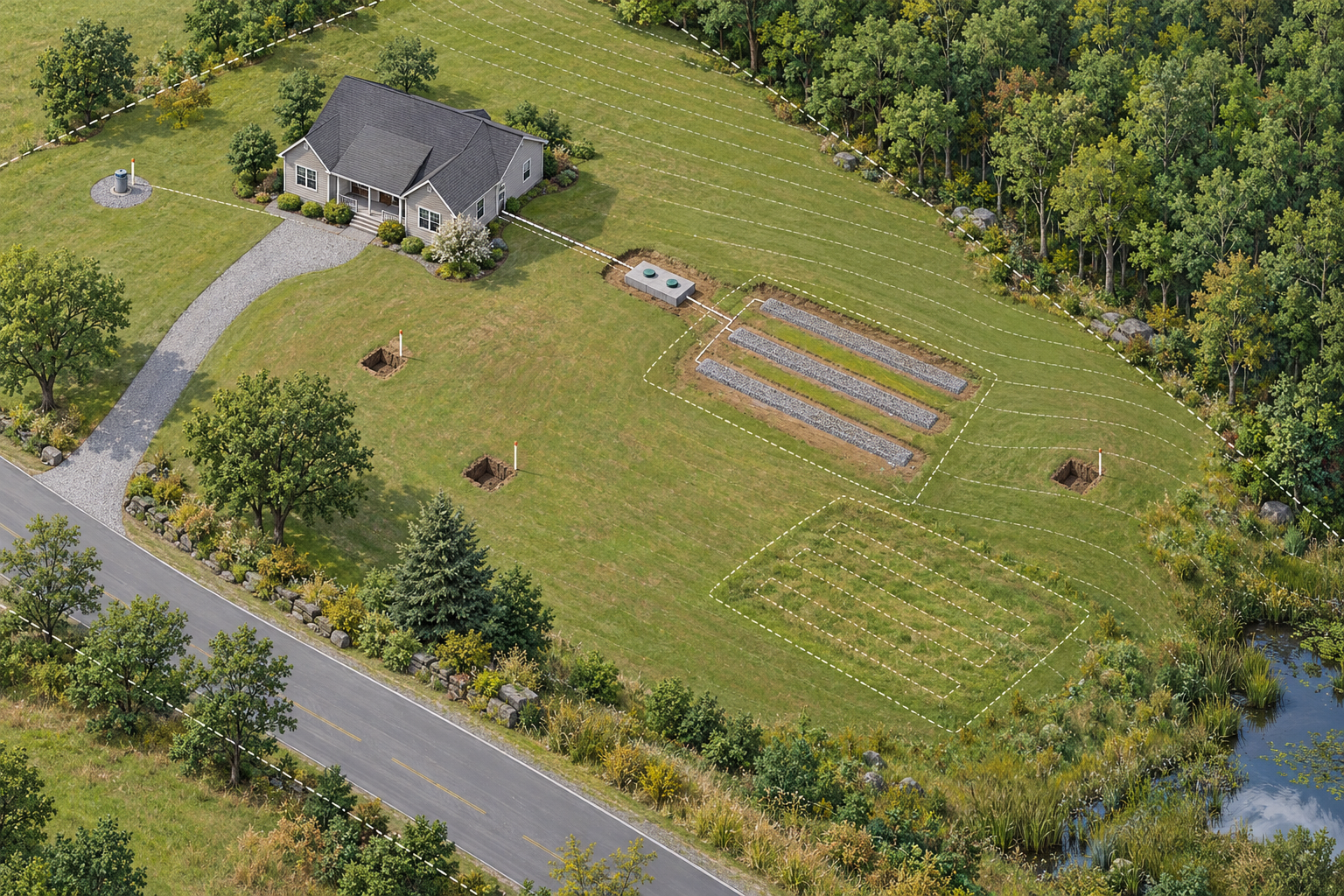
Before a tank or drainfield can be priced responsibly, the property has to show what kind of onsite system it can support. A “perc test” may be one part of that work, but it is not a universal name for the entire evaluation. Depending on the jurisdiction and site, the process may include soil observations, test pits, groundwater or bedrock assessment, slope and setback review, design, an application, and an inspection or filing.
Directional U.S. site-work estimate
Angi’s 2026 U.S. septic-installation guide lists $700–$2,000 for percolation and soil tests. This is a specialist market estimate, not a permit-fee schedule or a rule that every jurisdiction requires a percolation test. The required evaluation, design, and application depend on the property and authority; confirm what the estimate includes before comparing it with a local quote. It is not a Canadian price.
What you are paying to find out
The evaluation answers a feasibility question: where can wastewater be treated and dispersed without creating an unacceptable risk or violating local requirements? The answer depends on wastewater load, soil, slope, lot size, groundwater, proximity to sensitive water, climate, and regulation. It can also be constrained by the location of a private well, house, driveway, property line, or future building area.
The output may be a site report, test results, a plan showing the tank and field, design calculations, an authorization application, or a list of conditions. Ask what document you receive. A contractor saying “the lot should work” is not the same as a design that an authority can approve.
Perc test versus broader site evaluation
Percolation testing measures how quickly water moves through a particular soil under the method used by that jurisdiction. Some authorities rely more heavily on soil profile observations, test pits, seasonal groundwater information, or prescribed design criteria. The terms and required participants differ between states, provinces, and municipalities.
That difference changes cost. A simple test on an open lot may be a small professional service. A constrained replacement project may require several excavation points, additional seasonal information, a qualified designer or engineer, and a redesign after the first result. Do not accept a quoted “perc test” as proof that all design and approval costs are included.
Price layers that should be separated
- site visit, records review, and locating the existing system;
- soil observations, test pits, percolation or other field tests;
- groundwater, bedrock, slope, and well-separation assessment;
- system layout and design by the locally qualified professional;
- engineering or alternative-system treatment design where required;
- application, permit, filing, authority review, and inspection fees;
- redesign, resubmission, or additional testing if the first approach is not accepted.
Market prices for these services are local, and available research does not establish a dependable national U.S. or Canadian schedule. Compare scope and qualifications rather than choosing the lowest test price.
How site findings change the project
Suitable soil and enough usable land may support a conventional tank-and-field design. Shallow soil, high groundwater, bedrock, slope, limited area, or sensitive-water constraints may require a mound, drip, sand-filter, aerobic, pressure-dosed, or other engineered system. Those options add design, equipment, power, monitoring, maintenance, or fill layers; they are not simply a larger permit fee.
If the proposed field conflicts with an addition, driveway, pool, well, or future reserve area, relocating it can change excavation and restoration costs. A lot that technically fits a system may still be a poor purchase if the approved field consumes the only practical expansion area.
Examples of jurisdictional variation
British Columbia, Alberta, and Nova Scotia each demonstrate that onsite wastewater authorization, standards, qualified installers or designers, and maintenance obligations are administered through local or provincial frameworks. Those examples help explain why a national “permit cost” answer is unsafe. They do not establish the rules for another province, state, or municipality.
Ask the authority which rules apply to this parcel and whether the professional must file or obtain approval before construction. Confirm whether the required process changes for a replacement, addition, secondary suite, holding tank, or alternative treatment unit.
Questions before buying a difficult lot or authorizing tests
- What exact evaluation and documents are required in this jurisdiction?
- Who is qualified to perform the test and prepare the design?
- Is a replacement area required, and where could it fit?
- How will the private well, slope, groundwater, bedrock, and property boundaries affect the layout?
- Are permit, authority-review, inspection, and redesign fees included?
- What happens financially if the conventional design fails or is rejected?
- Does the report address a future addition or ADU, or only current use?
The most useful site-evaluation quote makes uncertainty explicit. It tells you what is being tested, what decision the result supports, and which later costs remain outside the initial fee.
How to compare evaluation proposals
Two proposals can both say “soil test” and still support different decisions. One may be a preliminary visit for a new lot; another may include test pits, records review, a replacement-area layout, a designer’s plan, and an application package. Ask for the field work, professional deliverable, authority submission, and number of revisions as separate lines.
The cheapest test may have low value if it does not answer the question that controls the purchase or construction decision. If you are buying a property, ask whether the evaluation is sufficient for the intended use and whether an existing system can be located and reviewed. If you are replacing a field, ask whether it evaluates the proposed replacement area as well as the current field. If an addition is planned, show the future footprint before the designer finalizes the layout.
Findings that change the economics
Suitable soil in the wrong location can be almost as limiting as unsuitable soil. A field may need to move away from a well, driveway, foundation, easement, or future building area. A slope can make gravity distribution unavailable. Seasonal groundwater or shallow bedrock can require imported material, pressure dosing, or an alternative treatment stage. Those are architectural changes to the system and should be priced as such.
Request a written list of assumptions and failure paths: what happens if the conventional option is rejected, if the reserve area does not fit, or if the authority requires additional evidence? That list helps prevent a low initial fee from becoming an unplanned redesign after the purchase or excavation has begun.