
Backups, slow drains, gurgling, odors, a wet or spongy field, unusually lush vegetation, surfacing wastewater, and a high-water alarm justify investigation, but none identifies one failed component. The cause may be inside plumbing, at the tank outlet, in a pump or control, in distribution, in the drainfield, or in saturated surrounding soil. U.S. specialist inspection prices are broad directional signals; the final diagnostic cost depends on access, system type, urgency, and testing.
Directional U.S. cost anchors
The current U.S. specialist guides display ranges of $3,593–$12,463 for septic-system installation, $100–$1,300 for inspection, $627–$3,041 for septic-tank repair, and $5,000–$12,000 for tank-and-drainfield replacement. These are broad market observations, not quotes or universal rates; they are not Canadian prices and must not be converted into CAD.
Not every article in this category has the same scope as those anchors. Use the closest comparison only to set an order of magnitude, then ask the contractor, designer, pumper, or authority to separate the work specific to this decision from access, excavation, design, permits, restoration, pumping, disposal, equipment, service, or future operating costs.
Start with diagnosis, not a repair label
The economic mistake is asking for “a drainfield repair” before establishing whether the field is the problem. A professional may review records, identify all tanks, inspect levels and baffles, check filters, test a pump and alarm, examine the distribution box, and assess the field. Pumping may be useful, but it is not proof that the whole system works.
The first visit may produce a likely cause, a need for a focused test, or a recommendation to stop using the system until a saturated condition changes. Those are different deliverables. Ask what the service call includes and what additional work requires approval.
Symptom does not equal intervention
| Symptom | Plausible problem classes | What changes the cost |
|---|---|---|
| Backup or slow drains | Interior drain restriction, tank/outlet blockage, pump fault, field or hydraulic problem | Whether all fixtures or only one are affected; whether the system is full or the site is saturated |
| Gurgling | Plumbing venting or restricted wastewater flow | Whether a building-drain or onsite-system professional is needed |
| Odor | Plumbing, tank access, venting, treatment, or surfacing wastewater | Location, persistence, and whether wastewater is reaching the surface |
| Wet or spongy field | Surface drainage, groundwater, overload, distribution issue, or field treatment failure | Weather, season, extent, and evidence of untreated wastewater |
| High-water alarm | Float, control, pump, power, blocked discharge, or downstream capacity | Whether the pump can be safely assessed and whether use must be reduced |
This table is a decision map, not a remote diagnosis.
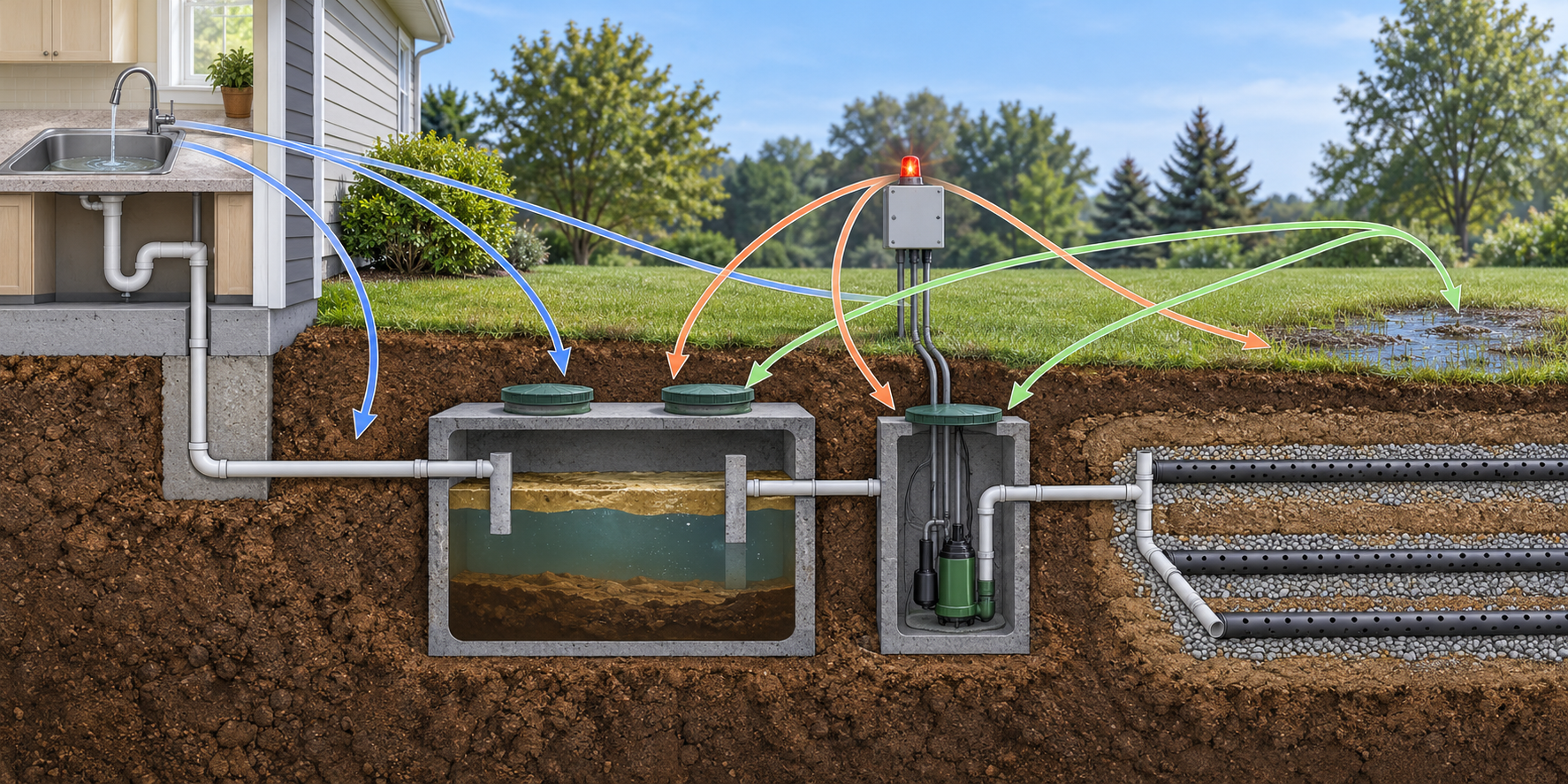
Likely cost layers
- initial service call and records review;
- tank access, inspection, and possible pumping;
- filter, baffle, outlet, or distribution-box assessment;
- pump, float, control, alarm, wiring, or check-valve testing;
- camera work or excavation where a buried line or component must be seen;
- site and field assessment, including ponding or unequal distribution;
- emergency stabilization, follow-up design, excavation, restoration, or replacement.
The inexpensive outcome may be a blocked outlet, filter, float, or accessible minor component. The expensive outcome may be a structural tank problem, failed pump system, soil-treatment failure, saturated site, or field replacement. The diagnosis is valuable because those paths have very different total economics.
Three diagnostic scenarios
Localized or plumbing-side problem: One fixture is slow, or a visible tank-side component is obstructed while the field appears unaffected. The cost may remain a service call and localized repair, but confirm that the observation covers the relevant system.
Pump or distribution problem: A high-water alarm or uneven field condition leads to pump, control, float, or distribution-box testing. Replacing one component may restore operation, but the quote should state whether the field was assessed before promising a complete fix.
Systemic field or site problem: Persistent ponding, surfacing wastewater, recurrent backup, saturated soil, or evidence of hydraulic overload may require a site evaluation and a repair-versus-replacement decision. Drainfield rehabilitation claims deserve caution; available guidance does not establish a dependable general method or outcome.
Urgency and safe boundaries
Sewage exposure is a health concern, and tank work can involve dangerous gases. Keep people and pets away from surfacing wastewater and use local health-authority or professional guidance for contaminated areas. Do not open or enter a tank, handle pump wiring, or operate equipment in a flooded or saturated area as a homeowner experiment.
If the system is actively backing up, the appropriate next step may be emergency stabilization. If flooding or high groundwater is involved, pumping and excavation may need to wait until conditions are safe; see the dedicated flood-recovery article.
What to request after diagnosis
Ask for the observed component, location, evidence, recommended repair boundary, exclusions, and what remains unknown. If the recommendation is a new field, ask whether the tank and distribution system can remain and whether a site/design approval is needed. If it is a pump replacement, ask whether the alarm, controls, electrical supply, chamber, and discharge path were included.
Compare repair quotes only after they describe the same uncertainty. A cheap component replacement is not a bargain if it leaves a known downstream failure untouched; a full replacement is not justified merely because a symptom sounds serious.
Make the diagnostic quote testable
Ask the provider to write down the symptom, the components to be inspected, the evidence that would support each repair path, and the point at which additional work needs approval. “Investigate septic issue” is difficult to compare. “Review records, access tank and pump chamber, inspect outlet and filter, test alarm, and report field observations” describes a decision-support service.
If the system has separate tanks or a pump chamber, confirm that the quote reaches each one. If a camera, excavation, or hydraulic test is proposed, ask whether the result will distinguish a blocked pipe from failed soil absorption. If the provider recommends replacement immediately, request the observations and ask whether a site/design professional must confirm the replacement option.
The economics of waiting
Waiting can be reasonable for a non-urgent, intermittent symptom when a professional has identified a safe monitoring plan. It is not a cost strategy when untreated wastewater is surfacing, a backup is active, an alarm is ignored, or the property is being used despite a saturated field. Delay can turn a localized repair into indoor damage, field contamination, or an emergency service decision.
At the same time, urgency should not eliminate scope discipline. An after-hours pump-out may be appropriate stabilization, but the permanent repair still needs a separate diagnosis and quote. The goal is to buy the next piece of information that changes the economic choice.