
Annual septic cost is an accounting exercise, not necessarily an annual service visit. A conventional gravity system may need an inspection every one to three years and pumping about every three to five years or as needed under general EPA guidance. An advanced or pumped system can add service contracts, electricity, controls, alarms, and replacement-part reserves. Local rules and actual solids accumulation may differ.
Annualize a published maintenance example
EPA’s maintenance-cost guidance gives a $250–$500 example every 3–5 years. Spread evenly across those years, that is roughly $50–$167 per year. This arithmetic is a planning model, not an annual price EPA quotes; it does not include other inspections, advanced-system service, repairs, or a replacement reserve. Canadian homeowners should use local quotes in CAD.
The layers in a realistic budget
Build the budget from separate reserves:
- Pumping reserve. Divide the expected local pump-out price by the interval supported by your records and system use. Include difficult access, multiple tanks, or a pump chamber when applicable.
- Inspection reserve. Set aside for periodic inspection, transfer documentation, or diagnostic work. Inspection is not automatically included with pumping.
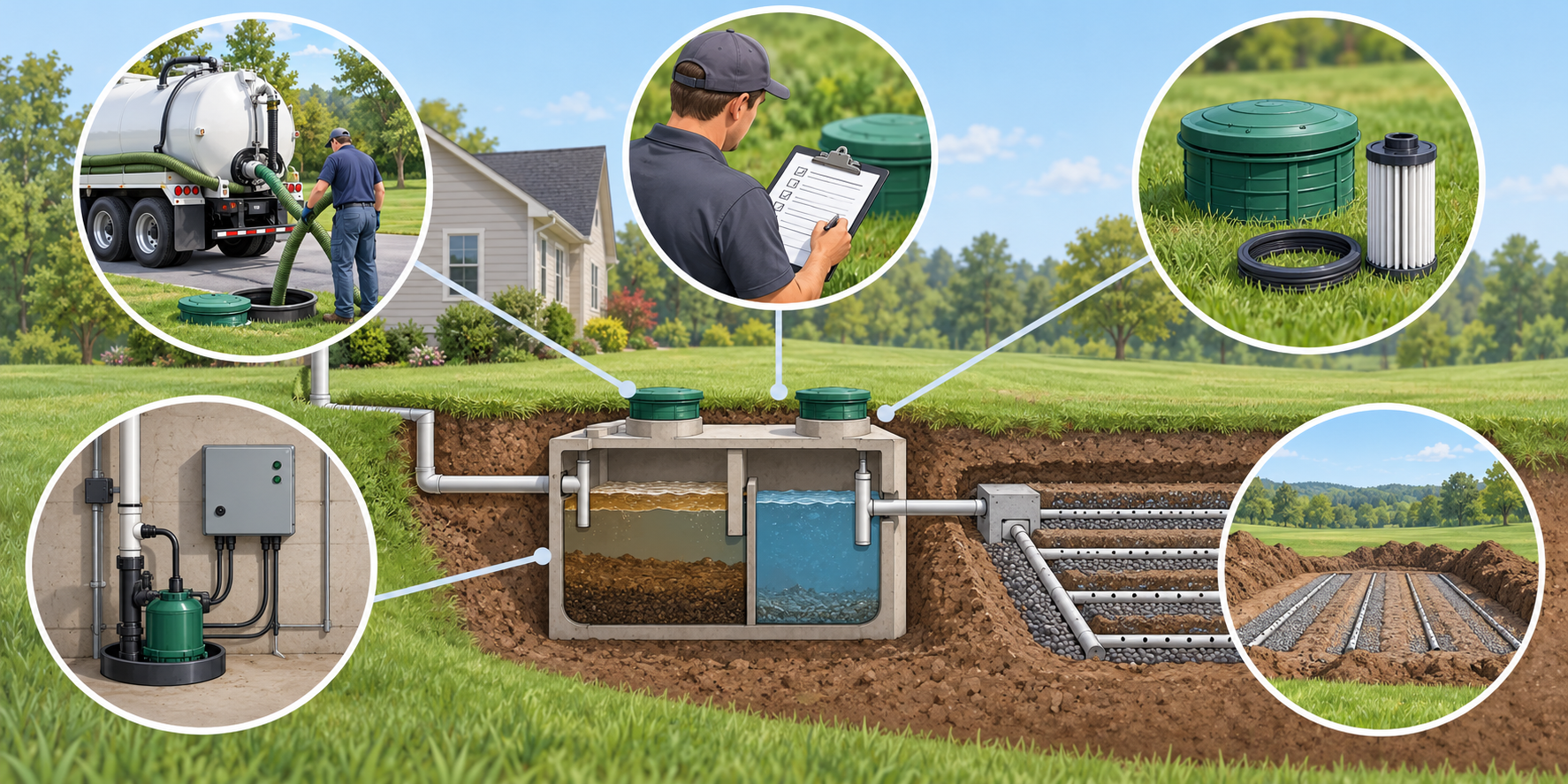
- Small-component reserve. Risers, lids, baffles, effluent filters, seals, and distribution components can create a service bill even when the tank and field remain serviceable.
- Pump and control reserve. Pumped, mound, drip, aerobic, and other advanced systems may need electrical diagnosis, floats, alarms, controls, pumps, blowers, or dosing components.
- Operating reserve. Pump power, required monitoring, reporting, service agreements, and treatment or disinfection components belong here where applicable.
- Long-term system reserve. A tank, distribution system, or drainfield may eventually need major work, but no reliable universal lifespan applies. Use inspection records and local professional advice instead of an age formula.
Conventional and advanced budgets are different
A simple gravity system concentrates its recurring costs in pumping, periodic inspection, minor access or filter work, and an eventual repair reserve. An advanced system may shift more cost into scheduled service. EPA guidance notes that systems with electrical, mechanical, pump, float, or advanced-treatment components need more frequent attention than a basic gravity arrangement.
An older Ontario rule often cited for class-specific aerobic servicing, R.R.O. 1990, Regulation 358, was revoked on June 23, 2009. Its agreement and inspection clauses are historical and do not establish current Ontario requirements. Check the current Building Code and responsible authority for the property. In B.C., owner records and authorized maintenance obligations provide another example of why recurring administration belongs in the budget.
Simple, typical, and complex ownership patterns
Simple owner budget: Known tank and field, exposed access, conventional gravity distribution, no pump, and predictable use. The annual number is mainly a pumping reserve plus periodic inspection and a small-component reserve.
Typical owner budget: Four-season occupancy, a filter or risers, moderate access difficulty, and occasional professional inspection. The household should also hold a larger reserve for a lid, baffle, distribution-box, or localized line issue.
Complex owner budget: A mound, drip, aerobic, sand-filter, or pressure-dosed system with pumps, alarms, controls, power, and a maintenance agreement. The service contract may be a required operating cost rather than an optional convenience. Budget for a diagnostic visit and replacement parts even when the system is working normally.
Use and records affect economics
Household size, water use, garbage-disposal use, leaks, occupancy pattern, and tank size affect solids and hydraulic loading. Spreading water use and fixing leaks are not substitutes for maintenance, but they can reduce avoidable hydraulic stress. Keep records of pumping, inspections, alarms, repairs, service contracts, design documents, and authority correspondence.
Records reduce future cost in two ways. They help a provider diagnose a change instead of repeating basic discovery, and they make a property-transfer conversation more concrete. A record that says “pumped” is less useful than one that also identifies the tank, measured solids, filter condition, pump status, and observed field limitations.
What the annual budget does not cover
Do not bury major project risks inside a small maintenance allowance. A wet field, surfacing wastewater, recurrent backup, structural tank damage, saturated site, new addition, or failed pump may require diagnosis and a separate repair or replacement decision. Design, permits, excavation, restoration, and alternative-system work can dominate years of routine maintenance.
Canadian readers should build the reserve from local CAD quotes. U.S. market observations can explain which line items exist, but they are not national Canadian prices and should not be exchanged into CAD mechanically.
A practical worksheet
Ask a local provider for separate prices for pumping, inspection, filter service, riser or lid work, pump/control service, and advanced-system contract coverage. Annualize only the recurring items. Keep a second, clearly labeled capital reserve for a tank, field, or redesign decision. This prevents a low annual number from creating false confidence about a system with a known unresolved condition.
Annualized cost is a planning model
For a conventional system, one simple model is: local pump-out price divided by the evidence-supported interval, plus periodic inspection divided by its interval, plus a small-component reserve. That is not a promise that the same amount will be spent every year. A household may spend little in one year and pay for pumping, a filter, and an inspection in the next.
For an advanced system, add the service agreement or visits, power, alarm response, filters, media, and a parts reserve before comparing annual totals. Do not hide a major future field project inside the same number. A capital reserve should show that a system can be functioning today while still carrying a meaningful future replacement risk.
Budget by use pattern
A full-time family, a seasonal cottage, a rental, and a property with a garbage disposal can accumulate solids and hydraulic load differently. Leaks and concentrated water use can create avoidable stress. Conversely, a low-occupancy home may have a lower routine volume but more freeze, access, and reopening issues. Use actual occupancy and service records to adjust the model instead of adopting a generic household average.
The budget is useful when it tells you which cost is controllable and which is not. Better access and records may reduce service friction; they cannot make unsuitable soil suitable. Timely diagnosis may avoid repeat emergency pumping; it cannot guarantee a failed field can be repaired.