
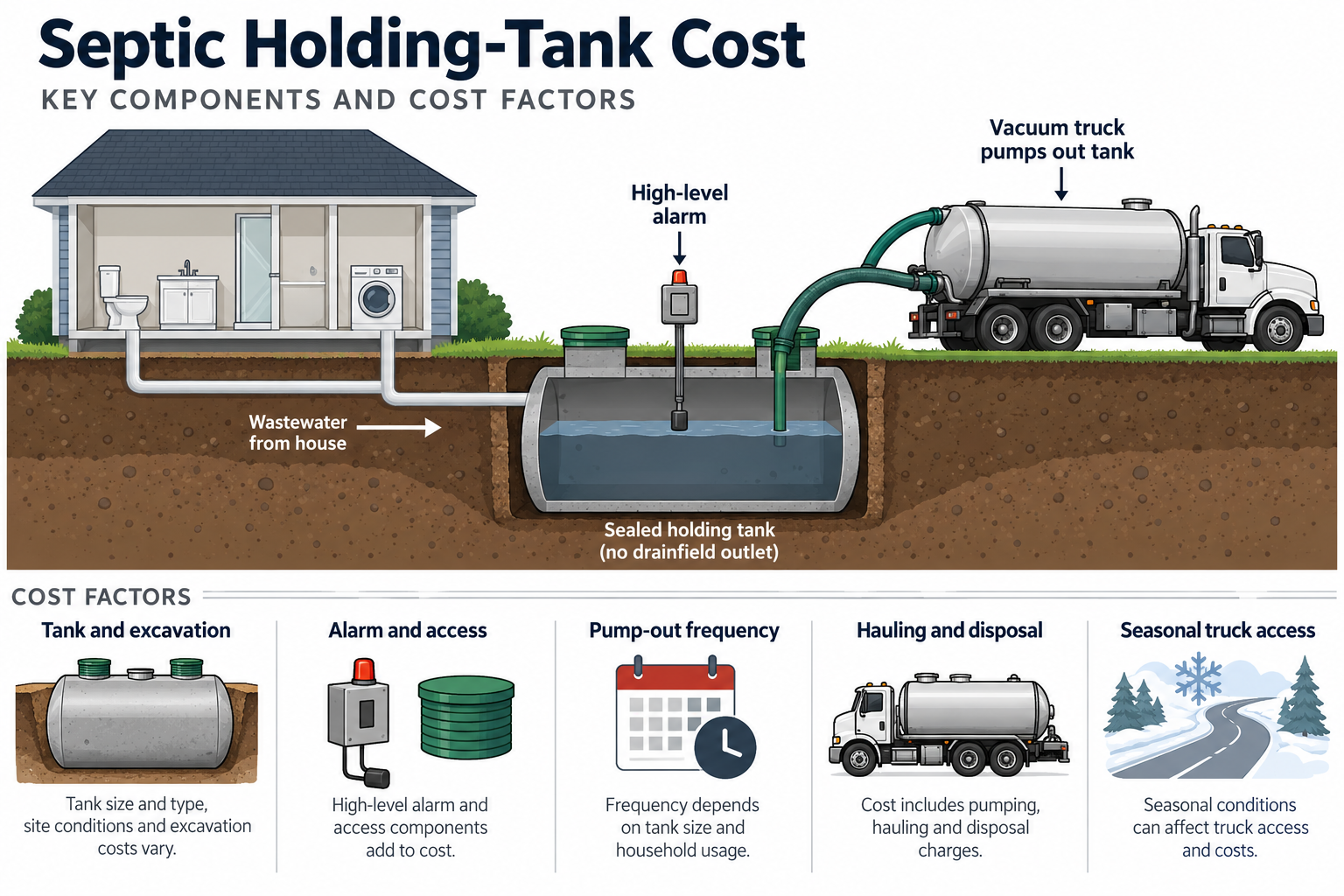
A holding tank stores wastewater for off-site pumping rather than treating and dispersing it through a drainfield. That can make it suitable for some constrained or seasonal properties where local rules allow it, but frequent hauling can dominate lifetime cost. Legality, approval, alarm requirements, capacity, and pumping arrangements are jurisdiction- and property-specific.
Directional U.S. cost anchors
The current U.S. specialist guides display ranges of $3,593–$12,463 for septic-system installation, $100–$1,300 for inspection, $627–$3,041 for septic-tank repair, and $5,000–$12,000 for tank-and-drainfield replacement. These are broad market observations, not quotes or universal rates; they are not Canadian prices and must not be converted into CAD.
Not every article in this category has the same scope as those anchors. Use the closest comparison only to set an order of magnitude, then ask the contractor, designer, pumper, or authority to separate the work specific to this decision from access, excavation, design, permits, restoration, pumping, disposal, equipment, service, or future operating costs.
Holding tank versus septic tank
A septic tank is one stage in a tank-and-soil treatment system. A holding tank is storage. It does not create a normal pumping interval based on solids accumulation; the household must arrange pumping before capacity is exhausted. This changes the ownership model from periodic maintenance to an ongoing hauling obligation.
Installation cost layers
- site evaluation, design, engineering, and authority approval;
- tank capacity, watertightness, access, and high-level alarm;
- excavation, rock, groundwater, bedding, backfill, and restoration;
- building connection and venting;
- truck access and a practical pumping route;
- inspection, records, and any required operating agreement.
Nova Scotia’s cited standard provides an example of professional-engineer conditions for residential holding-tank use. Ontario’s former warning-device and filled-tank provisions in R.R.O. 1990, Regulation 358 are historical; the regulation was revoked on June 23, 2009. Check the current Building Code and responsible authority for requirements applying to a particular property and tank class. Neither jurisdiction’s example is a universal North American rule.
The recurring hauling equation
Annual hauling cost depends on wastewater volume, tank capacity, occupancy, local pumping price, haul distance, disposal fees, seasonal access, and emergency availability. A full-time household can reach the tank’s service threshold much sooner than an intermittently used cottage. A larger tank may reduce visit frequency but increase installation cost and does not remove the need for reliable access and alarms.
Ask a local pumper to model a normal year, a high-use year, and an emergency or inaccessible visit. Do not treat a single pump-out quote as a lifetime forecast.
Property scenarios
Seasonal property: Lower annual volume may make hauling manageable, but winter roads, vacancy, freeze risk, and reopening need a clear plan.
Full-time residence: Frequent pumping can make a holding tank economically unattractive compared with an approved treatment and dispersal system, if one is feasible.
Remote or difficult-access site: Truck distance, road weight limits, weather, and emergency response can dominate. Category 034 covers broader remote-property economics; this article focuses on the wastewater storage decision.
Questions before choosing one
- Is a holding tank legally available and approvable for this property?
- What capacity, alarm, inspection, and records are required?
- How often will normal and peak occupancy require pumping?
- What are local haul, disposal, travel, and after-hours charges?
- Can a truck access the tank in winter and during a failure?
- Is an engineered treatment or sewer alternative feasible over the ownership horizon?
Model normal and difficult pumping years
Start with expected occupancy and wastewater volume, then ask the local pumper for the tank’s practical service threshold. Model a normal year, a high-use year, and a year in which winter access or a long truck route adds cost. A large tank may reduce visit frequency but can require more excavation and does not protect a household that ignores the alarm.
The alarm is an operating safeguard, not a substitute for planning. Ask who receives it, how quickly a provider can respond, and what the household does if the tank approaches capacity. Set the operating plan from the current approved design and authority requirements; do not rely on the revoked Ontario Regulation 358 text as current law.
Compare the alternatives honestly
An engineered soil-dispersal system may cost more upfront but less to operate if the site can support it. A sewer connection may have a large one-time fee but predictable utility billing. Holding-tank economics can be sensible for low-use seasonal occupancy or where no dispersal option is approvable, but full-time use, remote hauling, and poor access can reverse that result. Ask the designer to document why storage is the approved choice. Do not compare holding-tank installation with septic installation using upfront cost alone. Include every pump-out, access risk, alarm, inspection, and future use assumption. The cheaper initial tank can be the more expensive long-term system.
Capacity is an operating constraint
The useful capacity is not a reason to wait until the alarm is urgent. Ask the provider how occupancy, guests, laundry, leaks, and seasonal access affect the pumping plan. If the tank serves a full-time home, calculate whether frequent hauling is affordable during a high-use period rather than relying on an average month.
Also price the consequences of a missed pump: emergency dispatch, unavailable truck access, temporary vacancy, or authority involvement. These are scenario costs, not guaranteed charges, but they explain why alarm visibility and a dependable pumper belong in the initial decision.