
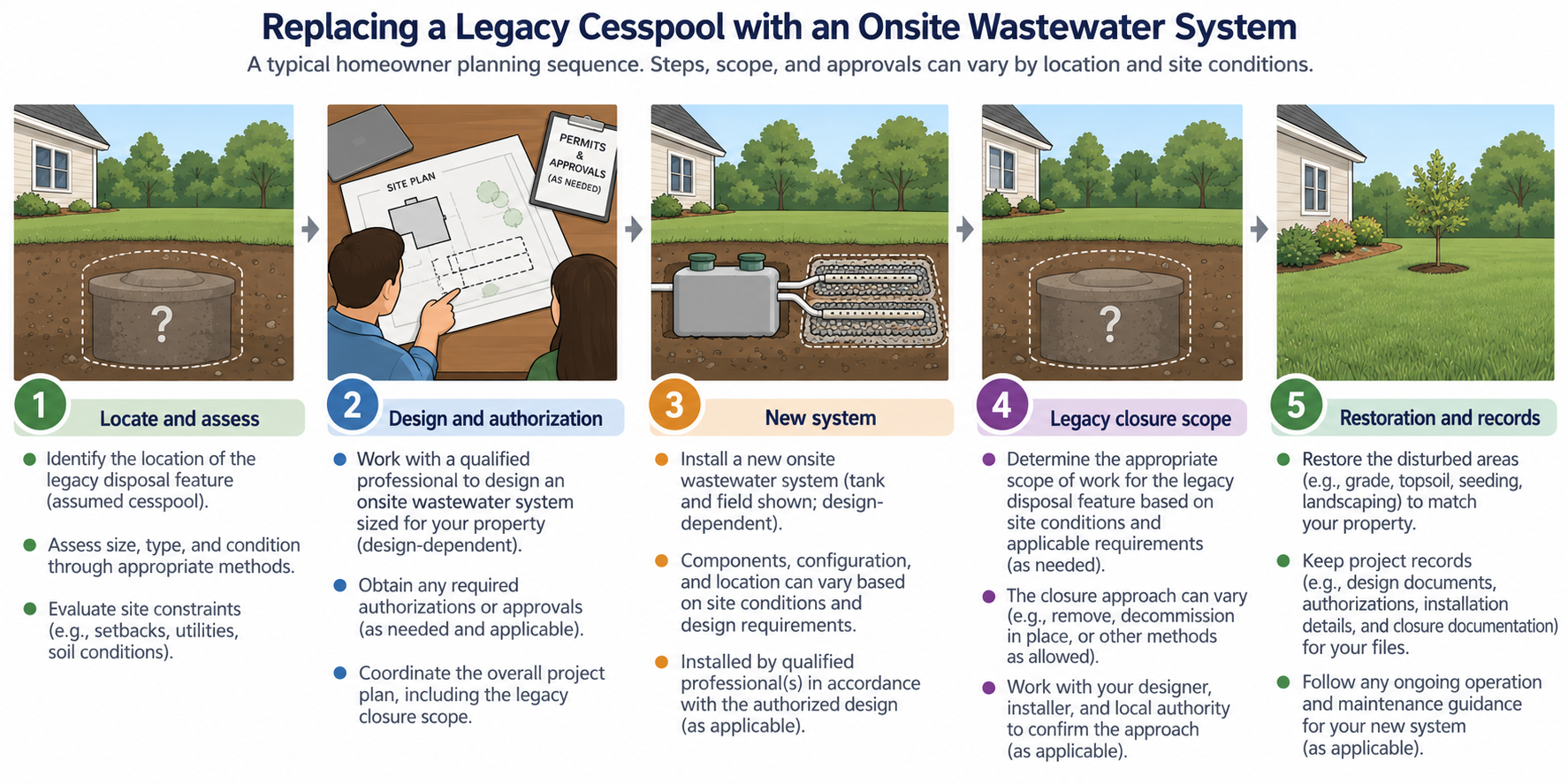
Replacing a cesspool is usually a new onsite-wastewater project, not a tank swap. The cost may include identifying the legacy system, site and soil evaluation, a new design, authorization, tank, drainfield, excavation, closure of the cesspool, inspection, and restoration. No universal U.S. or Canadian conversion price is established; local rules and site conditions dominate.
Directional U.S. cost anchors
The current U.S. specialist guides display ranges of $3,593–$12,463 for septic-system installation, $100–$1,300 for inspection, $627–$3,041 for septic-tank repair, and $5,000–$12,000 for tank-and-drainfield replacement. These are broad market observations, not quotes or universal rates; they are not Canadian prices and must not be converted into CAD.
Not every article in this category has the same scope as those anchors. Use the closest comparison only to set an order of magnitude, then ask the contractor, designer, pumper, or authority to separate the work specific to this decision from access, excavation, design, permits, restoration, pumping, disposal, equipment, service, or future operating costs.
Why the conversion is different
A modern septic system generally separates settling in a watertight tank from treatment and dispersal in a drainfield. A cesspool or similar legacy disposal structure may not provide the same arrangement or may have a different legal status. The first step is to establish what exists, where it is, and what the local authority requires.
Cost layers
- records search, locating, and investigation of the existing structure;
- site evaluation, soil tests, design, engineering, and permit;
- new tank, baffles, access, distribution, and drainfield or approved alternative;
- pump, controls, electrical, fill, or treatment equipment if required;
- pumping, closure or removal of the old structure;
- excavation, rock, groundwater management, disposal, backfill, grading, and restoration;
- inspection, filing, and closeout records.
The old cesspool may be a small part of the total. A difficult lot, limited reserve area, well separation, or municipal sewer availability can determine the project path.
Legal status is local
Do not state that all cesspools are illegal or that every property must convert immediately. Restrictions, replacement triggers, closure methods, and permit authority differ by state, province, and municipality. B.C. and Alberta illustrate distinct regulatory frameworks. Ask the local authority whether the conversion is required because of condition, sale, addition, environmental risk, or a new connection.
Three conversion cases
Conventional replacement: The lot has suitable soil and space for a standard tank and field. The major uncertainty is site evaluation, excavation, access, and closure.
Constrained lot: A mound, drip, sand-filter, aerobic, or other engineered design is needed. Design, equipment, power, and service costs rise, but a conventional system may not be approvable.
Sewer alternative: Available municipal sewer can change the comparison to connection fees, private lateral and trenching, septic abandonment, road restoration, and recurring sewer charges. Municipal-side detail belongs to Category 004.
Questions before authorizing
- What exactly is the existing disposal structure?
- What local rule or authority decision requires or permits conversion?
- Has the lot been evaluated for a new field and reserve area?
- Are closure, pumping, excavation, permits, inspection, and restoration included?
- Is a municipal connection feasible and what private-side work would remain?
- Which future property changes should the design accommodate?
Treat a conversion quote as a complete project scope. A new tank number alone does not address the site, field, legacy closure, or approval path.
Investigate before choosing a contractor
Ask for records, a site visit, and a written description of the existing cesspool. An unknown location or undocumented structure can add locating and excavation before the new system is designed. If the old disposal area overlaps the only feasible field or reserve area, closure and layout decisions may need to happen together.
Compare the conversion with the property’s actual alternatives. A conventional system may be the lowest-cost feasible path on a suitable lot. A constrained lot may require an engineered design with pumps, fill, treatment, and service. A municipal connection may replace field work but add public fees, lateral trenching, and recurring charges. Do not select a path based on a generic tank price.
Protect future records
Require the closeout package to identify the new tank, field, reserve area, permits, inspection, and old structure’s disposition. Those records affect future maintenance, additions, sales, and emergency diagnosis. A conversion that is physically complete but poorly documented can create another cost at the next ownership event.
Conversion can expose a property-wide decision
If the new field competes with the house, well, driveway, or future addition, the conversion is also a site-planning project. Ask whether the layout preserves access for pumping and whether the reserve area is protected. A design that solves the cesspool problem but prevents a planned addition may have a hidden ownership cost.
If the lot cannot support a conventional field, ask for a written comparison of engineered treatment and municipal sewer. Include recurring power, service, hauling or utility charges, authority obligations, and future repair access. No national cost table can resolve that comparison without the property and local market.