
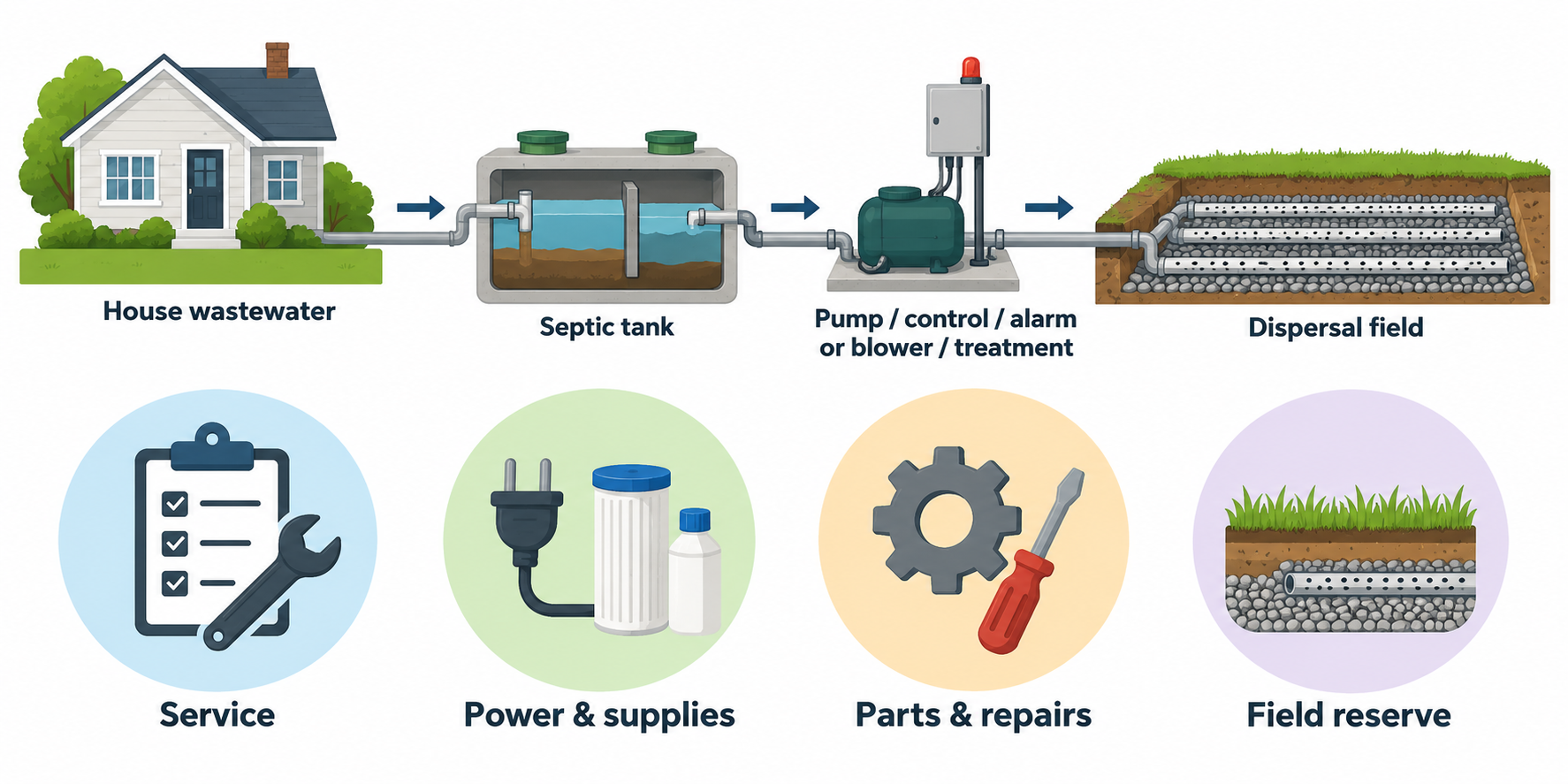
Advanced septic ownership costs more predictably through scheduled service and more unpredictably through mechanical components. A mound, drip, aerobic, pressure-dosed, or sand-filter system may add pumps, blowers, controls, alarms, treatment media, electricity, monitoring, and specialist visits to ordinary inspection and pumping. The approved design and local rules determine the actual obligations.
Directional U.S. cost anchors
The current U.S. specialist guides display ranges of $3,593–$12,463 for septic-system installation, $100–$1,300 for inspection, $627–$3,041 for septic-tank repair, and $5,000–$12,000 for tank-and-drainfield replacement. These are broad market observations, not quotes or universal rates; they are not Canadian prices and must not be converted into CAD.
Not every article in this category has the same scope as those anchors. Use the closest comparison only to set an order of magnitude, then ask the contractor, designer, pumper, or authority to separate the work specific to this decision from access, excavation, design, permits, restoration, pumping, disposal, equipment, service, or future operating costs.
What the recurring budget contains
- service agreement or scheduled inspection;
- pump, blower, float, alarm, control, and electrical checks;
- filters, treatment media, disinfection, or other consumables where the design uses them;
- tank pumping and sludge management;
- electricity and alarm response;
- reporting or monitoring fees where required;
- reserve for pump, blower, control-panel, valve, or other component replacement;
- field, tank, and site repair reserve.
EPA guidance distinguishes systems with electrical, mechanical, pump, float, or advanced-treatment components from a basic gravity arrangement. A former Ontario class-specific aerobic servicing rule in R.R.O. 1990, Regulation 358 was revoked on June 23, 2009; its agreement and annual-inspection clauses are historical, not current requirements. Confirm the current Building Code and responsible authority’s requirements for the property and approved system. B.C. guidance gives a separate example of checking controls and alarms on a pump-dosed system; that, too, is jurisdiction- or system-specific rather than a universal schedule.
Thurston County, Washington, provides another local example: as operational certificates renew after January 1, 2026, renewals for Glendon Biofilter and holding-tank systems become annual. The county requires Glendon-certified professional inspections for Glendon systems and does not allow certified-homeowner self-inspection for them. The county page does not state an inspection fee or an annual inspection interval; confirm the current requirements and price for the installed system with the authority and manufacturer.
Why annual service may be worth the cost
The service visit is not merely a routine fee. It can identify a weakening pump, failed alarm, blocked filter, low tank level, control issue, or operating condition before a backup or field overload. The economic value is highest when the service obligation is tied to a defined inspection and report rather than an unexplained “maintenance plan.”
Ask what the provider tests, records, cleans, adjusts, and excludes. A service contract may cover controls but not excavation, electrical repairs, replacement parts, pumping, or a failed drainfield.
Ownership scenarios
Low-complexity advanced system: One pump, basic controls, clear access, and a modest service requirement. Budget routine service, power, pumping, and a parts reserve.
Typical system: Pumped dispersal or treatment with alarms, filters, and scheduled service. The household should budget for a return visit after an alarm and confirm who responds outside normal hours.
High-complexity system: Multiple treatment stages, blowers, disinfection, monitoring, or legally required contracts. Compare the service provider’s availability, documentation, parts lead time, and long-term fee structure before focusing on installation price.
How to compare service contracts
Ask whether the contract names the system components, visit frequency, tests, response time, reporting, pumping, consumables, labor, parts, tax, and cancellation or transfer terms. Confirm that the provider is authorized or qualified where the jurisdiction requires it. A contract that simply promises “system maintenance” is hard to compare.
Questions before choosing an advanced design
- Which recurring items are required by the approved design or authority?
- What is the expected electricity and alarm-response arrangement?
- Which components have a replacement reserve and what access is needed?
- Can a local provider service the model year-round?
- What is excluded from the contract and what happens during a power outage?
Use local CAD quotes for Canadian budgeting. A U.S. service observation can illustrate cost layers but cannot become a Canadian annual total by conversion. The economically sound comparison includes installation, service, power, pumping, parts, and the consequences of missed maintenance.
A service contract is not a warranty
A contract may schedule inspections and respond to alarms while excluding normal wear, replacement parts, electrical service, excavation, or a failed drainfield. Read the exclusions and ask how the system is documented after each visit. If an agreement is required for approval, confirm the transfer process when the property is sold and the response process during a holiday or outage.
Build two reserves
Keep a recurring operating reserve for visits, power, pumping, filters, and reporting. Keep a separate capital reserve for pumps, blowers, controls, treatment equipment, and field work. This distinction prevents a low annual service figure from hiding a large component failure or system replacement risk. It also makes a conventional-versus-advanced comparison more honest.
If service providers are scarce in a rural or remote area, travel and parts lead time are economic drivers. Ask whether the system can be supported locally before treating the installation quote as complete.
Maintenance records have economic value
Keep service dates, alarm events, measured levels, component replacements, power interruptions, pumping, and authority reports. A record can show whether a problem is isolated or recurring and helps a technician avoid repeating basic discovery. It also matters when a property is sold or when an addition requires proof of the system’s design and operating history.
If a provider recommends a replacement part, ask whether it is preventive, failed, or simply aging. The answer affects whether it belongs in routine service, a capital reserve, or an urgent repair. A blanket recommendation to replace every component is as hard to evaluate as a contract that never names its exclusions.