
For a properly designed and operated ordinary septic system, routine additives are usually a poor substitute for inspection, pumping, sensible water use, and fixing an identified defect. The EPA additive fact sheet states that properly designed and operated systems do not need additives to function. The economic question is whether a recurring product purchase reduces a real, measured cost; generic claims about longer field life or avoided pumping should not be treated as established.
Directional U.S. cost anchors
The current U.S. specialist guides display ranges of $3,593–$12,463 for septic-system installation, $100–$1,300 for inspection, $627–$3,041 for septic-tank repair, and $5,000–$12,000 for tank-and-drainfield replacement. These are broad market observations, not quotes or universal rates; they are not Canadian prices and must not be converted into CAD.
Not every article in this category has the same scope as those anchors. Use the closest comparison only to set an order of magnitude, then ask the contractor, designer, pumper, or authority to separate the work specific to this decision from access, excavation, design, permits, restoration, pumping, disposal, equipment, service, or future operating costs.
What products claim
Products may be sold as bacteria or enzyme treatments, drainfield cleaners, degreasers, odor controls, phosphorus removers, or flocculants. Their claims can include breaking down solids, reducing odors, improving flow, or restoring a field. Those are not interchangeable products or outcomes.
The EPA fact sheet describes concerns with several classes. Strong acids or alkalis marketed as line or field cleaners can damage components or soil treatment. Organic solvents can harm microorganisms and groundwater and are restricted in many states. Odor products that kill bacteria can interfere with organisms involved in treatment. Biological-product long-term effects on soil treatment are not established as a universal benefit.
Additive cost versus maintenance value
The product price may be small compared with a pump-out, inspection, or field repair, which is why “cheap insurance” is persuasive. But a recurring purchase can become an annual expense without producing a verified result. A better maintenance budget prioritizes:
- a local pumping reserve based on tank size, use, and solids;
- periodic professional inspection;
- riser or filter access that makes future service easier;
- repair of leaks, alarms, blocked outlets, or damaged components;
- diagnosis when odors, backups, ponding, or surfacing wastewater appear.
An additive cannot make a pump work, clear a failed control, repair a cracked tank, correct unequal distribution, or recreate soil absorption capacity.
When product-specific instructions matter
A specialized aerobic or treatment system may have manufacturer-approved consumables or operating instructions. That does not make a generic additive appropriate for the system. Ask the designer, authorized service provider, or manufacturer whether the product is required, what exact model it applies to, and what evidence supports the use.
Local rules may also restrict chemicals or discharges. There is no universal exception list to rely on.
Three spending decisions
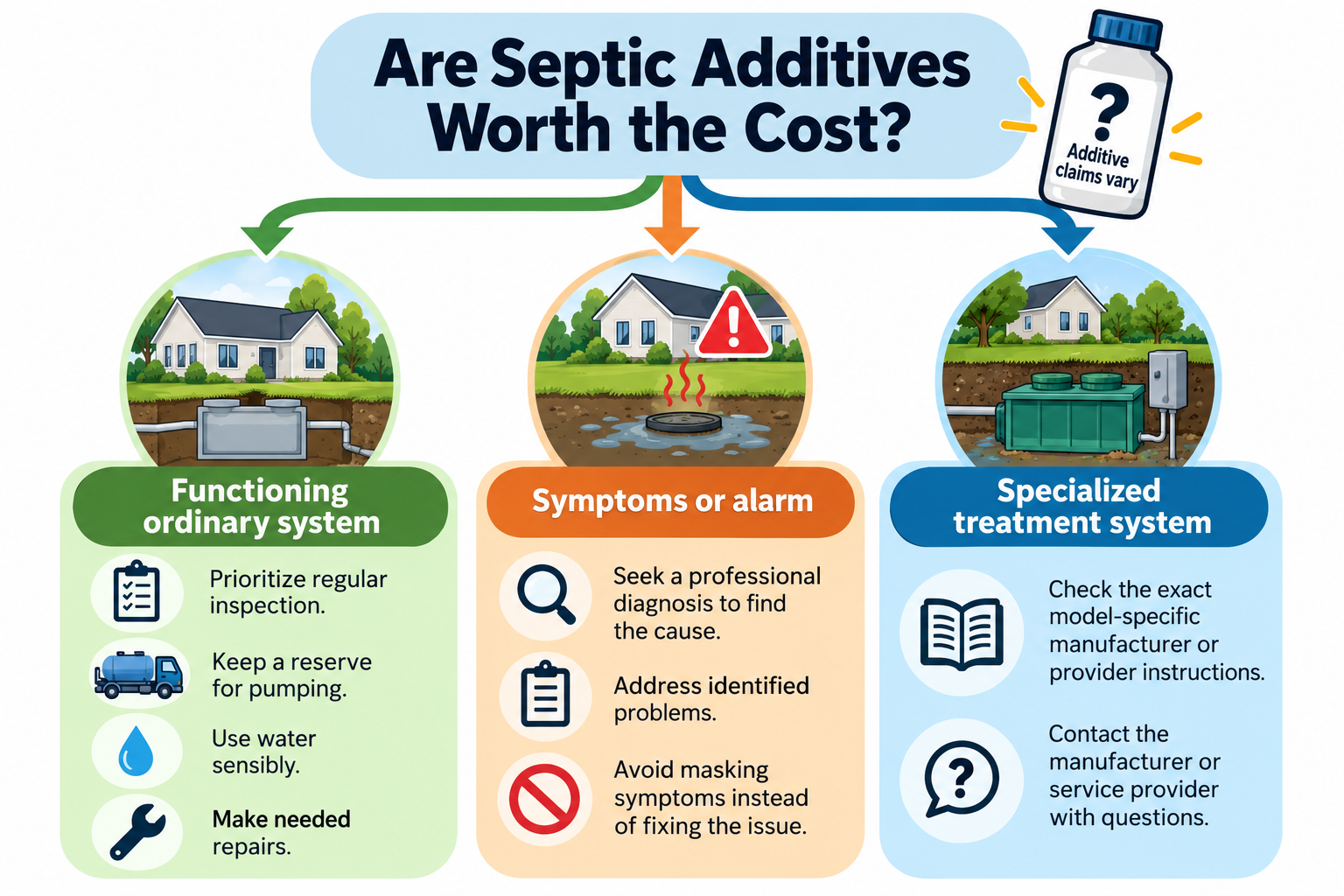
Routine conventional system: If the system is functioning, use the money for records, inspection, pumping when needed, leak repair, and access improvements rather than an unverified additive promise.
Odor or slow-drain problem: Do not mask the symptom. Diagnosis can identify plumbing, venting, tank, outlet, pump, distribution, or field conditions.
Specialized system: Follow the approved design and model-specific service plan. A product that is unnecessary for a conventional tank may be relevant only if a qualified source requires it for a specific unit.
Questions before buying
- What measured problem is the product supposed to solve?
- Does the manufacturer provide evidence for this system and condition?
- Could the ingredients damage tank, pipes, soil, treatment organisms, or groundwater?
- Is the product required by the approved system or merely marketed as optional?
- Would an inspection or pumping reserve address the risk more directly?
The cost-saving answer is usually not “buy a stronger additive.” It is to spend on the maintenance or diagnosis that corresponds to the actual system condition, and to treat product claims as product-specific rather than as a replacement for septic care.
A simple decision test
Before buying a product, name the condition it is meant to change, the evidence that the condition exists, and the outcome that would show improvement. If the answer is “prevent any possible future failure,” compare the recurring product cost with an inspection and pumping reserve. If the answer is “the drains are slow,” buy diagnosis rather than an odor or flow promise; the cause may be plumbing, the tank, a pump, distribution, or the field.
Do not confuse a product’s ability to change a tank observation with proof that the field is functioning. Solids, odors, and wastewater treatment are different questions. A product that claims to reduce sludge does not establish that the system can accept hydraulic load or that an outlet and field are sound.
What to keep in the maintenance record
Record the product, ingredients if known, reason for use, and any provider or manufacturer instruction. If a specialized system requires a consumable, record the model and exact instruction rather than generalizing it to ordinary tanks. This protects future service decisions and makes it easier to identify whether a symptom began before or after the product was introduced.
Do not buy a product to postpone diagnosis
If the goal is to stop a backup, ponding, alarm, or persistent odor, an additive purchase does not address the uncertainty. Ask a professional whether the problem is plumbing, tank, pump, distribution, field, groundwater, or surface drainage. A product can be inexpensive while the delay it causes is expensive; maintenance spending is most useful when it corresponds to an observed system condition.