
Flood recovery changes both the safe sequence and the likely cost. Floodwater can saturate the soil field, move silt into a tank or pump chamber, damage electrical equipment, erode or compact the field, and create indoor sewage exposure. EPA guidance says not to use the system until water in the absorption field is lower than surrounding water, and not to drink well water until it has been tested. Local authorities control reopening for the property.
Directional U.S. cost anchors
The current U.S. specialist guides display ranges of $3,593–$12,463 for septic-system installation, $100–$1,300 for inspection, $627–$3,041 for septic-tank repair, and $5,000–$12,000 for tank-and-drainfield replacement. These are broad market observations, not quotes or universal rates; they are not Canadian prices and must not be converted into CAD.
Not every article in this category has the same scope as those anchors. Use the closest comparison only to set an order of magnitude, then ask the contractor, designer, pumper, or authority to separate the work specific to this decision from access, excavation, design, permits, restoration, pumping, disposal, equipment, service, or future operating costs.
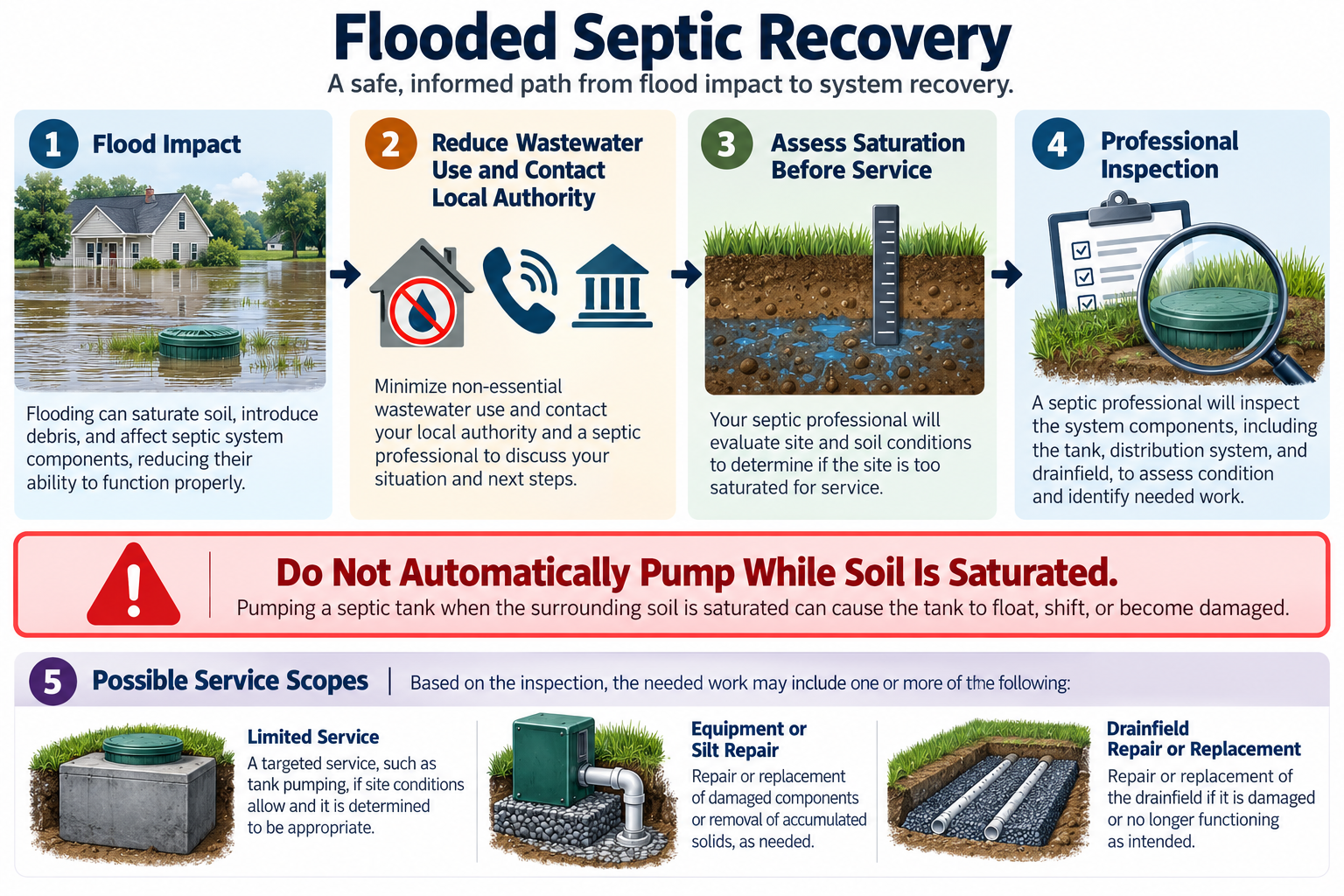
Do not begin with automatic pumping
EPA warns that pumping during flooded or saturated drainfield conditions can make a tank try to float and damage inlet or outlet piping. It can also allow mud or silt to enter the system. Reduce wastewater use and obtain professional or local-health guidance before opening or pumping the tank.
Once conditions permit, a trained specialist may inspect and service the tank and pump chamber, remove silt or debris, secure covers, assess electrical and mechanical components, and determine whether the field remains usable. Do not dig, drive, or operate heavy equipment over saturated field soil.
Recovery cost layers
- emergency consultation and authority coordination;
- post-flood inspection and records review;
- delayed pumping and professional tank or pump-chamber cleaning;
- silt, debris, erosion, cover, riser, or inlet/outlet work;
- pump, control, alarm, wiring, blower, or media-system assessment;
- drainfield testing, repair, replacement design, excavation, and restoration;
- well testing, indoor cleanup, disinfection, and reconstruction as separate scopes.
No universal flood-recovery total is established by available guidance. Damage severity, flood duration, soil saturation, erosion, equipment type, access, and insurance scope determine the project.
What may happen after inspection
Limited impact: Covers, vegetation, or a pump-chamber service issue is addressed after the site is safe. The authority or professional determines when normal use can resume.
Equipment or silt damage: A pump, control, alarm, media filter, tank outlet, or chamber needs cleaning or replacement. The quote should identify what was tested and what remains unverified.
Field damage: Silt clogging, compaction, erosion, or persistent saturation may require a field repair or replacement. EPA notes that a field clogged with silt may require a new system; this is a professional assessment, not an automatic outcome for every flood.
Well and indoor-water boundaries
Septic and private-well risks interact, but a flooded septic system does not establish that well water is contaminated. EPA guidance says not to drink well water until tested; private-well testing and treatment belong to Category 008. Sewage cleanup inside the home can require a separate restoration specialist and should not be folded into the septic pump-out line.
Questions to ask
- Is the soil still saturated, and who determines when service is safe?
- Has the system been used during or after flooding?
- Are tank flotation, silt, debris, erosion, electrical, pump, and media risks included?
- What parts of the field were actually inspected?
- What local authority or health guidance controls reopening?
- Does the proposal distinguish stabilization, repair, replacement, indoor cleanup, and well testing?
Flood recovery is a sequence decision. The cheapest immediate action can create more damage if it ignores saturated soil; the right quote begins with safe timing and a defined inspection before promising a repair.
Separate temporary relief from recovery
Temporary water-use reduction, authority contact, and professional inspection are not the same as restoring normal operation. Ask the provider to identify which work is stabilization, which work is cleaning or repair, and which work is a replacement recommendation. If the field has not been assessed after conditions recede, a tank-pumping invoice should not be treated as proof that the system is recovered.
Insurance or public-disaster programs may treat sewage cleanup, contents, structural damage, septic equipment, and field work differently. Coverage depends on the policy and program; do not assume it. Photograph conditions safely, preserve invoices, and ask the insurer and local authority which documentation they require without delaying safety decisions.
Ask for a recovery decision, not only a pump-out
Request the flood history, water level, system type, components inspected, silt or erosion findings, electrical status, field limitations, and reopening condition. A second quote is useful when it compares the same evidence and separates immediate work from uncertain future replacement. It is not useful when contractors use different assumptions about whether the field is wet or the tank can be safely opened.