
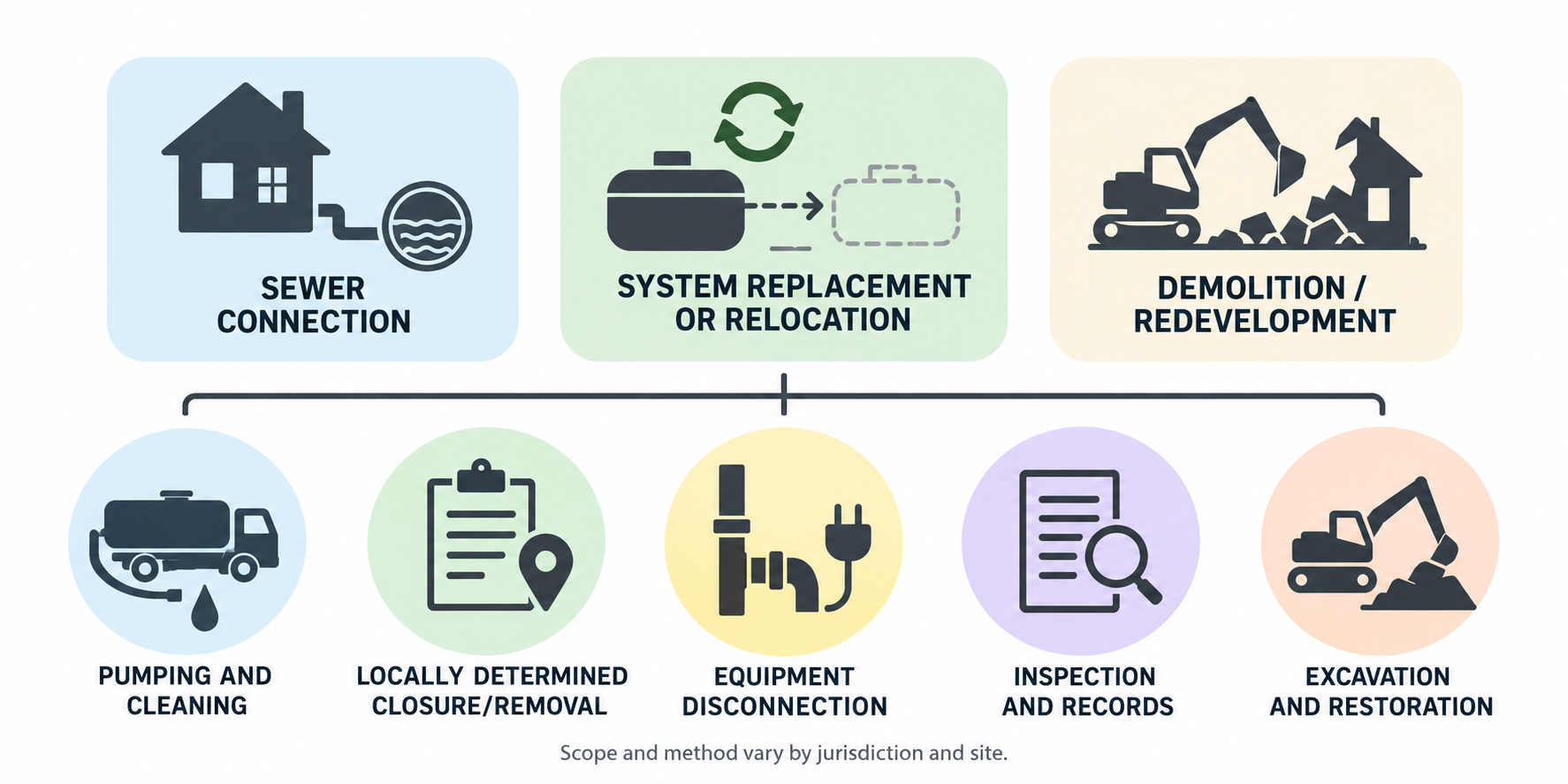
Decommissioning closes an onsite wastewater system that will no longer be used. It may be part of a sewer connection, a replacement-system relocation, demolition, or redevelopment. The work can include pumping, cleaning, tank closure or removal, pump and electrical disconnection, authority notification, inspection, records, excavation, and restoration. The required method is jurisdiction-specific.
Directional U.S. cost anchors
The current U.S. specialist guides display ranges of $3,593–$12,463 for septic-system installation, $100–$1,300 for inspection, $627–$3,041 for septic-tank repair, and $5,000–$12,000 for tank-and-drainfield replacement. These are broad market observations, not quotes or universal rates; they are not Canadian prices and must not be converted into CAD.
Not every article in this category has the same scope as those anchors. Use the closest comparison only to set an order of magnitude, then ask the contractor, designer, pumper, or authority to separate the work specific to this decision from access, excavation, design, permits, restoration, pumping, disposal, equipment, service, or future operating costs.
Why the closure method matters
An unused tank, pump chamber, or legacy disposal structure remains a property condition until it is handled under the applicable rule. Some authorities distinguish removing a tank from closing it in place; others require a qualified person, fill, inspection, filing, or proof of pumping. Do not copy a closure procedure from another jurisdiction or treat “abandoned” as a complete scope.
Cost layers
- authority research, application, notification, or inspection;
- pumping and cleaning by a qualified provider;
- tank, pump chamber, or cesspool closure, removal, or approved in-place treatment;
- electrical and control disconnection where applicable;
- excavation, equipment access, disposal, fill, backfill, grading, and restoration;
- records and closeout documentation.
U.S. and Canadian national price ranges are not established. Compare the method and deliverable, not just the truck or excavation line.
Common triggers
Sewer conversion: The septic tank and field must be addressed alongside the private sewer connection.
New field or relocation: The old components may occupy land needed for a new layout or reserve area.
Demolition or redevelopment: Broader demolition and logistics may belong to Category 026 or 024, while this article covers septic closure.
Bundling economics
Decommissioning during an already planned excavation can reduce mobilization and restoration duplication, but the septic closeout still needs its own responsibility and documentation. Ask whether the contractor is authorized for the local work and who files the completion record.
Questions for the authority and contractor
- What rule applies to this tank, field, pump chamber, or cesspool?
- Must the system be pumped, removed, filled, crushed, inspected, or reported?
- Who is qualified to perform and document the work?
- Are electrical, access, disposal, fill, backfill, and restoration included?
- What record will prove closure for a future buyer or permit application?
Do not approve a closure quote until the authority confirms the required outcome. The least expensive physical method may not be the least expensive compliant project if it leaves missing records or future property risk.
Decommissioning as part of a larger job
When sewer connection, a new field, or demolition is already planned, ask whether pumping, access, excavation, electrical disconnection, and restoration can be coordinated. Coordination can reduce repeated mobilization, but the septic closure should remain a separately identifiable deliverable. The quote should state what happens to the tank, pump chamber, field, and any old records.
What changes the cost
An exposed tank with clear records is easier to plan than an undocumented cesspool or a structure beneath a driveway. In-place closure may have a different excavation and restoration profile from removal. A pump chamber adds electrical and mechanical disconnection. A redevelopment project may need additional survey, fill, compaction, or documentation. These are property-specific variables, not a universal closure surcharge.
Ask for written confirmation of the final condition and the record that proves it. That documentation can matter later when a buyer, authority, insurer, or designer needs to know whether the former system was properly closed.